Facts
The plaintiff (Khoob Ram) filed a suit for declaration of title and joint possession of land inherited from his predecessor, Achhru, who acquired it through the share of Ghogli
Source reference: para 2, 8The dispute arose after the Assistant Collector 1st Grade, Karsog, ordered in 1994 that Defendant No. 1 (Puran Chand) be recorded as a non-occupancy tenant in the revenue records based on a field report of long-term possession
Source reference: para 2, 15The defendant asserted he was a tenant who paid rent and eventually acquired proprietary rights under Section 104 of the H.P. Tenancy and Land Reforms Act
Source reference: para 3Both the Trial Court and the First Appellate Court ruled in favor of the plaintiff, holding that the defendant was never inducted as a tenant and never paid rent
Source reference: para 8, 9The legal heirs of Defendant No. 1 appealed to the High Court
Source reference: para 10Issues
1. Whether the subject matter of the dispute regarding the claim of tenancy could be adjudicated by a Civil Court, and whether the orders conferring ownership rights could be interfered with?
Source reference: para 102. Whether the plaintiff's plea of acquiring title via a Will, while referencing tenancy and adverse possession, was maintainable due to being mutually destructive?
Source reference: para 10Law Applied
Section 37(3) and Section 46 of the H.P. Land Revenue Act, 1954, which allow a person aggrieved by revenue entries to institute a suit for declaration in a Civil Court
Source reference: para 17-19Full Bench decision in Chuhniya Devi v. Jindu Ram (1991), which established that Civil Court jurisdiction is not barred when challenging the correctness of entries made by Revenue Officers under the Land Revenue Act
Source reference: para 17-18A relationship of landlord and tenant requires an agreement and the payment of rent, as held in Telu Ram v. Hari Kumar (1975) and Bhagat Ram v. Brahma Nand (2010), noting that a "non-occupancy" entry in the cultivation column is insufficient without a corresponding entry in the rent column
Source reference: para 20-22Reasoning
The Court reasoned that the Assistant Collector’s 1994 order was passed under the H.P. Land Revenue Act merely to reflect possession, not to adjudicate tenancy under the H.P. Tenancy and Land Reforms Act; therefore, the Civil Court retained jurisdiction to determine the question of title
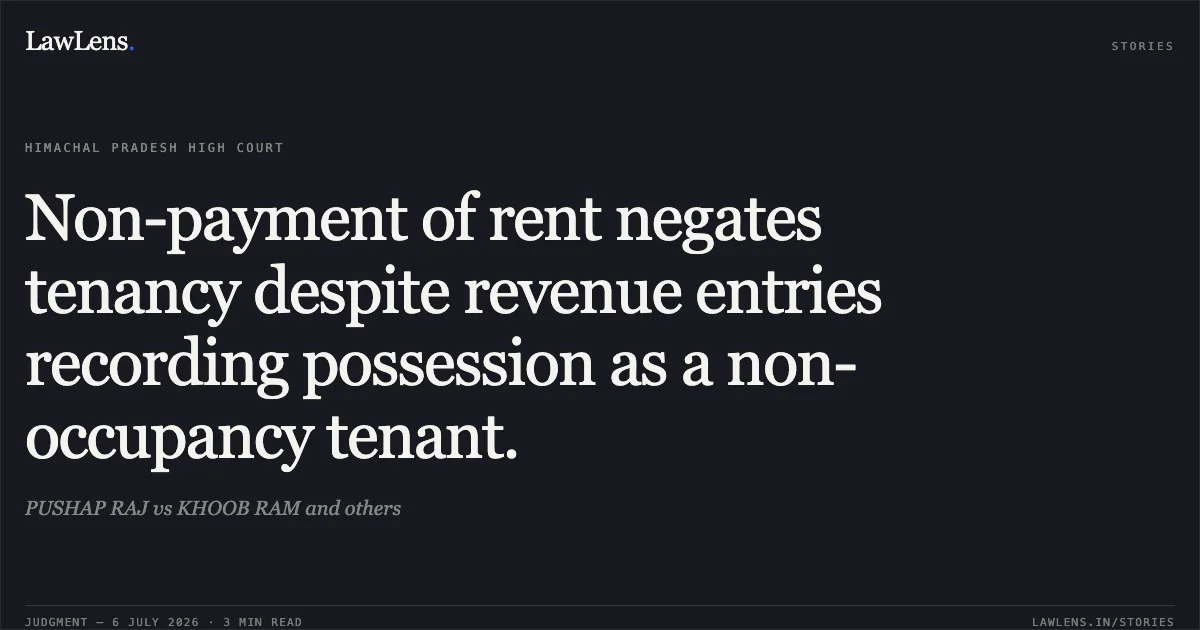
Source reference: para 16-19Upon examining the revenue records (Jamabandi 1997-98), the Court found the rent column was blank. It followed established precedents stating that revenue officials habitually record any person in possession as a "non-occupancy tenant" (Gair Maurusi), but such an entry is legally meaningless unless the payment of rent is proven
Source reference: para 20-23Regarding the second issue, the Court found no contradiction in the plaintiff's claim; even if a tenant cannot normally bequeath tenancy via a Will, the plaintiff's standing as the son and legal heir of Achhru sufficiently supported his claim to the property independently of the Will's technicalities
Source reference: para 24-25Holding
The High Court answered both substantial questions of law against the appellants/defendants. It held that the Civil Court had jurisdiction to adjudicate the dispute as the revenue entry was not supported by evidence of rent payment, negating the claim of tenancy
The Court affirmed the concurrent findings of the lower courts, dismissed the appeal, and upheld the decree in favor of the plaintiff
Source reference: para 27-28Acts & Sections Cited
13 provisions across 3 statutes referred to in this judgment. Linked provisions open on LawLens.
Himachal Pradesh Tenancy and Land Reforms Act, 19721
Himachal Pradesh Land Revenue Act, 1954
Specific Relief Act, 19631
Original Court PDF
PUSHAP RAJvsKHOOB RAM and others
Click to open original judgment
Original judgment, available to read, download and summarize on LawLens.in