Facts
The plaintiff sued for declaration of title, possession and permanent injunction over a 3,810-square-foot portion of Khasra No. 1450 at village Soram, relying on a bhumiswami patta granted to her parents in 2001–02.
Source reference: para. 3–4The defendants disputed her claim and asserted that the plaintiff’s father had bequeathed the property to defendant No. 1 by will.
Source reference: para. 5, 12The Trial Court rejected the declaration of ownership but ordered the defendants to deliver possession and restrained them from interfering with the plaintiff’s possession.
Source reference: para. 8The First Appellate Court dismissed the defendants’ appeal and rejected their application under Order XLI Rule 27 CPC to produce a patta.
Source reference: para. 9, 15–16The defendants appealed under Section 100 CPC.
Source reference: para. 2Issues
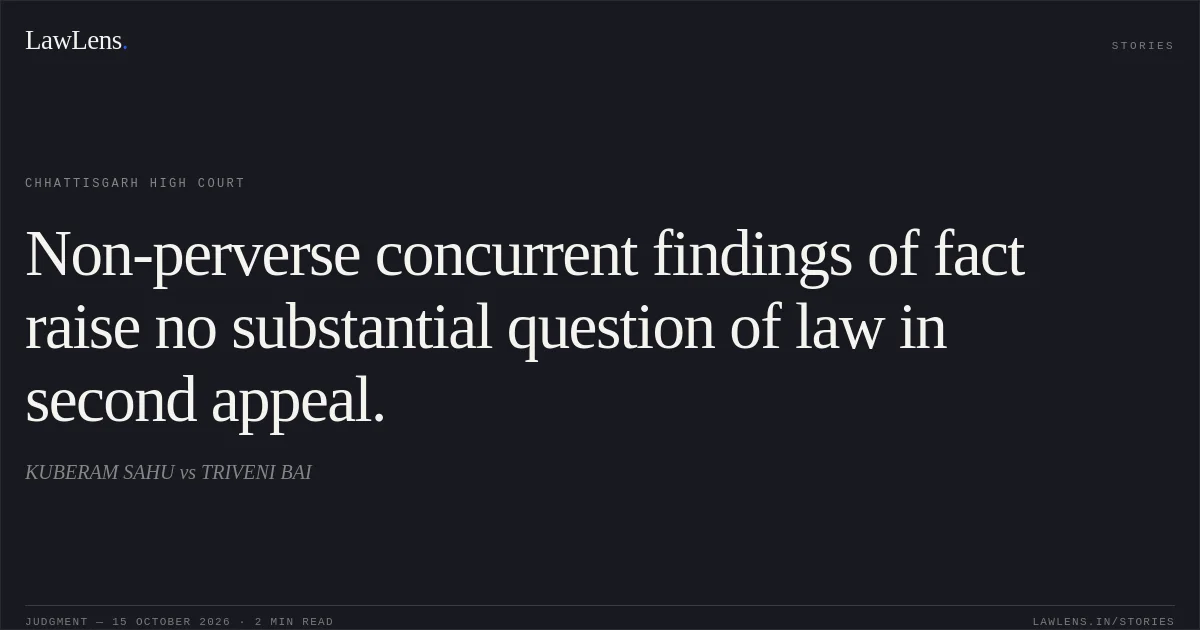
1. Whether the concurrent findings of the courts below gave rise to a substantial question of law warranting admission of the second appeal under Section 100 CPC?
Source reference: para. 10, 162. Whether the courts below erred in holding that the defendants had not proved the will, and in rejecting their application to produce an additional patta under Order XLI Rule 27 CPC?
Source reference: para. 10, 12, 15–16Law Applied
Section 100 CPC permits a second appeal only where a substantial question of law arises; formulation of such a question is a sine qua non for admission.
Source reference: para. 16The Court relied on Sir Chunilal V. Mehta and Sons Ltd. v. Century Spinning and Manufacturing Co. Ltd., AIR 1962 SC 1314, and Chandrabhan (Deceased) Through LRs. & Ors. v. Saraswati & Ors., 2022 SCC OnLine SC 1273, for that principle.
Source reference: para. 16Under Section 68 of the Evidence Act, 1872, an unprivileged will requiring attestation cannot be used in evidence unless at least one attesting witness is called to prove its execution.
Source reference: para. 12The admission of additional evidence under Order XLI Rule 27 CPC was considered in light of the First Appellate Court’s assessment of the circumstances and the defendants’ prior pleadings and conduct.
Source reference: para. 16Reasoning
The Trial Court found that none of the will’s attesting witnesses had been examined and therefore the will had not been proved as required by Section 68; the First Appellate Court affirmed that finding.
Source reference: para. 12The High Court found no perversity in that concurrent factual assessment.
Source reference: para. 12It also upheld the rejection of the additional patta application: the document allegedly concerned a patta granted in 2018, no such defence had been advanced during the suit, and the defendants’ pleaded case had relied on the will and an agreement.
Source reference: para. 16The courts’ findings were based on the evidence and did not raise a substantial question of law.
Source reference: para. 14, 16Holding
The High Court held that no substantial question of law arose for consideration and dismissed the second appeal.
It vacated the interim order dated 17 July 2026, directed that a decree be drawn accordingly, and made no order as to costs.
Source reference: para. 16Acts & Sections Cited
2 provisions across 1 statute referred to in this judgment. Each provision opens on LawLens.
Code of Civil Procedure, 19082
Original Court PDF
KUBERAM SAHUvsTRIVENI BAI
Click to open original judgment
Original judgment, available to read, download and summarize on LawLens.in