Facts
The Petitioners, engaged as a daily-rated Tractor Driver (1993) and Lift Operator (1992) respectively by AIIMS, alleged oral termination of their services in 1995 without notice or retrenchment compensation
Source reference: p. 2-3They claimed to have completed over 240 days of continuous service in the year preceding termination
Source reference: p. 3The Labor Court, via Awards dated 13.02.2004, held that although AIIMS is an "industry" and the Petitioners were "workmen," they failed to prove completion of 240 days of service, rendering their termination legal
Source reference: p. 10The Petitioners challenged these Awards, asserting that the Management withheld employment records despite being served notices for production
Source reference: p. 4Issues
1. Whether the Respondent-Management (AIIMS) constitutes an "industry" under Section 2(j) of the Industrial Disputes Act, 1947
Source reference: para. 92. Whether the Petitioners established completion of 240 days of continuous service within the meaning of Section 25B of the Act to invoke the protection of Section 25F
Source reference: para. 113. Whether the Labor Court erred in its appreciation of evidence and the shifting of the evidentiary onus
Source reference: para. 18Law Applied
The Court applied the definition of "industry" as established in Bangalore Water Supply & Sewerage Board v. A. Rajappa, noting that the doctrine remains binding despite the reference in State of U.P. v. Jai Bir Singh
Source reference: para. 10Regarding the burden of proof, the Court relied on R.M. Yellatti v. Assistant Executive Engineer, which clarifies that while the initial legal burden lies on the workman, the evidentiary onus shifts to the management if they withhold primary records in their exclusive custody
Source reference: para. 13-14The Court also invoked Section 114 Illustration (g) of the Indian Evidence Act regarding adverse inference
Source reference: para. 17The principles for monetary compensation in lieu of reinstatement from Bharat Sanchar Nigam Limited v. Bhurumal
Source reference: para. 30Reasoning
The Court observed that the Labor Court committed a patent error by concluding the Petitioners failed to discharge their burden
Source reference: para. 24While the Petitioners provided sworn testimony and served notices for production of records, the Management admitted the existence of such records but failed to produce them without valid justification
Source reference: para. 19-22The Court found the Labor Court's finding that records were "destroyed" to be perverse, as Management witnesses admitted their affidavits were prepared based on those very records
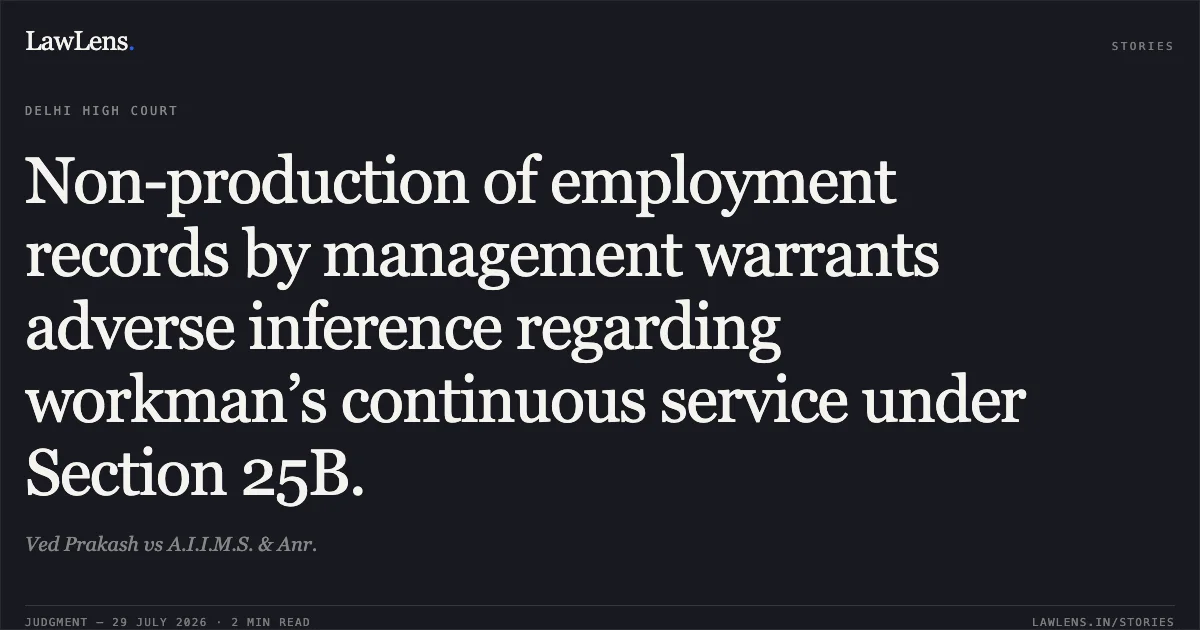
Source reference: para. 24Consequently, following R.M. Yellatti, the evidentiary onus shifted to the Management; their failure to produce muster rolls or specific details of breaks in service justified an adverse inference
Source reference: para. 26-27Since 240 days of service were established and Section 25F was admittedly not followed, the retrenchment was held illegal
Source reference: para. 28Holding
The High Court set aside the Labor Court Awards dated 13.02.2004
It held that the Petitioners were entitled to protection under Section 25F of the Industrial Disputes Act. However, citing the lapse of 30 years since termination, the Court declined reinstatement and regularization
Source reference: para. 31, 33The Court directed the Respondent to pay a lump-sum compensation of ₹3,00,000/- to each Petitioner within eight weeks, failing which interest at 9% per annum would apply. The Writ Petitions were allowed
Source reference: para. 32, 34Acts & Sections Cited
5 provisions across 2 statutes referred to in this judgment. Linked provisions open on LawLens.
Industrial Disputes Act, 19474
Indian Evidence Act, 18721
Original Court PDF
Ved PrakashvsA.I.I.M.S. & Anr.
Click to open original judgment
Original judgment, available to read, download and summarize on LawLens.in