Facts
On 17 July 1993, Kalia @ Sanjaya Mohanty (P.W.15) and Prakash Hota (P.W.11) were allegedly attacked near Baji Chhak, Dhenkanal, by the accused persons, who were armed with weapons including a sword, farsha, bhujali, iron rod and lathi. The injured witnesses sustained serious bleeding injuries and were taken to hospital; the prosecution case was subsequently investigated and a charge-sheet was filed under Sections 147, 148, 149, 341, 326, 307 and 427 of the IPC
Source reference: p.3–4The Trial Court convicted the accused under Section 326 read with Section 149 IPC, as well as Sections 148, 341 and 426 IPC, and imposed concurrent sentences, including three years’ rigorous imprisonment under Section 326 IPC. The Appellate Court affirmed the conviction and sentence on 22 March 2003.
Source reference: p.2, 5During the pendency of the revision, Petitioners 2, 3, 4 and 6 died; the revision therefore proceeded only in respect of Bidyadhar @ Bijini Behera and Gangadhar @ Sanaganga Rout, Petitioners 1 and 5.
Source reference: p.3The surviving petitioners contended that the alleged weapons, particularly the sword and bhujali, were not produced before the Trial Court, while the seized iron rod was neither properly produced nor sent for examination. The State relied on the testimony of the injured witnesses, doctors and investigating officers.
Source reference: p.6–7Issues
1. Whether the evidence of the injured witnesses, doctors and investigating officers was sufficient to sustain the petitioners’ conviction despite the non-production or inadequate examination of the alleged weapons of assault?
Source reference: p.6–82. Whether, in the circumstances, the conviction under Section 326 IPC ought to be altered to one under Section 325 IPC?
Source reference: p.8–93. Whether the sentence should be modified in view of the lapse of nearly three decades since the occurrence and the petitioners’ conduct during that period?
Source reference: p.9–11Law Applied
The Court exercised revisional jurisdiction under Section 401 of the Code of Criminal Procedure, 1973.
Source reference: p.1It considered the offences under Sections 326 and 325 IPC: Section 326 concerns voluntarily causing grievous hurt by dangerous weapons or means, whereas Section 325 concerns voluntarily causing grievous hurt without the aggravated weapon-based element.
Source reference: p.2, 5The Court also considered the allied convictions under Sections 148, 341 and 426 IPC, relating respectively to rioting armed with a deadly weapon, wrongful restraint and mischief.
Source reference: p.2, 5The governing evidentiary principle applied was that non-production of the weapon is not, by itself, fatal where the oral testimony of injured witnesses and the medical evidence reliably establish the assault and injuries; however, the absence of the material object may create doubt regarding the specific weapon-based aggravation required for Section 326 IPC.
Source reference: p.6–9Reasoning
The Court accepted that the evidence of the injured witnesses, P.Ws.11 and 15, was supported by the medical testimony of the doctors and the evidence of the investigating officers.
Source reference: p.7–8The nature of the injuries, including multiple fractures suffered by P.W.15, was sufficient to establish that grievous hurt had been caused, and therefore the petitioners were not entitled to acquittal.
Source reference: p.7–8However, the prosecution had not produced the alleged sword, bhujali or other weapons before the Trial Court, and even the seized iron rod was not properly subjected to judicial scrutiny or examination.
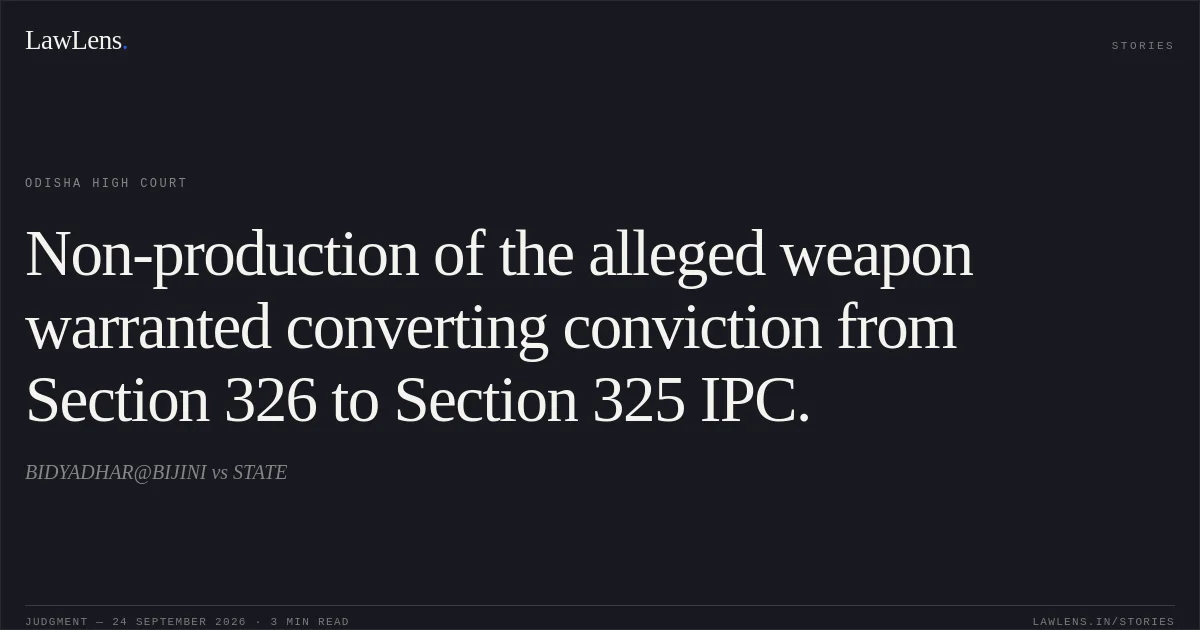
Source reference: p.6, 9In view of this evidentiary deficiency, the Court held that the aggravated offence under Section 326 IPC was not satisfactorily established, although the commission of grievous hurt remained proved. It consequently altered the conviction from Section 326 IPC to Section 325 IPC.
Source reference: p.8–9Considering that the occurrence had taken place almost thirty years earlier and that there was no material showing that the surviving petitioners had committed any further offence, the Court found that sending them back to custody would serve no useful purpose.
Source reference: p.9–10Holding
The revision was partly allowed. The Court declined to acquit the surviving petitioners but altered their conviction from Section 326 IPC to Section 325 IPC because of the non-production and inadequate examination of the weapons of offence.
Their sentence was confined to the period of incarceration already undergone, while the other consequential convictions and directions were not otherwise disturbed.
Source reference: p.10–11Each petitioner was directed to deposit Rs.1,200 before the Trial Court within fifteen days, of which Rs.1,000 was to be paid to injured P.W.15 and Rs.200 to injured P.W.11 as compensation; failure to deposit the amount would permit the Trial Court to proceed in accordance with law.
Source reference: p.11–12The Criminal Revision was accordingly disposed of.
Source reference: p.13Acts & Sections Cited
10 provisions across 2 statutes referred to in this judgment. Each provision opens on LawLens.
Code of Criminal Procedure, 19731
Original Court PDF
BIDYADHAR@BIJINIvsSTATE
Click to open original judgment
Original judgment, available to read, download and summarize on LawLens.in