Facts
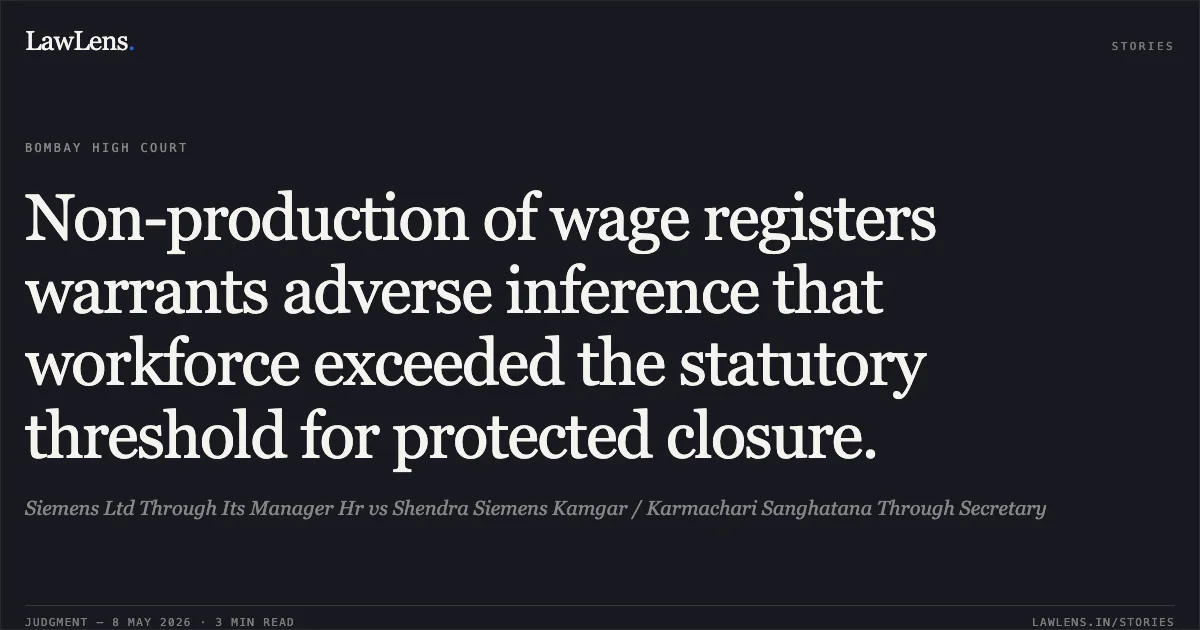
The Petitioner, a Public Limited Company, issued a notice on August 14, 2014, to discontinue operations, followed by a closure notice on September 27, 2014, under Section 25-FFA of the Industrial Disputes Act, 1947.
Source reference: para. 4The Petitioner claimed it employed exactly 99 workmen, thus only requiring a 60-day notice for closure.
Source reference: para. 5, 11The Respondent Union filed a Charter of Demands, asserting that the Petitioner actually employed over 100 workmen, which would necessitate prior government permission under Chapter V-B (Section 25-O) of the Act.
Source reference: para. 5, 11The Industrial Tribunal, Aurangabad, ruled in favor of the Union, finding the headcount exceeded 100.
Source reference: para. 6The Petitioner challenged this finding in the High Court, asserting that the burden of proof lay on the Union and that administrative staff were wrongly classified as "workmen".
Source reference: para. 7-9Issues
1. Whether the Petitioner industrial establishment employed 100 or more workmen on the date of the alleged closure, thereby attracting the mandatory prior permission requirements of Chapter V-B of the Industrial Disputes Act.
Source reference: para. 5, 172. Whether the burden of proof was properly discharged and whether an adverse inference could be drawn against the employer for the non-production of the Wages Register.
Source reference: para. 20, 24Law Applied
The court applied Section 25-K of the Industrial Disputes Act, which stipulates that Chapter V-B applies to establishments employing not less than 100 workmen on average per working day for the preceding twelve months.
Source reference: para. 18The court contrasted Section 25-O (mandatory prior permission for closure) with Section 25-FFA (60-day notice for smaller establishments).
Source reference: para. 18The court defined "workman" under Section 2(s), noting that employees are deemed workmen unless they fall under specific managerial or supervisory exceptions.
Source reference: para. 23Regarding evidence, the court relied on the principle that the party in possession of the "best evidence" (the employer) must produce it, or face an adverse inference.
Source reference: para. 20Reference was made to Shankar Chakravarti v. Britannia Biscuit Co. Ltd. regarding the burden of proof.
Source reference: para. 8Reasoning
The court found that the Respondent Union discharged its initial burden by providing a granular breakdown of 183 to 208 total workers (including direct, staff, and indirect workmen).
Source reference: para. 21The court observed that the Petitioner failed to comply with the Tribunal’s order to produce the comprehensive Wages Register, despite being the legal custodian of such records.
Source reference: para. 20Consequently, the court drew an adverse inference against the Petitioner for withholding primary evidence.
Source reference: para. 20During cross-examination, the Petitioner’s witness admitted to the presence of staff members (e.g., Laser Cutting Operators and Store Keepers) but failed to produce appointment letters or evidence proving they performed purely managerial duties to exclude them from the definition of "workman".
Source reference: para. 22-23The court reasoned that the Petitioner’s attempt to fix the headcount at exactly 99 was a "calculated move" to evade the rigours of Section 25-O.
Source reference: para. 25Holding
The court held that the Petitioner employed more than 100 workmen, making the closure without prior government permission void ab initio for violation of Chapter V-B.
The Writ Petition was dismissed, and the Industrial Tribunal’s order was upheld.
Source reference: para. 26The court further rejected the Petitioner’s request for a stay on the judgment, noting the long pendency of the matter and the fact that the employees remained out of service.
Source reference: para. 29Acts & Sections Cited
6 provisions across 1 statute referred to in this judgment. Linked provisions open on LawLens.
Industrial Disputes Act, 19476
Original Court PDF
Siemens Ltd Through Its Manager HrvsShendra Siemens Kamgar / Karmachari Sanghatana Through Secretary
Click to open original judgment
Original judgment, available to read, download and summarize on LawLens.in