Facts
Naresh Kumar, aged approximately 31 years, allegedly travelled from Palwal to Ajhai on 08.05.2012 after his uncle Hansraj purchased his journey ticket and boarded him on a Palwal–Agra EMU train.
Source reference: para. 2Near kilometre 1479/15–17 between Palwal and Rundhi Railway Stations, Naresh allegedly fell from the running train after a heavy jerk and sustained fatal injuries.
Source reference: para. 2The occurrence was recorded by the GRP, Faridabad, through DDR No. 12 dated 08.05.2012.
Source reference: para. 2His widow and other dependants filed a claim before the Railway Claims Tribunal seeking compensation.
Source reference: no citationThe Tribunal dismissed the claim, principally holding that no journey ticket was recovered from the deceased, discrepancies existed in the statements recorded during the police proceedings, and the timing of discovery of the body suggested that Naresh had died while crossing the railway track rather than by falling from the train.
Source reference: para. 4The claimants challenged that decision under Section 23 of the Railway Claims Tribunal Act, 1987.
Source reference: para. 1The High Court also noted that the Tribunal had mistakenly referred to the deceased as “Gulab Singh,” raising concern that material from another case may have been mixed with the present record.
Source reference: para. 4.1Issues
Whether the deceased was a bona fide passenger despite the non-recovery of a journey ticket from his person.
Source reference: paras. 6–6.1Whether the deceased’s death resulted from an accidental fall from a running passenger train, constituting an “untoward incident” under the Railways Act, 1989.
Source reference: paras. 6–8.1Whether the appellants were entitled to statutory compensation and, if so, what amount and interest were payable.
Source reference: para. 9Law Applied
The Court applied Section 23 of the Railway Claims Tribunal Act, 1987, governing appeals to the High Court.
Source reference: para. 1Under Sections 123(c)(2) and 124-A of the Railways Act, 1989, an accidental fall of a passenger from a train carrying passengers constitutes an “untoward incident” attracting no-fault liability, subject to the statutory exceptions.
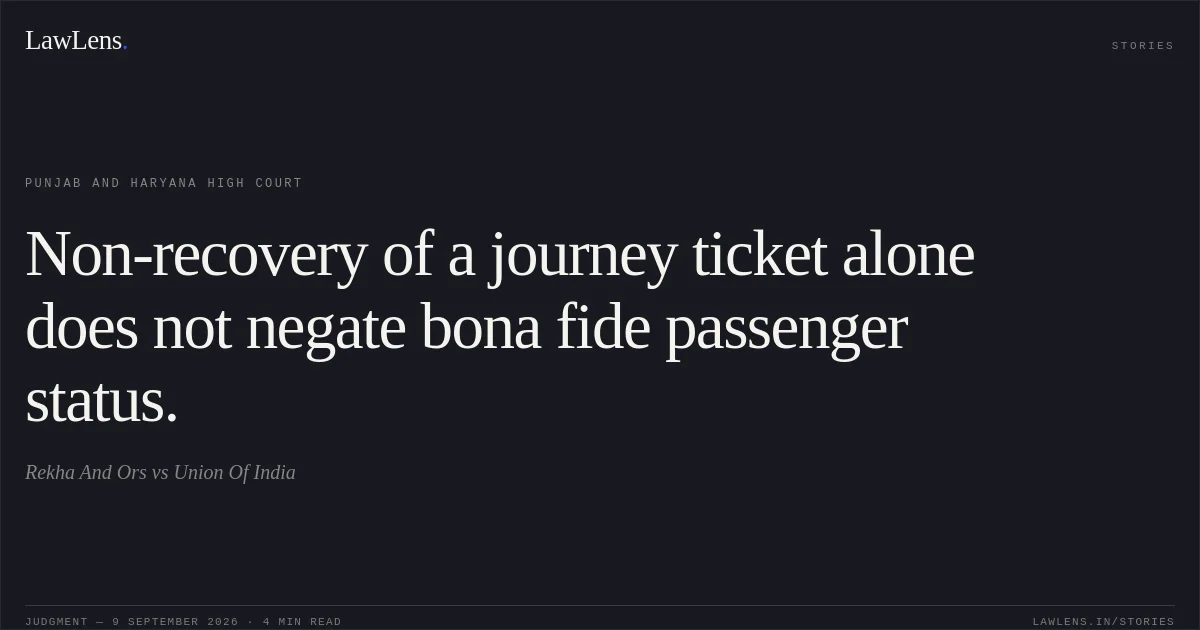
Source reference: para. 7.1Relying on Union of India v. Rina Devi, (2019) 3 SCC 572, the Court held that mere non-recovery of a ticket from the deceased does not, by itself, disprove bona fide passenger status; once the claimant presents facts indicating bona fide travel, the burden shifts to the Railways to establish otherwise.
Source reference: para. 6The Court also relied on Radha Yadav v. Union of India, (2019) 3 SCC 410, for determining compensation by comparing the amount applicable on the date of the accident, with reasonable interest, against the statutory compensation applicable on the date of the award, and awarding the higher amount.
Source reference: para. 9Reasoning
The Court found that Hansraj’s sworn testimony that he had purchased the ticket and boarded Naresh on the train was sufficient to discharge the claimants’ initial burden of showing bona fide travel.
Source reference: para. 6.1The absence of a ticket was not decisive because the GRP Death Report recorded that the deceased had no clothing on the upper part of his body, supporting the claimants’ explanation that the shirt containing the ticket and other articles had been lost in the accident.
Source reference: para. 6.1The discrepancies concerning the time at which Naresh reached the station and the time when the body was discovered were treated as insufficient to outweigh the positive testimony and contemporaneous GRP and railway records.
Source reference: para. 6.2The Court further noted that the Tribunal had ignored the deceased’s mother’s statement attributing his death to a fall from the train and had relied on speculation that he was struck while crossing the track.
Source reference: para. 6.3; para. 7Since the Railways produced no cogent evidence that Naresh was a trespasser or that an unknown train had struck him, and failed to produce any report allegedly expected from the driver or guard of such train, the Court drew an adverse inference against the Railways.
Source reference: para. 7On the preponderance of probabilities, the circumstances established that Naresh was a bona fide passenger who accidentally fell from the running train, thereby satisfying Sections 123(c)(2) and 124-A of the Railways Act.
Source reference: paras. 8–8.1Holding
The appeal was allowed and the Tribunal’s order dated 23.07.2015 was set aside.
The Court held that Naresh was a bona fide passenger and that his death resulted from an untoward incident under Section 123(c)(2) of the Railways Act.
Source reference: paras. 8–8.1The appellants were awarded Rs. 4,00,000 with simple interest at 9% per annum from the date of filing of the claim application until realization, or Rs. 8,00,000, whichever was higher, in accordance with Rina Devi and Radha Yadav.
Source reference: para. 10The Railway Administration was directed to deposit the amount before the Tribunal within three months of receiving the certified judgment, for disbursement among the eligible dependants.
Source reference: para. 10In case of default, interest at 12% per annum would accrue from expiry of the three-month period until realization.
Source reference: para. 10Acts & Sections Cited
2 provisions across 2 statutes referred to in this judgment. Each provision opens on LawLens.
Railway Claims Tribunal Act, 19871
Railways Act, 19891
Original Court PDF
Rekha And OrsvsUnion Of India
Click to open original judgment
Original judgment, available to read, download and summarize on LawLens.in