Facts
On 17 January 2015, Shambhu Roy, accompanied by his brother-in-law Rajkant Roy and Nandan, reached Phillaur Railway Station to travel to Amritsar.
Source reference: para. 2Nandan purchased a computerized ticket for two passengers from Phillaur to Amritsar and handed it to the deceased.
Source reference: para. 2While Shambhu Roy was boarding the Tata Mori Express from Platform No. 2, the train started moving, causing him to lose balance and fall beneath the train, resulting in his death at the spot.
Source reference: para. 2The Station Master informed the GRP, and inquest and post-mortem proceedings were conducted.
Source reference: para. 2The Railway Claims Tribunal, Chandigarh Bench, dismissed the claim application on 30 October 2017, principally because no journey ticket was recovered from the deceased and because it disbelieved or found discrepancies in the evidence of Nandan.
Source reference: paras. 1, 3Issues
Whether non-recovery of a journey ticket from the deceased was sufficient, by itself, to disprove his status as a bona fide railway passenger.
Source reference: paras. 3–5Whether the deceased’s death, caused by falling from a moving passenger train while boarding it, constituted an “untoward incident” under Sections 123(c)(2) and 124-A of the Railways Act, 1989.
Source reference: para. 6Whether the appellants were entitled to compensation and, if so, what amount and interest were payable.
Source reference: paras. 9–10Law Applied
The Court applied Sections 123(c)(2) and 124-A of the Railways Act, 1989.
Source reference: para. 6–7Section 123(c)(2) includes the accidental falling of a passenger from a train carrying passengers within the definition of an “untoward incident,” while Section 124-A imposes strict liability on the Railway Administration, subject to the statutory exceptions in its proviso.
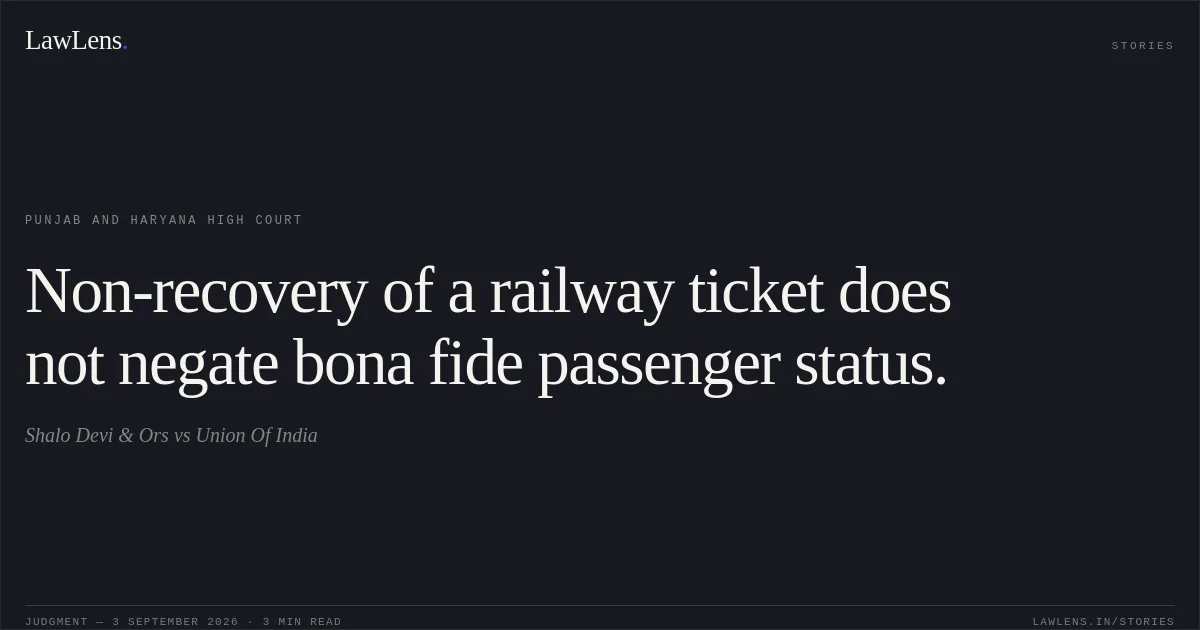
Source reference: para. 6–7Relying on Union of India v. Rina Devi, (2019) 3 SCC 572, the Court held that mere non-recovery of a ticket from an injured or deceased passenger does not, by itself, negate bona fide passenger status; once the claimant presents credible material showing possession of a valid ticket, the burden shifts to the Railways to establish otherwise.
Source reference: para. 5The Court also relied on Kamukayi and Others v. Union of India, Civil Appeal No. 3799 of 2023, and Radha Yadav v. Union of India, (2019) 3 SCC 410, including the principle that the compensation applicable on the date of the accident, with reasonable interest, must be compared with the enhanced statutory compensation applicable on the date of the award, and the higher amount should be granted.
Source reference: paras. 5, 9Reasoning
The Court found that Nandan’s evidence that he had purchased two tickets and handed one to the deceased was materially corroborated by the contemporaneous statement of Booking Clerk Rajni Bala, which confirmed purchase of ticket No. F03428685 from Phillaur to Amritsar at approximately 3:55 p.m.
Source reference: para. 5.1The absence of the ticket from the deceased’s body was therefore not conclusive, particularly in view of the surrounding official records.
Source reference: para. 5.1The Station Master’s memo, GRP proceedings, inquest, post-mortem, and the discovery of the deceased between the platform and railway track substantially supported the occurrence.
Source reference: para. 6The fact that the Guard did not witness the fall, or that no alarm-chain pulling was recorded, did not disprove the incident.
Source reference: para. 6The Court further held that alleged discrepancies in witness statements and the Tribunal’s conjectures regarding the direction or prudence of the deceased’s journey could not override the contemporaneous documentary evidence.
Source reference: para. 7Since the deceased was travelling as a bona fide passenger and died after accidentally falling from the train, the incident fell within Sections 123(c)(2) and 124-A.
Source reference: paras. 6–8No statutory exception to strict liability was established by the Railways.
Source reference: paras. 6–8Holding
The deceased was held to be a bona fide passenger whose death resulted from an untoward incident under Sections 123(c)(2) and 124-A of the Railways Act, 1989.
The appeal was allowed and the Tribunal’s order dated 30 October 2017 was set aside.
Source reference: para. 10The appellants were awarded Rs. 4,00,000 with simple interest at 9% per annum from the date of filing of the claim application until realization, or Rs. 8,00,000, whichever was higher, in accordance with Rina Devi and Radha Yadav.
Source reference: paras. 9–10The Railway Administration was directed to deposit the amount with accrued interest before the Tribunal within three months of receiving the certified copy of the judgment, after which the Tribunal was to disburse it among the eligible dependent-appellants.
Source reference: para. 10In case of default, interest at 12% per annum was payable on the amount due from expiry of the three-month period until actual realization.
Source reference: para. 10Acts & Sections Cited
2 provisions across 1 statute referred to in this judgment. Each provision opens on LawLens.
Railways Act, 19892
Original Court PDF
Shalo Devi & OrsvsUnion Of India
Click to open original judgment
Original judgment, available to read, download and summarize on LawLens.in