Facts
Himanshu Sharma allegedly travelled from Gajraula to Dehradun on 19 June 2023 in search of employment. After informing his father on 20 June 2023 that no employment had been arranged and that he was returning home, he allegedly travelled towards Gajraula by Train No. 14042, the Mussoorie Express. His body was subsequently found between Fazalpur and Muzzampur Railway Stations, and the appellants claimed that he had accidentally fallen from the moving train due to a sudden jerk and overcrowding.
Source reference: p.2, para. 2During the inquest, a railway ticket for the Gajraula–Dehradun journey dated 19 June 2023, along with a mobile phone and cash, was recovered from him; no return ticket was found.
Source reference: p.2, para. 2The Railway Claims Tribunal dismissed the claim application, holding that the deceased’s status as a bona fide passenger and the occurrence of an “untoward incident” had not been proved.
Source reference: p.2, para. 3The appellants challenged that decision under Section 23 of the Railway Claims Tribunal Act, 1987.
Source reference: p.1, para. 1Issues
Whether the evidence established that the deceased was a bona fide passenger at the time of the occurrence, despite the non-recovery of a return journey ticket?
Source reference: p.4, para. 6; pp.4–6, paras. 7–10Whether the deceased’s death resulted from an “untoward incident” within the meaning of the Railways Act, 1989, particularly an accidental fall from Train No. 14042?
Source reference: p.4, para. 6; pp.6–7, paras. 11–16Law Applied
The Court applied the statutory scheme governing compensation for railway accidents under the Railways Act, 1989, including the concept of an “untoward incident,” and exercised appellate jurisdiction under Section 23 of the Railway Claims Tribunal Act, 1987.
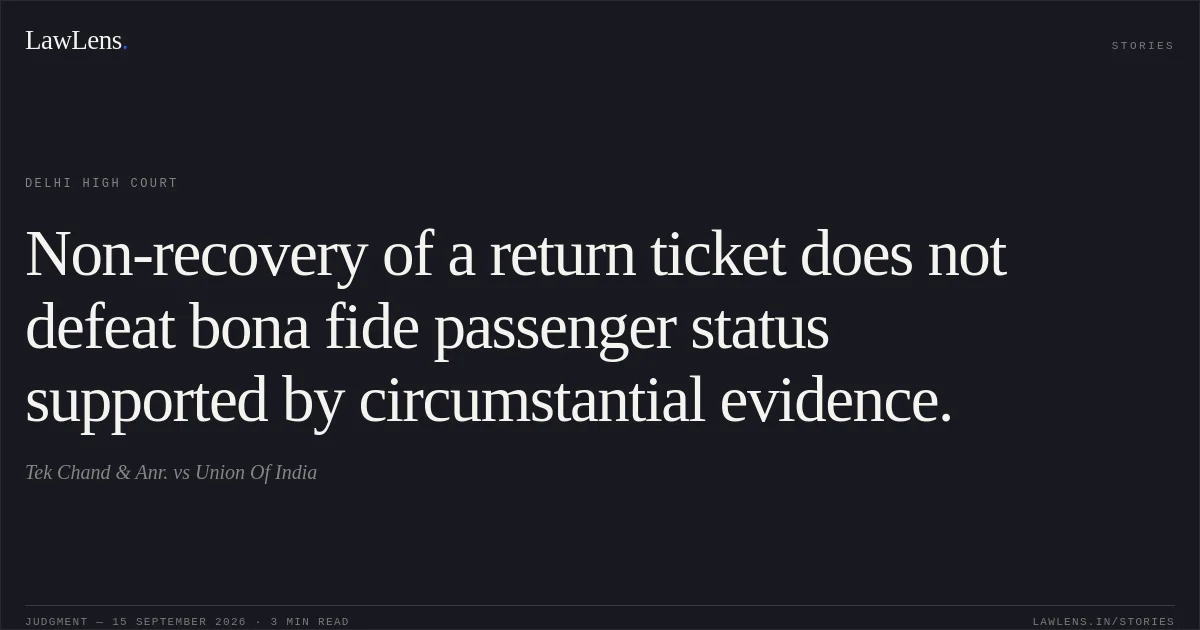
Source reference: p.1, para. 1; p.4, para. 6Relying on Union of India v. Rina Devi, (2019) 3 SCC 572, and Lata v. Union of India, 2026 SCC OnLine 1350, the Court held that the claimant must initially place foundational facts establishing bona fide travel and the occurrence, but the mere absence or non-recovery of a ticket is not conclusive against bona fide passenger status.
Source reference: p.5, para. 10The Court further applied the principle that railway compensation provisions are beneficial in nature and that a claim should not be rejected merely because the timing of the accident cannot be established with exact precision, particularly in the absence of positive contrary evidence.
Source reference: pp.7–8, paras. 15–16Reasoning
The Court found that the appellants had discharged their initial burden by relying on the recovered Gajraula–Dehradun ticket, the inquest and jamatalashi records, and the father’s consistent testimony that the deceased had commenced his return journey from Dehradun.
Source reference: pp.4–5, paras. 8–10The respondent did not dispute the deceased’s journey to Dehradun or produce evidence showing that he had not begun his return journey. Accordingly, the non-recovery of a return ticket could not, by itself, negate bona fide passenger status.
Source reference: p.5, para. 10On the occurrence, the Tribunal had treated the deceased’s body being noticed at approximately 1:35 a.m. and Train No. 14042 passing the location at approximately 1:49 a.m. as disproving the alleged fall.
Source reference: pp.6–7, paras. 12–14The High Court held that this reasoning overlooked the train’s earlier movement: the train had passed Fazalpur and Muzzampur at approximately 12:53 a.m. and 12:50 a.m., respectively, proceeded to Najibabad, and thereafter returned towards those stations after departing Najibabad at 1:32 a.m.
Source reference: pp.6–7, paras. 12–14Thus, the train’s subsequent passage at 1:49 a.m. did not exclude the possibility that the deceased had fallen during its earlier movement. The TSR, read with the return-loop movement and the surrounding circumstances, did not disprove the appellants’ case.
Source reference: p.7, paras. 14–16Holding
The High Court held that the deceased had been established as a bona fide passenger and that the Tribunal had erred in rejecting the claim solely on the basis of the missing return ticket and an incomplete appreciation of the TSR timings.
The impugned judgment dated 15 March 2024 was set aside.
Source reference: p.8, paras. 17–18The matter was remanded to the Railway Claims Tribunal to assess the compensation payable in accordance with law and to direct disbursement within two months of receiving the High Court’s order.
Source reference: p.8, paras. 17–18The parties were directed to appear before the Tribunal on 8 October 2026.
Source reference: p.8, paras. 17–18Acts & Sections Cited
1 provisions across 1 statute referred to in this judgment. Each provision opens on LawLens.
Railway Claims Tribunal Act, 19871
Original Court PDF
Tek Chand & Anr.vsUnion Of India
Click to open original judgment
Original judgment, available to read, download and summarize on LawLens.in