Facts
The appellant sought compensation for the death of her husband, Dheer Singh, who allegedly fell from Train No. 14043, the Garhwal Express, near Gate No. 74, Hapur, on 11 December 2015, and later died of his injuries.
Source reference: p. 1–2, para. 1The Railway Claims Tribunal dismissed the claim, relying, among other things, on the non-recovery of a ticket, the location and nature of the injuries, and a police report stating that the deceased had become entangled with a train. The appellant challenged that decision under Section 23 of the Railway Claims Tribunal Act, 1987.
Source reference: p. 2, para. 3Issues
Whether the deceased was a bona fide passenger notwithstanding that no railway ticket was recovered from him.
Source reference: p. 3, paras. 6–7Whether his death resulted from an “untoward incident” under the Railways Act, 1989, including whether the evidence established an accidental fall rather than a run-over while crossing the track.
Source reference: p. 5, paras. 8–12Law Applied
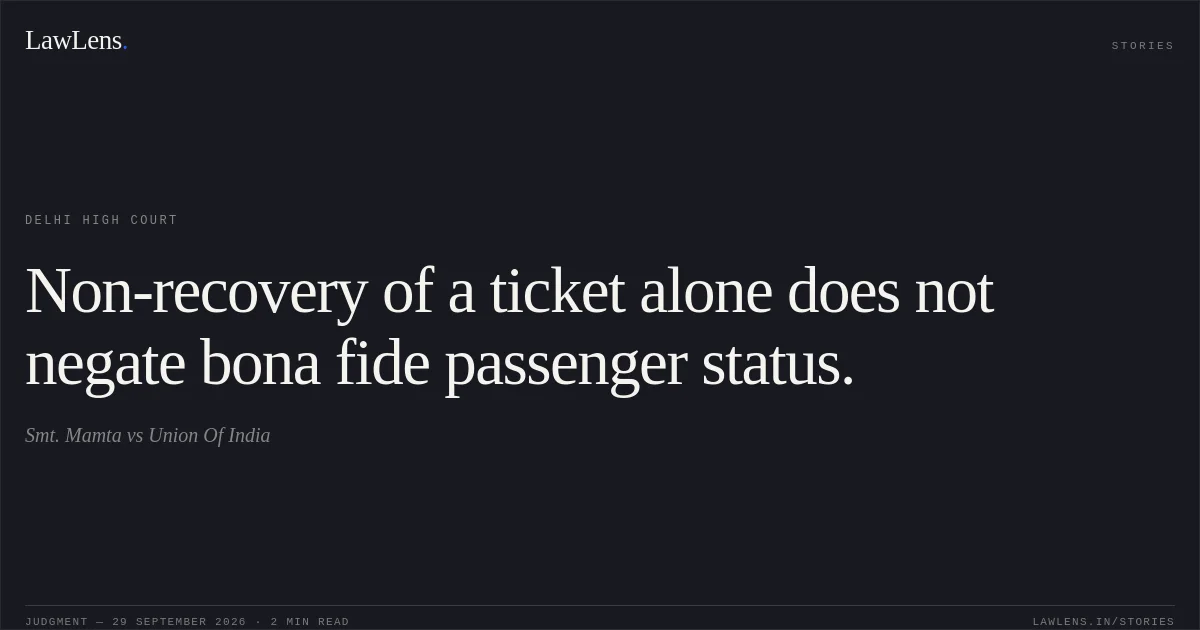
Section 2(29) of the Railways Act, 1989 defines a passenger as a person travelling with a valid pass or ticket; however, non-recovery of a ticket from a deceased person is not, by itself, conclusive against bona fide passenger status.
Source reference: p. 4, para. 7Under Union of India v. Rina Devi, the claimant may discharge the initial burden through relevant facts and attending circumstances, after which the Railways must rebut the claim with cogent evidence; this principle was also affirmed in Lata v. Union of India and Sukhabhai Nanjibhai Makwana v. Union of India.
Source reference: p. 4, para. 7Section 123(c)(2) covers an accidental fall from a train as an untoward incident.
Source reference: p. 6, para. 11The Court also considered Section 124-A and held that a description of the deceased as a habitual alcoholic, without evidence of intoxication at the time or a connection to the accident, did not establish an applicable exception; it relied on Mohd. Ubaid v. Union of India on the need for medical or scientific evidence of intoxication.
Source reference: pp. 6–7, para. 11Reasoning
The widow’s evidence that the deceased had left for Delhi intending to travel by train, together with the surrounding circumstances, was sufficient to discharge the initial burden of showing bona fide passenger status. The missing ticket did not determine the issue, and the Railways produced no cogent evidence to rebut that status.
Source reference: p. 4, para. 7On the cause of death, the contemporaneous railway and GRP record stated that a person had fallen from the Garhwal Express, while the later police conclusion that the deceased had become entangled with a train was not based on eyewitness evidence. The injuries and the body’s location did not, without supporting medical or other evidence, rule out an accidental fall. Nor did the reference to habitual alcoholism establish intoxication or an exception under Section 124-A.
Source reference: pp. 5–7, paras. 9–12Holding
The Court held, on a preponderance of probabilities, that the deceased was a bona fide passenger and sustained fatal injuries in an accidental fall from the Garhwal Express, constituting an untoward incident under Section 123(c)(2) of the Railways Act.
It set aside the Tribunal’s judgment and remanded the matter to the Tribunal to assess compensation in accordance with law, with directions for disbursement within two months of receipt of the order; the appeal was allowed and disposed of.
Source reference: pp. 7–8, paras. 14–16Acts & Sections Cited
3 provisions across 2 statutes referred to in this judgment. Each provision opens on LawLens.
Railway Claims Tribunal Act, 19871
Railways Act, 19892
Original Court PDF
Smt. MamtavsUnion Of India
Click to open original judgment
Original judgment, available to read, download and summarize on LawLens.in