Facts
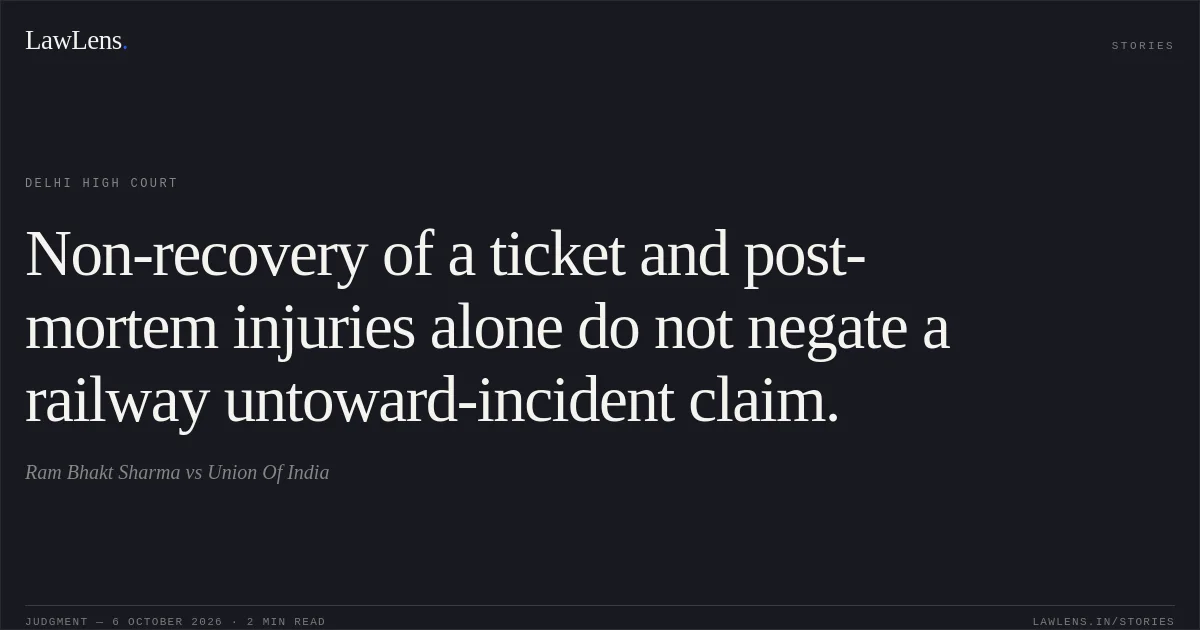
The appellant sought compensation for the death of his son, Shiv Kumar, who allegedly fell from a passenger train while travelling from Kashganj to Hathras on 28 November 2011.
Source reference: paras. 1–3The Railway Claims Tribunal dismissed the claim, finding that the deceased was not proved to be a bona fide passenger and that his death did not result from an “untoward incident.”
Source reference: paras. 1–3The Tribunal relied, among other things, on the non-recovery of a journey ticket, railway records concerning discovery of the body, and injuries recorded in the post-mortem report.
Source reference: paras. 1–3The appellant appealed under Section 23 of the Railway Claims Tribunal Act, 1987.
Source reference: para. 1Issues
1. Whether the deceased was a bona fide passenger despite the non-recovery of his journey ticket.
Source reference: para. 62. Whether the deceased’s death resulted from an “untoward incident” within the meaning of Section 123(c)(2) of the Railways Act, 1989.
Source reference: paras. 7–10Law Applied
Section 23 of the Railway Claims Tribunal Act, 1987 provides for an appeal from a decision of the Railway Claims Tribunal.
Source reference: para. 1Under Section 123(c)(2) of the Railways Act, 1989, the relevant question is whether the death resulted from an “untoward incident.”
Source reference: para. 7Applying Union of India v. Rina Devi, (2019) 3 SCC 572, and Lata v. Union of India, 2026 SCC OnLine SC 1350, the Court held that non-recovery of a journey ticket is not, by itself, conclusive against bona fide passenger status.
Source reference: para. 6A claimant may discharge the initial burden by establishing relevant facts and attending circumstances; the burden then shifts to the Railways to rebut the claim with cogent evidence.
Source reference: para. 6Reasoning
The appellant testified that his son had purchased a valid ticket. Although the Tribunal did not accept the co-passenger’s testimony, it could not reject bona fide passenger status solely because the ticket was not recovered. The Court found that the appellant’s evidence and the attending circumstances discharged the initial burden, which the Railways failed to rebut.
Source reference: para. 6As to the cause of death, the Station Master’s Memo and Panchnama established the circumstances in which the body was found, but not the sequence of events.
Source reference: paras. 8–11Two trains had passed on separate lines at about the same time, but no statement from either train’s Guard or Loco Pilot established that the deceased had been run over by the goods train.
Source reference: paras. 8–11Nor did the post-mortem report contain a medical opinion that the injuries were incompatible with an accidental fall from the passenger train. The Tribunal therefore could not treat the body’s condition, including the decapitation, as determinative of how the death occurred.
Source reference: paras. 8–11Holding
The Court set aside the Tribunal’s findings on both bona fide passenger status and whether the death resulted from an untoward incident.
It allowed the appeal and remanded the matter to the Tribunal to assess compensation in accordance with law, with directions that the authorities concerned disburse it within two months of receiving the order.
Source reference: paras. 12–14The matter was directed to be listed before the Tribunal on 26 November 2026.
Source reference: paras. 12–14Acts & Sections Cited
2 provisions across 2 statutes referred to in this judgment. Each provision opens on LawLens.
Railway Claims Tribunal Act, 19871
Railways Act, 19891
Original Court PDF
Ram Bhakt SharmavsUnion Of India
Click to open original judgment
Original judgment, available to read, download and summarize on LawLens.in