Facts
The Appellant and the prosecutrix (PW-1) were in a consensual romantic and physical relationship for approximately two years
Source reference: p. 11, 12The prosecutrix alleged that the Appellant recorded a video of her bathing without her knowledge and subsequently threatened to upload it to Facebook to prevent her from contacting him or seeking marriage
Source reference: p. 5, 8Following a complaint, the Appellant was charged under Sections 376, 493, 354C, and 506 Part II of the IPC
Source reference: p. 2The Trial Court acquitted him of rape and voyeurism (Sections 376, 493, 354C) citing the consensual nature of the relationship and non-recovery of the video, but convicted him under Section 506 Part II for criminal intimidation
Source reference: p. 3, 12The High Court of Madras upheld this conviction
Source reference: p. 14The Appellant challenged the conviction before the Supreme Court, arguing that the acquittal under Section 354C and the non-recovery of the mobile phone/video invalidated the charge of intimidation
Source reference: p. 3, 4Issues
1. Whether the prosecution proved beyond reasonable doubt the charge of criminal intimidation under Section 506 Part II IPC despite the non-recovery of the alleged video evidence
Source reference: p. 18 / para 202. Whether a threat to upload a private video of a woman bathing constitutes an intent to "impute unchastity" under the aggravated limb of Section 506 IPC in light of modern constitutional values
Source reference: p. 22 / para 29Law Applied
The Court applied Section 503 of the IPC, which defines criminal intimidation as threatening injury to reputation with intent to cause alarm
Source reference: p. 19It invoked Section 506 Part II IPC, providing enhanced punishment if the threat is to "impute unchastity to a woman"
Source reference: p. 19-20The Court relied on Section 106 of the Evidence Act regarding facts "especially within the knowledge" of a person
Source reference: p. 42The Court relied on Section 114 regarding presumptions of human conduct
Source reference: p. 46It further integrated the constitutional principles of privacy and dignity under Article 21 as elucidated in K.S. Puttaswamy v. Union of India and Joseph Shine v. Union of India to interpret "unchastity" as an interference with sexual autonomy and privacy
Source reference: p. 27, 24, 28-29Reasoning
The Court reasoned that "unchastity" must be re-interpreted beyond antiquated moralist definitions to encompass violations of a woman's sexual autonomy, privacy, and dignity
Source reference: p. 26, 30It held that threatening to publish a video of a woman bathing—regardless of her sexual history—is an assault on her dignity and constitutes "imputing unchastity"
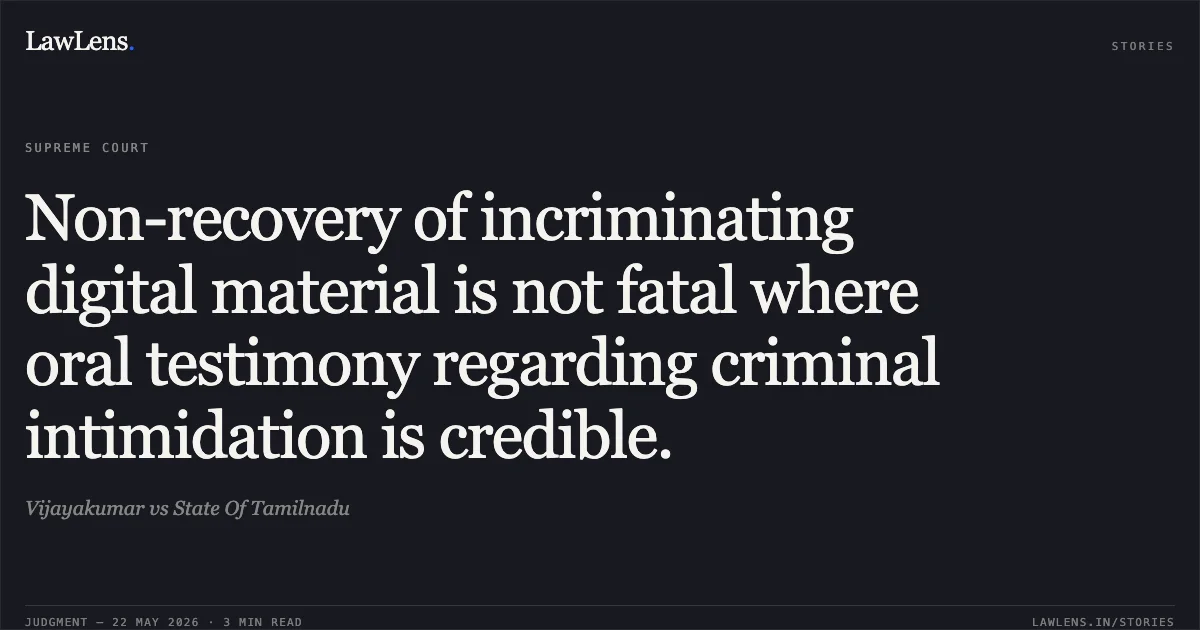
Source reference: p. 31Regarding the lack of physical evidence (the video), the Court held that non-recovery is not fatal if testimonial evidence is credible
Source reference: p. 38The Court applied Section 106 of the Evidence Act, noting that because the incidents occurred within a private interpersonal relationship, the truth of the threat was within the "especial knowledge" of the Appellant
Source reference: p. 44-45Since the Appellant failed to provide a plausible alternative version during his Section 313 CrPC examination—offering only bare denials—the Court drew a reasonable inference in favor of the prosecutrix’s consistent testimony
Source reference: p. 61-62, 71The Court found the prosecutrix’s testimony reliable as it remained unimpeached during cross-examination and was corroborated by her sisters
Source reference: p. 63, 69-70Holding
The Supreme Court held that the prosecution successfully proved the charge under Section 506 Part II IPC beyond reasonable doubt
The Court clarified that the victim’s genuine alarm and the Appellant’s intent to silence her through the threat were sufficient for conviction, even without the physical recovery of the digital material
Source reference: p. 67The Court dismissed the appeal and upheld the conviction, but modified the sentence to the period of custody already undergone by the Appellant
Source reference: p. 77-78Acts & Sections Cited
10 provisions across 2 statutes referred to in this judgment. Each provision opens on LawLens.
Indian Penal Code, 1860
Bharatiya Sakshya Adhiniyam, 20231
Original Court PDF
VijayakumarvsState Of Tamilnadu
Click to open original judgment
Original judgment, available to read, download and summarize on LawLens.in