Facts
The appellant’s husband (the deceased) allegedly fell from a moving train on July 7, 2018, while traveling from Shikohabad to Etawah, resulting in his death.
Source reference: para. 2A claim for compensation was filed, asserting the deceased was a bona fide passenger whose ticket was lost during the accident.
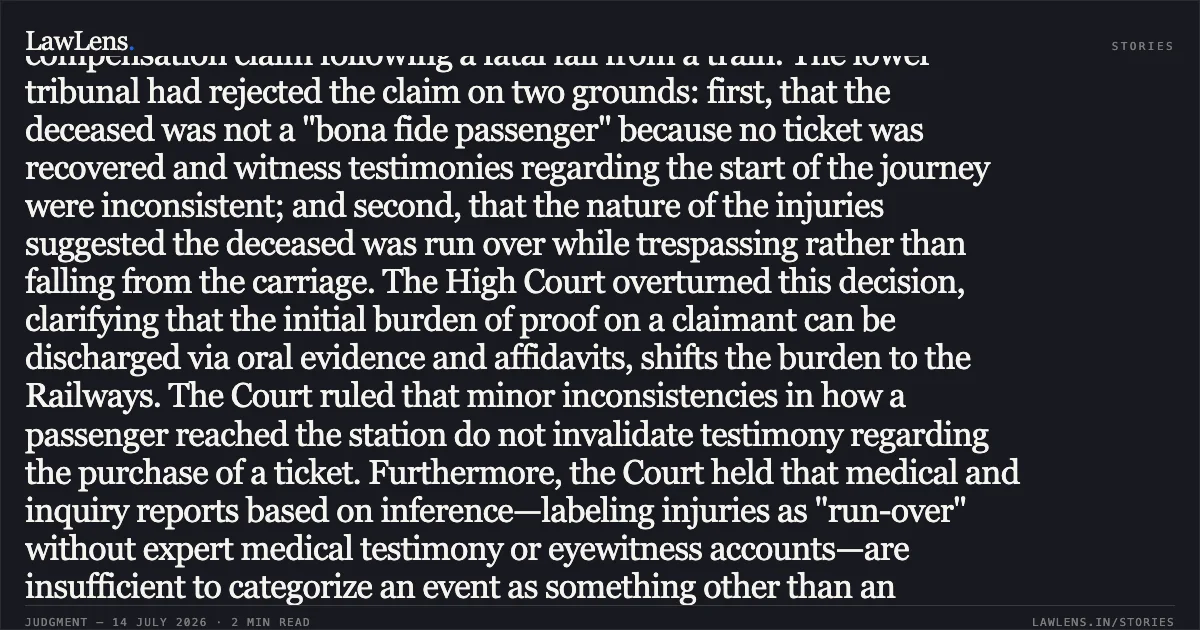
Source reference: para. 2The Railway Claims Tribunal dismissed the application, finding that the appellant failed to prove the deceased’s status as a bona fide passenger due to the lack of a recovered ticket and inconsistencies in witness testimonies regarding how the journey commenced.
Source reference: para. 3, 8The Tribunal also characterized the death as a "run-over" incident rather than an "untoward incident" based on the Panchnama and DRM report.
Source reference: para. 11Issues
1. Whether the deceased was a bona fide passenger at the time of the incident despite the non-recovery of a journey ticket.
Source reference: para. 7, 82. Whether the death of the deceased resulted from an "untoward incident" as defined under the Railways Act.
Source reference: para. 7, 11Law Applied
The Court applied Sections 123(c) and 124A of the Railways Act, 1989, which define "untoward incidents" and the liability of the Railways for compensation.
Source reference: para. 3It heavily relied on the precedent set by the Supreme Court in Union of India v. Rina Devi, which established that the mere absence of a ticket does not negate a claim of being a bona fide passenger.
Source reference: para. 4, 9Under this doctrine, once a claimant files an affidavit of relevant facts, the initial burden of proof is discharged, shifting the onus to the Railways to provide evidence to the contrary.
Source reference: para. 9Section 23 of the Railway Claims Tribunal Act, 1987, governed the appellate jurisdiction of the High Court.
Source reference: para. 1Reasoning
The Court found that the Tribunal erred by overemphasizing minor testimonial contradictions and the absence of a physical ticket.
Source reference: para. 10It reasoned that the testimony of a witness (AW-2) who saw the ticket purchase was not dislodged during cross-examination, and the Railways failed to provide affirmative evidence to the contrary.
Source reference: para. 10Regarding the nature of the accident, the Court rejected the Tribunal’s "run-over" conclusion, noting that the Panchnama and DRM reports were merely inferential.
Source reference: para. 12The Court observed that the respondent failed to produce expert medical evidence or eyewitness accounts (such as the Loco Pilot or Guard) to prove trespassing or suicide, which are necessary to rebut the presumption of an "untoward incident".
Source reference: para. 12, 13Holding
The Court held that the deceased was a bona fide passenger and that his death constituted an "untoward incident" under the Act.
The Court allowed the appeal and set aside the Tribunal’s judgment.
Source reference: para. 15The matter was remanded to the Tribunal with directions to assess and disburse the appropriate compensation to the appellant within two months of the order.
Source reference: para. 14Acts & Sections Cited
2 provisions across 2 statutes referred to in this judgment. Each provision opens on LawLens.
Railway Claims Tribunal Act, 19871
Railways Act, 19891
Original Court PDF
SavitrivsUnion Of India
Click to open original judgment
Original judgment, available to read, download and summarize on LawLens.in