Facts
The appellants, aged and economically disadvantaged parents from Uttar Pradesh, sought compensation for the death of their son, Pinku, who died on 05.07.2016.
Source reference: p.1, 3The deceased was traveling from Kanpur Central to New Delhi on the Bhagalpur-New Delhi Express when he allegedly fell from the train near Dadri Railway Station.
Source reference: p.3The Railway Claims Tribunal (RCT) dismissed the claim on 14.11.2017, ruling that the deceased was neither a bona fide passenger nor a victim of an "untoward incident".
Source reference: p.3The appellants filed the present appeal with a 1326-day delay, citing poverty, illiteracy, and the fact that the certified copy of the judgment was only received on 30.07.2021.
Source reference: p.1-2Issues
1. Whether the delay of 1326 days in filing the appeal should be condoned given the appellants' socio-economic circumstances and the beneficial nature of the legislation?
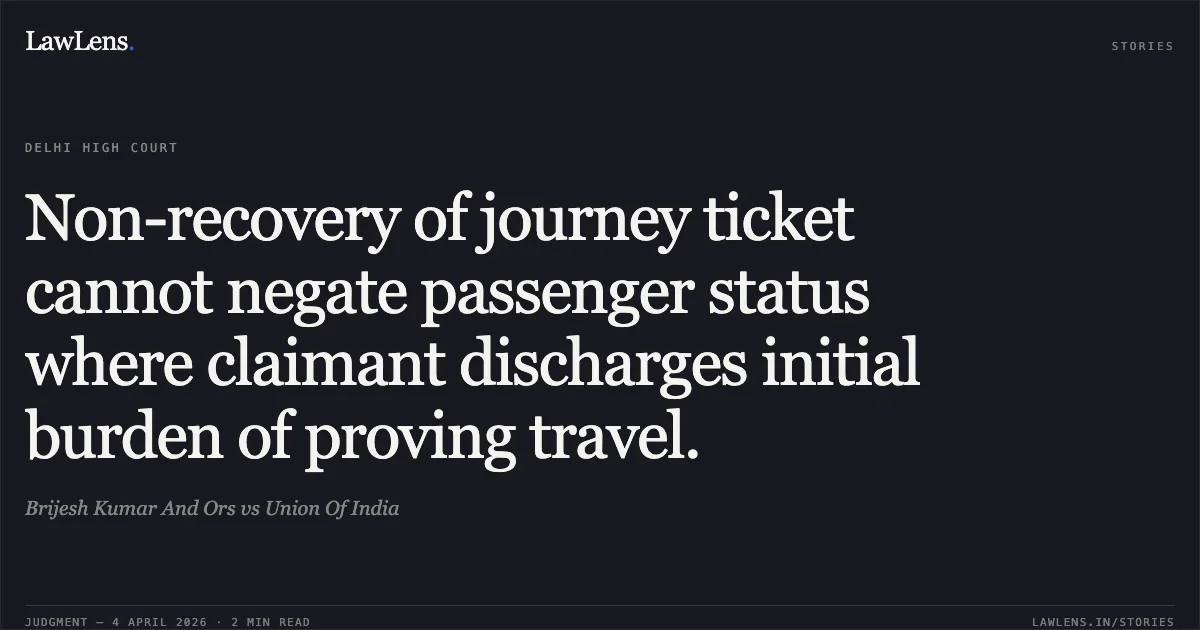
Source reference: p.1-32. Whether the deceased was a "bona fide passenger" in the absence of a recovered journey ticket?
Source reference: p.4, 63. Whether the incident constitutes an "untoward incident" under Section 123(c) of the Railways Act, 1989?
Source reference: p.4-5Law Applied
The Court applied the Railways Act, 1989, specifically Section 123(c) (definition of "untoward incident") and Section 124-A (strict liability for compensation).
Source reference: p.5It relied on Union of India v. Prabhakaran Vijaya Kumar, establishing that liability under Section 124-A is strict and negligence is irrelevant unless a specific exception is proven.
Source reference: p.5-6Regarding passenger status, the Court followed Union of India v. Rina Devi, which held that ticket non-recovery is not conclusive and the burden of proof shifts to the Railways once the claimant provides an affidavit of travel.
Source reference: p.6For the condonation of delay, the Court referenced Mohsina v. Union of India and Shalini Gihar v. Union of India regarding the liberal approach for poor litigants, alongside the Supreme Court’s Suo Moto Writ Petition (Civil) No. 3 of 2020 regarding COVID-19 limitation extensions.
Source reference: p.2Reasoning
The Court first condoned the 1326-day delay, emphasizing that beneficial social welfare legislation requires a liberal, justice-oriented approach to ensure genuine claims are not defeated by technicalities.
Source reference: p.2On the merits, the Court found the RCT’s conclusion—that the deceased was "run over" while crossing tracks—to be speculative and unsupported by evidence.
Source reference: p.5Conversely, the Gateman's contemporaneous report of a passenger falling from the train provided chronological evidence of an accidental fall.
Source reference: p.4-5Under the principle of strict liability, the Court held that the incident was an "untoward incident" as no statutory exceptions were proven by the respondent.
Source reference: p.5-6Regarding the deceased's status as a bona fide passenger, the Court noted that the father (AW-1) provided an unchallenged affidavit stating he witnessed the ticket purchase.
Source reference: p.6Per Rina Devi, this shifted the burden to the Railways, which failed to lead any rebuttal evidence or timely file a DRM report.
Source reference: p.6Holding
The Court condoned the delay of 1326 days and set aside the RCT judgment dated 14.11.2017.
It held that the deceased was a bona fide passenger and his death resulted from an untoward incident.
Source reference: p.5-6The matter was remanded to the Tribunal to assess the compensation amount and disburse the same within two months.
Source reference: p.7The appeal was allowed.
Source reference: p.7Acts & Sections Cited
2 provisions across 2 statutes referred to in this judgment. Each provision opens on LawLens.
Railways Act, 19891
Railway Claims Tribunal Act, 19871
Original Court PDF
Brijesh Kumar And OrsvsUnion Of India
Click to open original judgment
Original judgment, available to read, download and summarize on LawLens.in