Facts
The respondent-workman was initially appointed by the petitioner (APEDA) in September 1998 on a contractual basis for specific periods
Source reference: p. 2His final contractual engagement was from 08.07.2011 to 31.12.2011, after which his services were discontinued
Source reference: p. 2The appointment orders explicitly stated the posts were non-sanctioned, contractual, and that non-renewal would not confer any right to regularisation
Source reference: p. 3The workman raised an industrial dispute, leading to an Award dated 01.10.2019 by the Central Government Industrial Tribunal (CGIT), which directed his reinstatement and a lump sum payment of ₹1,00,000 in lieu of back wages
Source reference: p. 2, 3The petitioner challenged this Award, contending that the termination was a simple non-renewal of contract and did not amount to "retrenchment"
Source reference: p. 4Issues
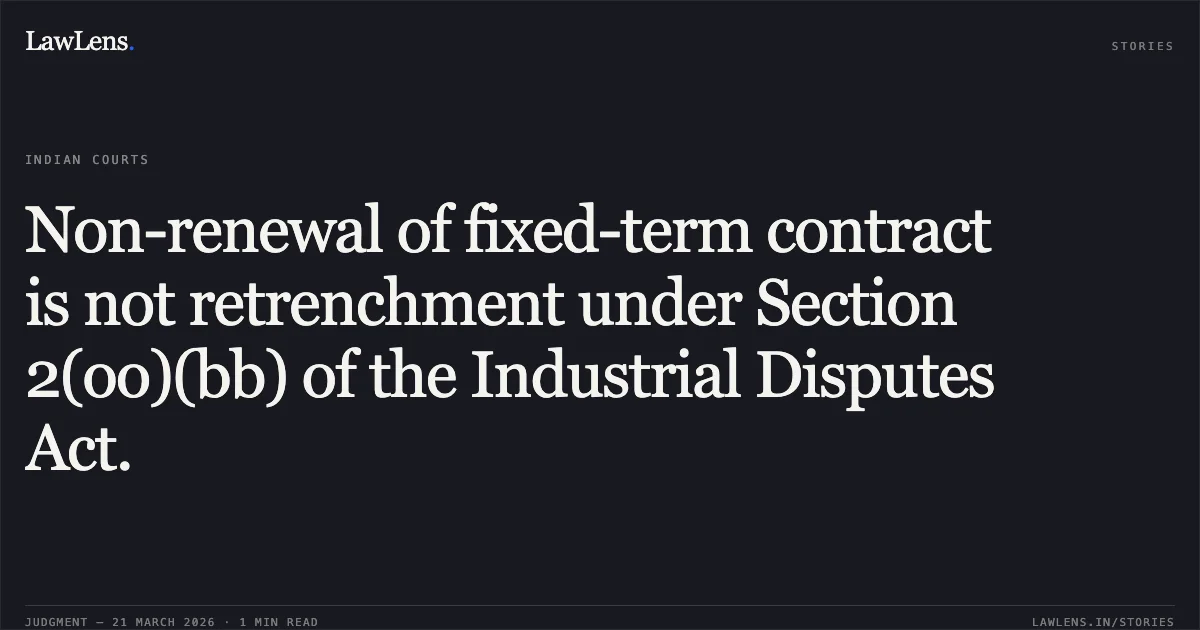
1. Whether the discontinuation of the workman’s services upon the expiry of a fixed-term contract constitutes "retrenchment" under Section 2(oo) of the Industrial Disputes Act, 1947?
Source reference: p. 4, 92. Whether the sheer length of contractual service (13 years) entitles a workman to reinstatement despite the lack of a sanctioned post and the existence of a specific non-renewal clause?
Source reference: p. 4, 9Law Applied
Section 2(oo)(bb) of the Industrial Disputes Act, 1947, which excludes termination resulting from the non-renewal of a contract from the definition of "retrenchment"
Source reference: p. 10Director, Institute of Management v. Smt. Pushpa Srivastava (1992), holding that non-renewal of a contractual employee does not trigger retrenchment protections
Source reference: p. 4Surendranagar District Panchayat v. Dahyabhai Amarsinh (2005), the court noted that Section 25F (conditions precedent to retrenchment) is not applicable where the workman fails to prove continuous service or where the termination falls under the exception of Section 2(oo)(bb)
Source reference: p. 5, 11Section 17B regarding the payment of wages pending proceedings in higher courts
Source reference: p. 12Reasoning
The court found that the CGIT’s finding of a permanent employer-employee relationship was perverse and unsubstantiated by the record
Source reference: p. 3, 9It reasoned that since the discontinuation happened after the expiry of the contract period (31.12.2011) and not during its pendency, the requirement for notice did not arise
Source reference: p. 4, 10Under Section 2(oo)(bb), the cessation of service due to non-renewal is a statutory exception to retrenchment
Source reference: p. 10The court observed that APEDA, as a statutory body, cannot be forced to continue an engagement against a non-sanctioned post if there is no necessity or available funds
Source reference: p. 10It further noted the absence of mala fides, as no new person was appointed to replace the respondent
Source reference: p. 11Consequently, the court held that the length of service alone cannot override the contractual nature of the appointment or the statutory exceptions provided in the Act
Source reference: p. 12Holding
The High Court allowed the writ petition and set aside the CGIT Award dated 01.10.2019, vacating the direction for reinstatement
the court directed the petitioner to pay: (i) full back-wages for specific periods where Section 17B payments were missed (Oct-Nov 2019 and Jan-March 2020); and (ii) a lump sum compensation of ₹3,00,000 within 45 days
Source reference: p. 13The court clarified that this compensation was granted based on the "peculiar facts and circumstances" of the case and should not serve as a precedent
Source reference: p. 13Acts & Sections Cited
6 provisions across 1 statute referred to in this judgment. Linked provisions open on LawLens.
Industrial Disputes Act, 19476
Original Court PDF
Agricultural And Processed Food Products Exports Development Authority (Apeada)vsThe Union Of India And 2 Ors
Click to open original judgment
Original judgment, available to read, download and summarize on LawLens.in


