Facts
The petitioner took a loan from M/s Indusind Bank (Opposite Party No. 2) to purchase a truck.
Source reference: para. 4The truck was subsequently seized by the police for illegal operation, and the petitioner defaulted on a loan amount exceeding Rs. 17,00,000/-.
Source reference: para. 4The bank filed a complaint (C.P. Case No. 472 of 2017) which was referred for police investigation under Section 156(3) Cr.P.C.; the police submitted a Final Report stating the dispute was civil in nature.
Source reference: para. 4The bank then filed a protest petition (C.P. Case No. 101 of 2019) and on 07.08.2019, the Additional Chief Judicial Magistrate, Bermo, found a prima facie case against the petitioner under Section 406 of the Indian Penal Code (IPC) for criminal breach of trust.
Source reference: para. 2, 4The petitioner moved the High Court under Section 482 Cr.P.C. to quash these proceedings.
Source reference: para. 1-2Issues
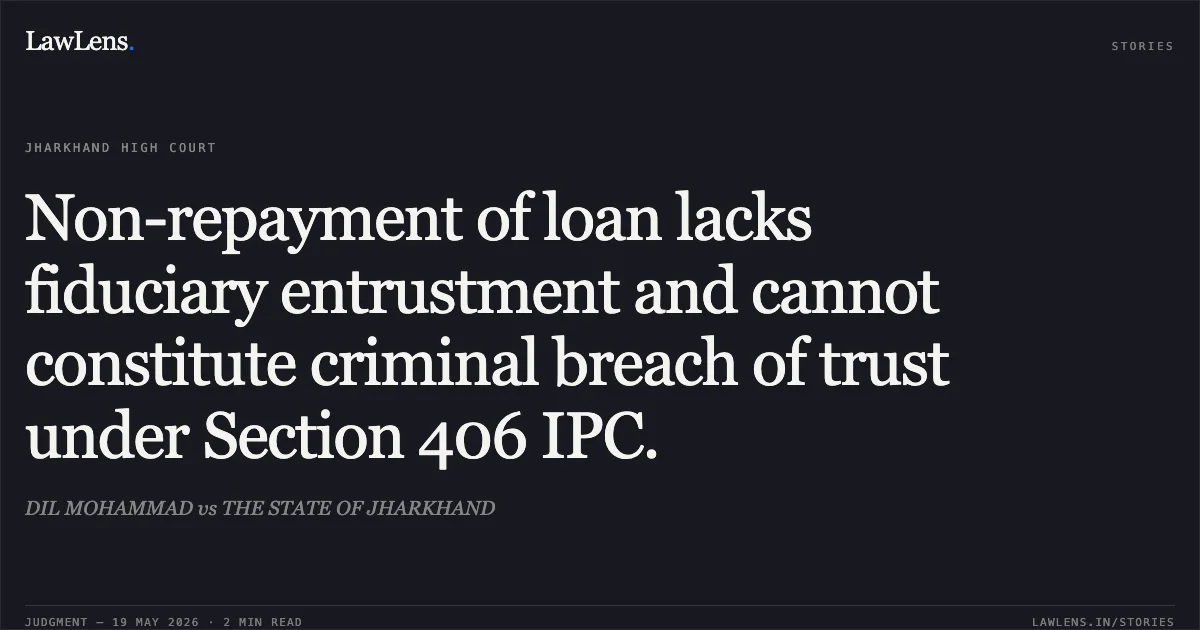
1. Whether the failure to repay a bank loan constitutes the offence of criminal breach of trust under Section 406 of the IPC.
Source reference: para. 7-92. Whether the continuation of the criminal proceeding against the petitioner amounts to an abuse of the process of law.
Source reference: para. 10Law Applied
The court applied Section 405 (defined) and Section 406 (punishment) of the IPC regarding criminal breach of trust, noting that the essential ingredients are "entrustment" and "dishonest misappropriation".
Source reference: para. 7The court relied on Ram Narayan Popli v. CBI (2003) 3 SCC 641, which establishes that misappropriation or conversion to own use in violation of a legal contract is necessary for the offence.
Source reference: para. 7The court cited Satishchandra Ratanlal Shah v. State of Gujarat (2019) 2019 Supreme (SC) 337, which held that a mere inability to return a loan does not constitute cheating or criminal breach of trust unless fraudulent intent existed at the inception.
Source reference: para. 5Reasoning
The court reasoned that for an offence under Section 406 IPC to be made out, there must be "property entrusted." In a bank loan transaction, the ownership of the money passes from the bank to the borrower at the time of disbursement.
Source reference: para. 8The court explained that there is no "entrustment" in the fiduciary sense because the bank does not continue to own the property once lent; rather, the loan creates a civil obligation to repay rather than a fiduciary trust.
Source reference: para. 8The court observed that the only allegation against the petitioner was the non-repayment of the loan, and in the absence of any specific allegation of dishonest misappropriation of entrusted property, the ingredients of Section 406 IPC were not satisfied.
Source reference: para. 9-10Holding
The Court held that the dispute was essentially civil and the criminal prosecution was an abuse of the process of law.
The Court quashed and set aside the order dated 07.08.2019 and the entire criminal proceeding in C.P. Case No. 101 of 2019 and allowed the criminal miscellaneous petition.
Source reference: para. 11-13Acts & Sections Cited
6 provisions across 2 statutes referred to in this judgment. Each provision opens on LawLens.
Code of Criminal Procedure, 19732
Indian Penal Code, 18604
Original Court PDF
DIL MOHAMMADvsTHE STATE OF JHARKHAND
Click to open original judgment
Original judgment, available to read, download and summarize on LawLens.in