Facts
The petitioners challenged a publication dated 22.11.2019 declaring them "wilful defaulters" under the RBI Master Circular.
Source reference: para. 1This classification originated from the account of a sister concern, Extol Industries Ltd., being declared a Non-Performing Asset (NPA) on 31.03.2016 due to common directors.
Source reference: para. 2Although the Debts Recovery Tribunal (DRT) set aside the account's downgrading on 09.12.2024—finding no default—the Bank appealed to the DRAT, which granted a status quo order but did not stay the DRT’s judgment.
Source reference: para. 2The High Court observed that the case was squarely covered by its previous decision in M/s Extol Industries and others v. Bank of Baroda (WP No. 12955 of 2019), involving identical issues and the same Corporate Debtor.
Source reference: para. 3Issues
1. Whether the classification of the petitioners as wilful defaulters was valid under the RBI Master Circular when the underlying NPA classification was set aside by the DRT.
Source reference: para. 1-2, 142. Whether a writ petition challenging a wilful defaulter declaration is maintainable when parallel proceedings under the Insolvency and Bankruptcy Code (IBC) are pending.
Source reference: para. 11-13Law Applied
RBI Master Circular on Wilful Defaulters (01.07.2015), which defines wilful default as a failure to repay despite having the capacity, or the diversion/siphoning of funds for unauthorized purposes.
Source reference: para. 14Insolvency and Bankruptcy Code (IBC), 2016 is a self-contained code with inbuilt checks and balances, as established in Mohammed Enterprises (Tanzania) Ltd. v. Farooq Ali Khan.
Source reference: para. 11per Union of India v. Guwahati Carbon Ltd. (2012), a writ petition is generally not maintainable under Article 226 when a specific statute provides an internal remedial mechanism.
Source reference: para. 12Reasoning
The court reasoned that the Bank provided sufficient evidence demonstrating the petitioners' capacity to repay and the subsequent diversion of funds.
Source reference: para. 14Net-worth statements of the directors and transfers to related entities (including Xyron Technologies) while liabilities remained outstanding constituted "diversion" and "siphoning" under the RBI framework.
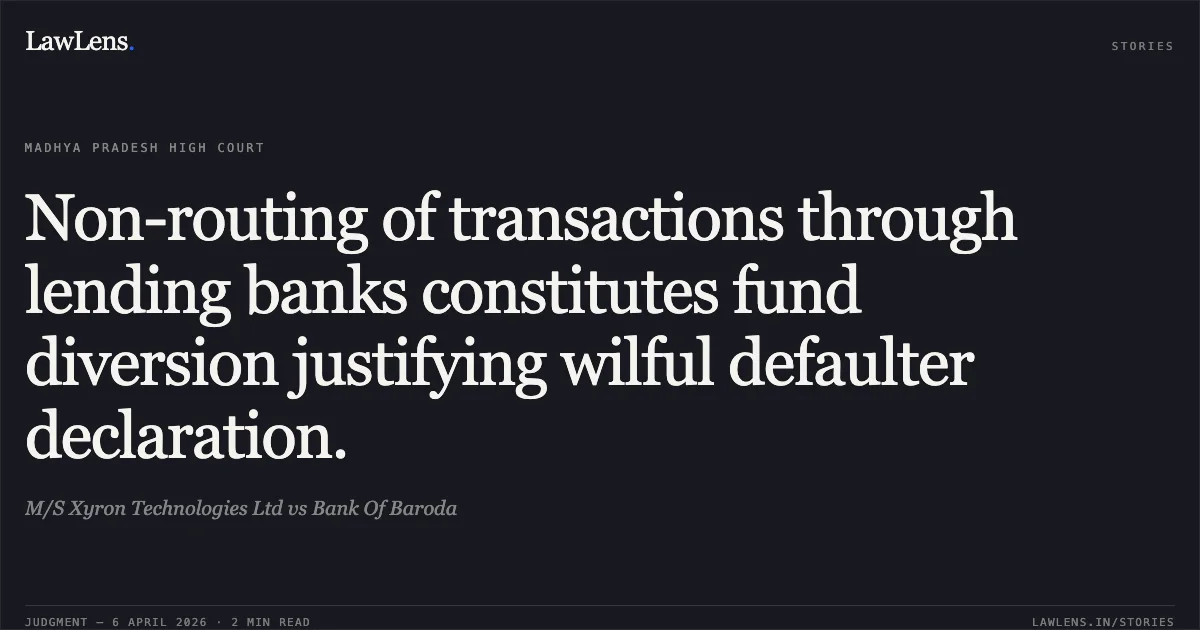
Source reference: para. 14The court specifically noted that "non-routing of transactions" through the lender bank is a distinct ground for wilful default as it impairs the lender's ability to monitor funds.
Source reference: para. 14Crucially, the court held that the IBC proceedings and SARFAESI actions are independent; the admission of insolvency proceedings by the NCLT (upheld by NCLAT) established the existence of "debt," rendering the challenge to the wilful defaulter status unsustainable.
Source reference: para. 11-13Since the petitioners failed to produce financial records to prove a lack of capacity to pay or to justify the inter-entity transfers, they failed to discharge the burden of proof required under the Master Circular.
Source reference: para. 14Holding
The court dismissed the petition, holding that the petitioners were not entitled to any relief as the issues were identical to those in WP No. 43139 of 2025 and WP No. 12955 of 2019, which were previously dismissed.
The court affirmed that the findings in the connected cases applied mutatis mutandis to the present case.
Source reference: para. 5No order as to costs was made.
Source reference: para. 16Acts & Sections Cited
1 provisions across 1 statute referred to in this judgment. Each provision opens on LawLens.
Insolvency and Bankruptcy Code, 2016.1
Original Court PDF
M/S Xyron Technologies LtdvsBank Of Baroda
Click to open original judgment
Original judgment, available to read, download and summarize on LawLens.in