Facts
The respondent, a Sub-Inspector in the Jharkhand Police, was posted as In-charge of Muffasil Police Station in 2010. Following the seizure of seven trucks in a mining case, a complainant alleged that the Investigating Officer (IO) demanded a bribe with the respondent's consent to submit a release report to the court
Source reference: para 6-9Based on an inquiry report by the DSP, departmental proceedings were initiated. The respondent did not participate in the inquiry
Source reference: para 10The inquiry officer found the charges proved based on documents and the confession of a co-delinquent, without examining any witnesses
Source reference: para 10, 15, 22The disciplinary authority imposed a punishment of withholding one annual increment (equivalent to two black marks) on 31.08.2011
Source reference: para 10Appeals and revisions were dismissed
Source reference: para 11The respondent challenged these orders via W.P.(S) No. 6549 of 2012. The learned Single Judge quashed the punishment orders on 16.05.2024 because a second show-cause notice and the inquiry report were not served
Source reference: para 5, 12Issues
1. Whether the non-service of the second show-cause notice and the inquiry report vitiated the disciplinary proceedings, given the respondent's non-participation in the inquiry
Source reference: para 212. Whether the findings of the inquiry officer, based solely on documents without examining witnesses (including the complainant), were legally sustainable
Source reference: para 24-25Law Applied
The court primarily relied on the principle of natural justice as articulated in Managing Director, ECIL Others v. B. Karunakar Others, which mandates the supply of the inquiry report to a delinquent employee to prevent a denial of justice, provided prejudice is shown
Source reference: para 20It further applied the standard for quasi-judicial proceedings established in Roop Singh Negi v. Punjab National Bank, holding that charges in a departmental proceeding must be proved by evidence and that materials collected during a criminal investigation cannot automatically be treated as evidence in disciplinary proceedings
Source reference: para 23Reasoning
The court rejected the appellants' contention that the respondent's failure to participate in the inquiry waived his right to a second show-cause notice.
Source reference: no citationThe court observed that the inquiry officer committed a "grave prejudice" by not examining a single witness, including the complainant, making the findings based solely on documents procedurally flawed
Source reference: para 22, 24Citing B. Karunakar, the court determined that the denial of the inquiry report prevented the respondent from pointing out these evidentiary lapses to the disciplinary authority
Source reference: para 25The court emphasized that the inquiry officer, performing a quasi-judicial function, had an independent duty to arrive at a finding based on recorded materials rather than relying on external confessions or unproven documents
Source reference: para 23Since the respondent had already retired in 2022, the court found it inappropriate to remand the matter for a fresh inquiry
Source reference: para 27Holding
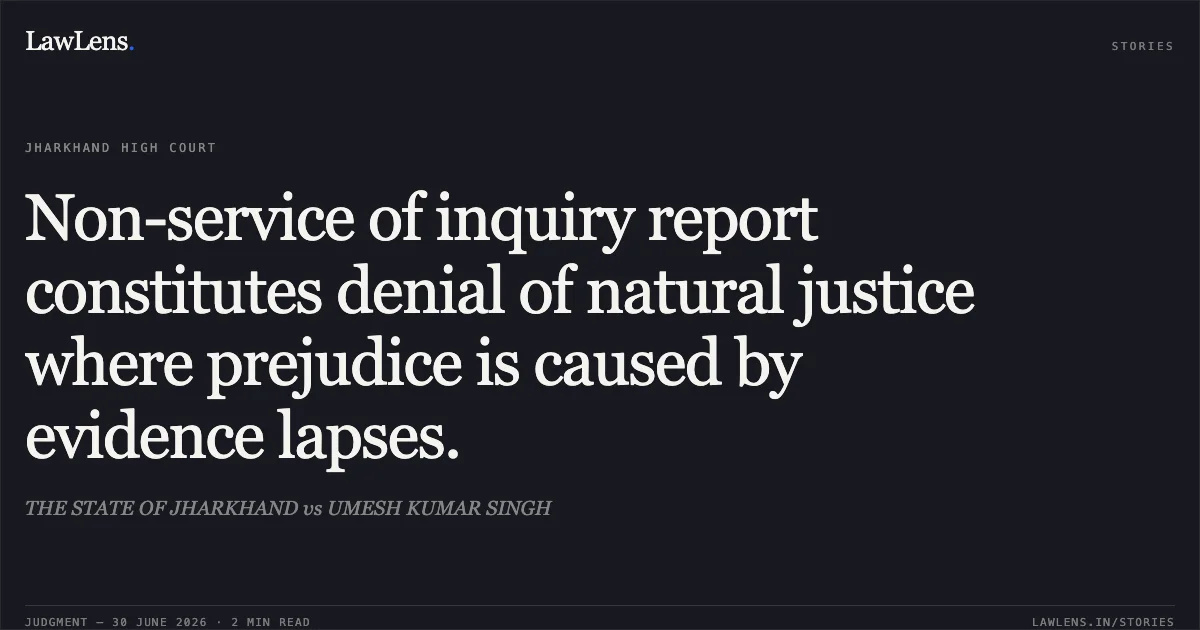
The court answered that the non-service of the inquiry report caused substantial prejudice and the departmental proceeding was conducted in violation of the principles of natural justice
The Division Bench upheld the Single Judge's order quashing the punishment and directed the extension of consequential benefits to the respondent. The Letters Patent Appeal was dismissed as devoid of merit
Source reference: para 5, 27, 28Acts & Sections Cited
7 provisions across 1 statute referred to in this judgment. Each provision opens on LawLens.
Indian Penal Code, 18607
Original Court PDF
THE STATE OF JHARKHANDvsUMESH KUMAR SINGH
Click to open original judgment
Original judgment, available to read, download and summarize on LawLens.in


