Facts
The dispute concerned ownership of a commercial unit originally acquired by a partnership firm.
Source reference: paras. 5–8; pp. 2–4The appellants and the first and second respondents became partners under a 1985 partnership deed containing an arbitration clause.
Source reference: paras. 5–8; pp. 2–4The appellants claimed that their purported 1995 retirement deed was forged and that the 1985 partnership continued; the first and second respondents relied on the subsequent retirement and partnership arrangements, under which the third and fourth respondents acquired interests in the subject asset.
Source reference: paras. 5–8; pp. 2–4The appellants sought arbitration under Section 11 of the Arbitration and Conciliation Act, 1996.
Source reference: paras. 5–8; pp. 2–4The High Court declined to include the third and fourth respondents because they were not signatories and did not fall within the recognised exceptions.
Source reference: paras. 5–8; pp. 2–4The Supreme Court considered whether they were nevertheless veritable parties to the dispute; limitation and estoppel issues were left open for the Arbitral Tribunal.
Source reference: paras. 5–8, 14–18; pp. 2–4, 7–9Issues
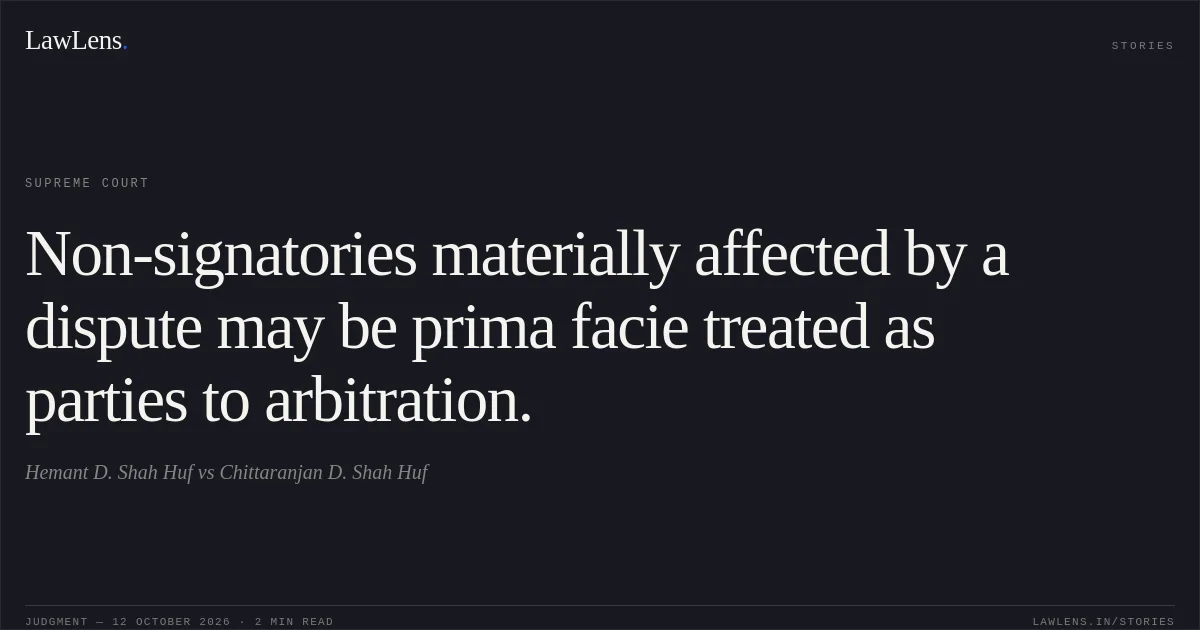
1. Whether the third and fourth respondents, though not signatories to the 1985 arbitration agreement, were veritable parties to the dispute and should be included in the arbitration
Source reference: paras. 4–5, 14–17; pp. 2, 7–92. Whether the questions of limitation and estoppel against including the third and fourth respondents were to be determined at the referral stage or left to the Arbitral Tribunal
Source reference: paras. 16, 18; pp. 9–10Law Applied
Section 11 of the Arbitration and Conciliation Act, 1996 empowers the referral court to consider, on a prima facie basis, whether a non-signatory is a party to the arbitration agreement; that determination does not displace the Arbitral Tribunal’s authority to decide the issue on the evidence and applicable legal principles.
Source reference: paras. 10–12; pp. 5–6Under Cox & Kings Ltd. v. SAP India Pvt. Ltd., the written-agreement requirement in Section 7 does not categorically exclude non-signatories, and a non-signatory may be bound where its relationship with signatories and conduct show an intention to be bound; the Group of Companies doctrine does not exclude other principles for binding non-signatories.
Source reference: paras. 10–12; pp. 5–6Hindustan Petroleum Corporation Ltd. v. BCL Secure Premises Pvt. Ltd. confirms that the referral court may assess whether a non-signatory is, in substance, a party, while preserving the Tribunal’s jurisdiction to decide the matter finally.
Source reference: para. 13; p. 7Reasoning
The dispute over the asset turned on whether the appellants’ alleged 1995 retirement was valid.
Source reference: paras. 14–16; pp. 7–9If it was invalid, the parties’ rights could revert to the 1985 partnership arrangement, potentially affecting the interests the third and fourth respondents derived through later partnership deeds.
Source reference: paras. 14–16; pp. 7–9Their rights were therefore substantially implicated in the very dispute referred to arbitration, making them veritable parties on a prima facie assessment, notwithstanding their non-signatory status.
Source reference: paras. 14–16; pp. 7–9The Court did not finally resolve whether they were bound by the arbitration agreement: the Tribunal retained authority to decide that question, along with limitation and estoppel.
Source reference: paras. 16, 18; pp. 9–10Holding
The appeal was disposed of by modifying the impugned order to hold, prima facie, that the third and fourth respondents were veritable parties to the arbitration despite not signing the 1985 partnership deed.
The questions of their ultimate status, limitation, and estoppel were left open for determination by the Arbitral Tribunal.
Source reference: paras. 16, 18; pp. 9–10Acts & Sections Cited
3 provisions across 1 statute referred to in this judgment. Each provision opens on LawLens.
Arbitration and Conciliation Act, 19963
Original Court PDF
Hemant D. Shah HufvsChittaranjan D. Shah Huf
Click to open original judgment
Original judgment, available to read, download and summarize on LawLens.in