Facts
The Appellants filed Indian Patent Application No. 202117006438 on February 16, 2021, for an invention titled "Technologies for Rapid Detection and Quantitation of Volatile Organic Compounds (VOCs) using Breath Samples"
Source reference: p. 1-2Following a First Examination Report (FER) issued on April 18, 2023, the Appellants submitted amended claims focusing on a breathalyzer system using a Terahertz (THz) spectrometer and a heating element for field detection of cannabinoids
Source reference: p. 2-3On January 31, 2025, the Respondent refused the application, citing lack of inventive step under Section 2(1)(ja), non-patentability under Section 3(i) (diagnostic methods), and insufficiency of disclosure under Section 10(4) and (5) of the Patents Act, 1970
Source reference: p. 2The Appellants challenged this order before the Delhi High Court, alleging the order was cryptic, unreasoned, and failed to apply established legal tests for inventive steps
Source reference: p. 4-5Issues
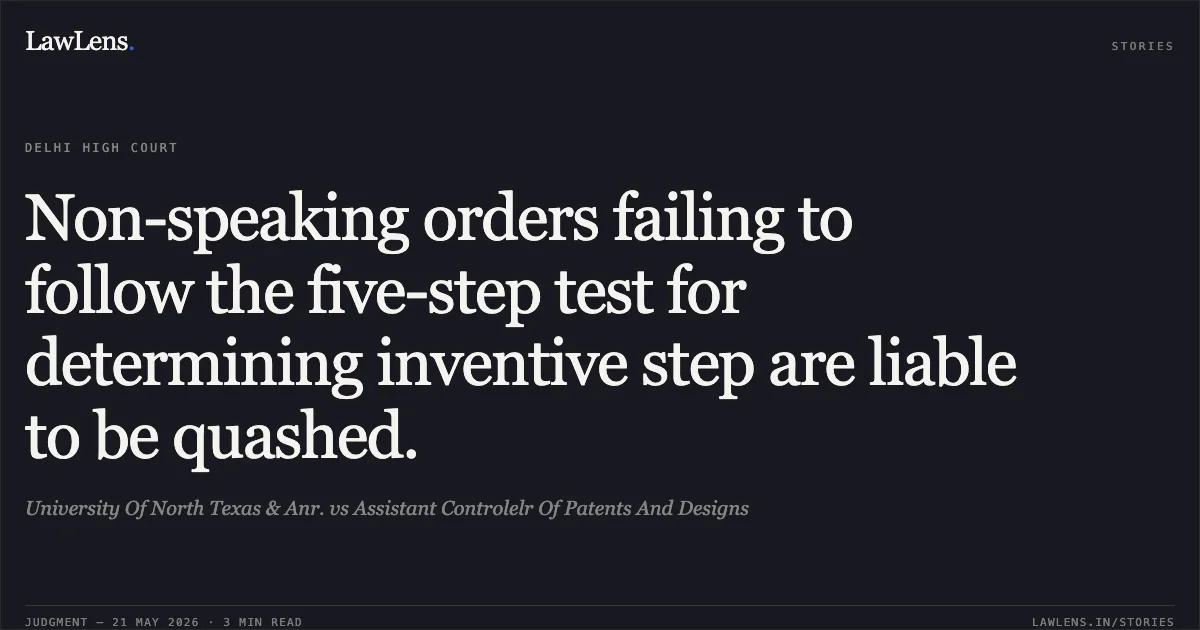
1. Whether the Respondent failed to follow the mandatory five-step test for determining "inventive step" and obviousness under Section 2(1)(ja)
Source reference: p. 5, 112. Whether the claimed invention constitutes a "diagnostic method" under Section 3(i)
Source reference: p. 8, 173. Whether the specifications provided sufficient disclosure under Section 10(4) regarding the "molecule collector" and "heating element"
Source reference: p. 6, 15Law Applied
Section 2(1)(ja) regarding "inventive step" and Section 3(i) regarding non-patentable diagnostic methods of the Patents Act, 1970
Source reference: p. 2-3The court relied on the five-step test for obviousness established in F. Hoffmann-La Roche Ltd. & Anr. v. Cipla Ltd. (2015) and reiterated in Tapas Chatterjee v. Assistant Controller (2025), which requires identifying the person skilled in the art and the inventive concept before assessing differences from prior art
Source reference: p. 4, 11The court also applied the framework from Agriboard International LLC v. Deputy Controller (2022), requiring a three-element analysis (prior art disclosure, subject invention disclosure, and manner of obviousness) for inventive step adjudication
Source reference: p. 3-4, 15Regarding Section 10(4), it cited JFE Steel Corporation v. Controller of Patents (2026), holding that a rejection for insufficiency must be supported by independent reasoning
Source reference: p. 15Reasoning
The Court observed that the Respondent failed to sequentially follow the mandatory steps for assessing obviousness, specifically failing to identify an "ordinary person skilled in the art" (Step 1) or correctly identify the "inventive concept" (Step 2)
Source reference: p. 11-12The Court found the Respondent’s conclusion—that substituting a SERS sensor with a THz spectrometer was a "routine optimization"—to be cryptic as it failed to analyze the specific technical differences highlighted by the Appellants and lacked a "hindsight approach" safeguards
Source reference: p. 12-14Regarding Section 10(4), the Court noted the Respondent ignored paragraphs [0027] and [0028] of the specification which detailed the "molecule collector" and "heating element"
Source reference: p. 16Finally, on Section 3(i), the Court held the Respondent failed to apply any legal test to determine if the method was truly "diagnostic," noting the invention was a field-detection tool for cannabinoids (DUIM) rather than a method for identifying a disease or disorder
Source reference: p. 17-18Holding
The Court answered the issues in the affirmative, holding that the impugned order was unreasoned and suffered from non-application of mind
The Court quashed and set aside the order dated January 31, 2025. It remanded the matter to the Respondent to reconsider Indian Patent Application No. 202117006438 afresh, directing the issuance of a detailed, speaking order within four months after providing the Appellants a fresh hearing
Source reference: p. 18Acts & Sections Cited
3 provisions across 1 statute referred to in this judgment. Each provision opens on LawLens.
Patents Act, 19703
Original Court PDF
University Of North Texas & Anr.vsAssistant Controlelr Of Patents And Designs
Click to open original judgment
Original judgment, available to read, download and summarize on LawLens.in