01Facts
The petitioner, while serving as a Junior Engineer at the Distribution Centre, Rajmilan, was implicated in an incident of electrocution on 09.07.2007 that resulted in the death of a minor.
¶ 2Following a civil court award directing the respondent company to pay compensation of Rs. 1,79,500/-, the company issued a show-cause notice to the petitioner.
¶ 2-3Despite the petitioner submitting a detailed reply on 21.02.2014, the disciplinary authority (Respondent No. 5) ordered a recovery of Rs. 87,413/- from his salary and imposed a punishment of "censure" without conducting a formal enquiry or providing a reasoned explanation.
¶ 3-4The petitioner's departmental appeal was subsequently dismissed via a non-speaking order on 09.02.2016.
¶ 302Issues
i.1. Whether the disciplinary and appellate authorities violated the principles of natural justice by passing non-speaking orders and failing to consider the petitioner’s reply to the show-cause notice.
¶ 6, 10ii.2. Whether the recovery of compensation and imposition of censure under Rule 16 of the M.P. Civil Services (Classification, Control and Appeal) Rules, 1966, was legally sustainable without recording specific findings of misconduct.
¶ 4, 1003Law Applied
Rule 16 of the M.P. Civil Services (Classification, Control and Appeal) Rules, 1966, which mandates the consideration of representations/replies submitted by delinquent employees before the imposition of minor penalties.
¶ 6, 10The doctrine that recording clear, cogent, and succinct reasons is an essential component of natural justice and a safeguard against arbitrary administrative action as established in Kranti Associates Private Limited and Anr. v. Masood Ahmed Khan and others (2010) 9 SCC 496.
¶ 7, 11, 12Precedent from coordinate bench in Manbahor Patel v. Managing Director and others (WP No. 1121/2017), which quashed similar non-speaking orders issued by the same respondents.
¶ 7, 1204Reasoning
The Court observed that while the petitioner had submitted a detailed explanation to the show-cause notice, the disciplinary authority's order dated 29.10.2015 was entirely silent on why that explanation was unacceptable.
¶ 10The Court reasoned that "reasons are the heart beat of the orders" and found that both the disciplinary and appellate authorities failed to demonstrate an application of mind to the grounds raised by the petitioner.
¶ 12By failing to assign reasons, the authorities violated the procedural requirements under Rule 16 of the 1966 Rules and the "due process" standards outlined in Kranti Associates.
¶ 11, 13The Court noted that even administrative or quasi-judicial decisions affecting a person's rights must be transparent and objective to sustain a litigant’s faith in the justice system.
¶ 1205Holding
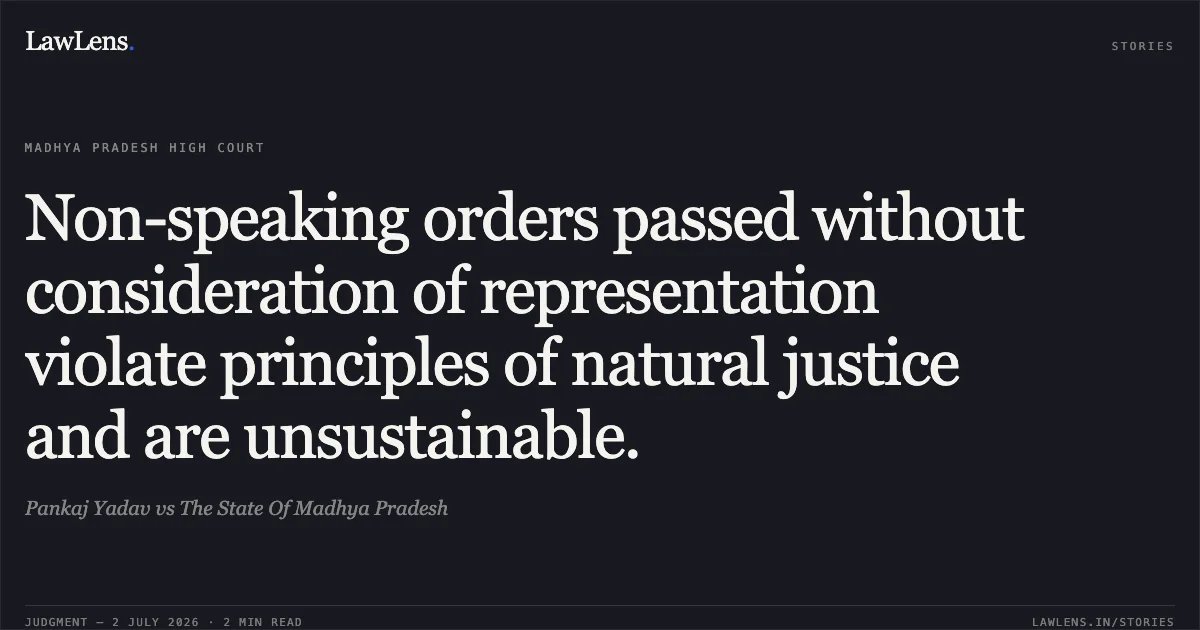
The court held that the orders were arbitrary and unsustainable due to the lack of reasoning.
¶ 13The High Court allowed the writ petitions and quashed the impugned recovery and censure orders dated 29.10.2015 and 09.02.2016, remitting the matter to the disciplinary authority to reconsider the case and pass a reasoned, speaking order within three months.
¶ 14Original Court PDF
Pankaj YadavvsThe State Of Madhya Pradesh
Click to open original judgment
Original judgment, available to read, download and summarize on LawLens.in