Facts
The respondents were engaged by Prasar Bharati on a contractual basis for fixed tenures (two years).
Source reference: no citationGunjan Varshney was appointed as Regional Sales Head in 2014.
Source reference: p. 2Her services were terminated in February 2015 via a one-month notice without assigning reasons, per Clause 6 of her contract.
Source reference: p. 3-4Srishti Shanker’s contract as Output Editor expired by efflux of time; she was subsequently offered a fresh contract at a reduced remuneration based on a Performance Appraisal Committee (PAC) recommendation.
Source reference: p. 15-16The Central Administrative Tribunal (CAT) quashed the termination/remuneration revision, holding that such actions violated principles of natural justice and citing that one set of contractual employees cannot be replaced by another.
Source reference: p. 5-7Issues
1. Whether the Central Administrative Tribunal (CAT) had jurisdiction to adjudicate service matters of contractual employees engaged by Prasar Bharati.
Source reference: p. 4 / para. 72. Whether the termination of a contractual employee via a "termination simpliciter" clause requires adherence to the principles of natural justice (audi alteram partem).
Source reference: p. 8 / para. 133. Whether an employer can be legally compelled to offer a renewed contract on the same financial terms after the original contract expires.
Source reference: p. 17 / para. 41Law Applied
Section 14(3)(b) of the Administrative Tribunals Act, 1985, affirming the Tribunal's jurisdiction over contractual employees of notified organizations.
Source reference: para. 7The Division Bench precedent in Union of India v. Satish Joshi, which establishes that a non-punitive discharge or non-extension of a contract does not attract the right to be heard.
Source reference: p. 8, para. 13-14Right to regularization principles established in Jaggo v. Union of India and State of Karnataka v. Uma Devi, noting these protections apply to long-term "back door" or irregular appointments rather than short-term contracts terminated under clear contractual "notice" clauses.
Source reference: p. 11-12, para. 20-22Reasoning
The Court reasoned that Gunjan Varshney’s termination was a "discharge simpliciter" under Clause 6 of her agreement, which allowed termination without assigning reasons.
Source reference: p. 13, para. 27Since the order was non-stigmatic and the respondent had served for less than a year, the CAT erred in requiring a full disciplinary procedure (show cause notice/hearing).
Source reference: p. 13, para. 25The Court observed that equity cannot override settled law regarding contract enforcement.
Source reference: p. 13, para. 26Regarding Srishti Shanker, the Court found there was no "mid-term" breach; the original contract expired, and the employer made a fresh offer at a lower rate based on PAC recommendations.
Source reference: p. 17, para. 39The Court held that a Tribunal cannot "foist" specific contractual terms upon an employer or compel it to renew a contract on identical terms once the previous term expires.
Source reference: p. 17, para. 41Holding
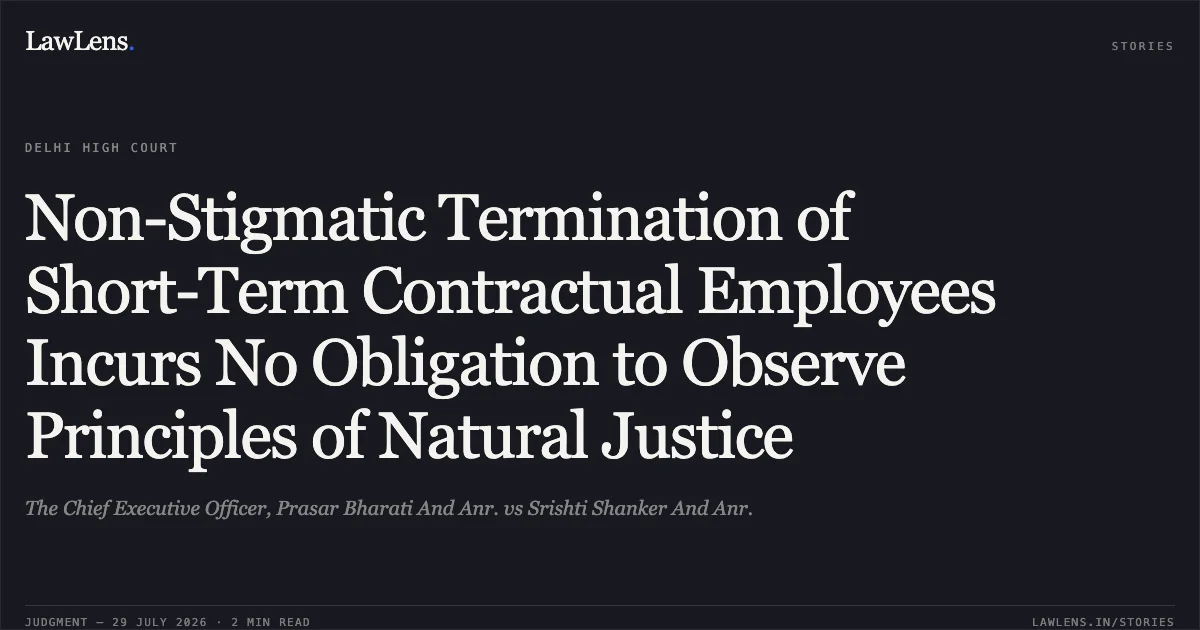
The Court held that natural justice is not required for a non-stigmatic termination of a short-term contract governed by a "notice" clause.
Both Writ Petitions were allowed, and the CAT’s orders quashing the termination of Varshney and the remuneration offer to Shanker were set aside. The Court dismissed the original OAs but directed, under the principle of actus curiae neminem gravabit, that no recoveries be made from Shanker for payments already received during the litigation.
Source reference: p. 14, para. 29; p. 18, para. 44, 46Acts & Sections Cited
2 provisions across 1 statute referred to in this judgment. Each provision opens on LawLens.
Prasar Bharati (Broadcasting Corporation of India) Act, 19902
Original Court PDF
The Chief Executive Officer, Prasar Bharati And Anr.vsSrishti Shanker And Anr.
Click to open original judgment
Original judgment, available to read, download and summarize on LawLens.in