01Facts
The petitioner was appointed as a Scientific Assistant (Biology) in 1976 and later promoted to Senior Scientific Officer (Biology) in 1984.
¶ 2Despite possessing an academic background in Zoology, he was attached to the Toxicology (Chemistry) Division in 1997. He submitted multiple representations stating he lacked the requisite Chemistry qualifications to perform toxicological duties.
¶ 3Consequently, he was issued a charge sheet on 09.08.2001 for misconduct due to his failure to perform duties in the Toxicology Division between 1997 and 1999.
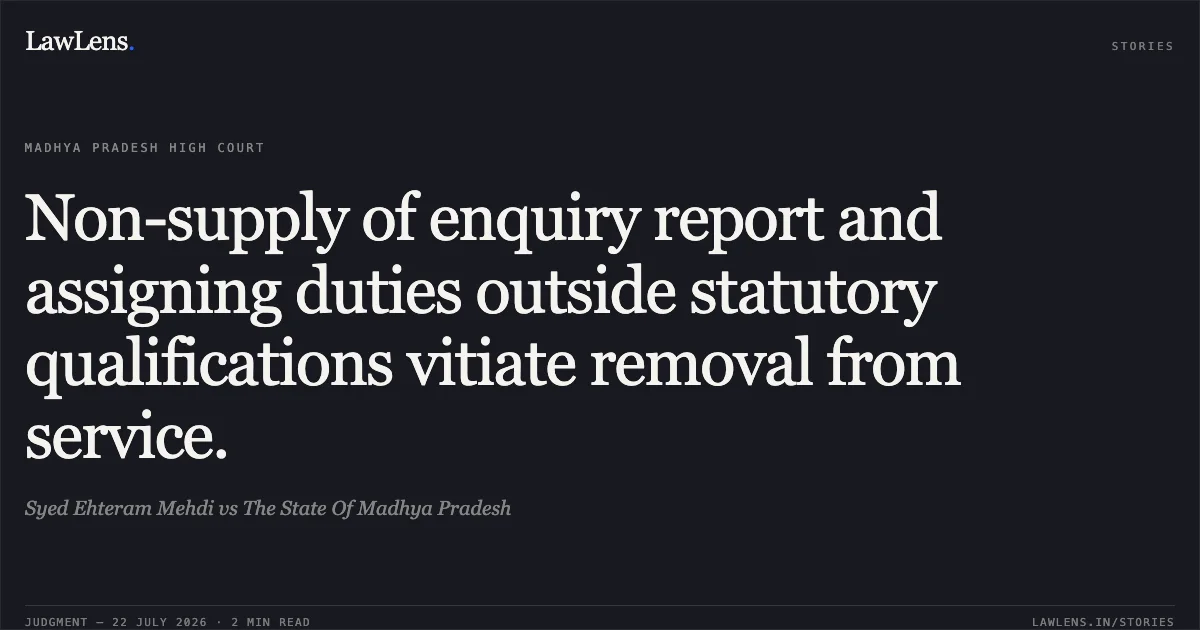
¶ 4Following a departmental enquiry, the State issued an order on 11.01.2012—just eight months prior to the petitioner’s superannuation—removing him from service.
¶ 5The petitioner challenged this order primarily on the grounds that the enquiry report was never supplied to him, violating principles of natural justice.
¶ 602Issues
i.1. Whether the assignment of toxicological duties to a specialist in Biology constituted a valid basis for a charge of misconduct.
¶ 15ii.2. Whether the non-supply of the enquiry officer’s report to the delinquent employee prior to the imposition of a major penalty vitiated the departmental proceedings.
¶ 16iii.3. Whether the penalty of removal from service was disproportionate and arbitrary given the petitioner's qualifications and service record.
¶ 8, 1503Law Applied
The Court applied the Madhya Pradesh Forensic Science Laboratory (Gazetted) Service Rules, 1993, which strictly separate the statutory qualifications and divisions for Biology and Chemistry.
¶ 14, 15The right to receive an enquiry report is a fundamental component of natural justice under Article 311 of the Constitution as established in Managing Director, ECIL v. B. Karunakar (1993).
¶ 16Any penalty imposed without providing the enquiry report is fundamentally flawed and legally unsustainable, even after the 42nd Amendment, as affirmed in State Bank of India v. Mohammad Badruddin (2019) and State of Uttar Pradesh v. Vinod Kumar Katheria (2021).
¶ 17, 18Provisions in the judgment · 1 · Linked ones open on LawLens
Code of Criminal Procedure, 1973 Section 293
04Reasoning
The Court found that under the 1993 Rules, the Biology and Chemistry divisions are distinct statutory categories; thus, expecting a Biology specialist to perform Chemistry-based toxicological work was "inherently arbitrary".
¶ 15The petitioner’s refusal was deemed professional responsibility rather than insubordination.
¶ 15The Court noted that the State admitted via RTI that the enquiry report dated 24.04.2008 was never supplied to the petitioner.
¶ 16The disciplinary authority further misrepresented to the Public Service Commission (PSC) that the report had been served, thereby vitiating the advisory process.
¶ 9, 17Applying the B. Karunakar framework, the Court observed that while the standard remedy is to remit the matter for a fresh enquiry from the stage of serving the report, such a course is impossible here as the petitioner exceeded the age of 70 and has already superannuated.
¶ 2005Holding
The Court allowed the writ petition and quashed the removal order dated 11.01.2012 and the relieving order dated 18.01.2012. The departmental enquiry was declared procedurally flawed.
¶ 21The Court directed the respondents to treat the petitioner as having been in continuous service until his superannuation on 30.09.2012. The State is ordered to pay full back wages, arrears of salary, and time-scale upgrades (Kramonnati) within 60 days, and restore all retiral benefits (pension, gratuity, etc.) with interest at 6% per annum from 01.10.2012 until payment.
¶ 21Original Court PDF
Syed Ehteram MehdivsThe State Of Madhya Pradesh
Click to open original judgment
Original judgment, available to read, download and summarize on LawLens.in