Facts
The applicant, a Deputy Director (then Assistant Commissioner of Customs), challenged a charge memorandum dated 23.02.2015 and a subsequent punishment order dated 13.05.2024.
Source reference: p. 1-2It was alleged that in 2012, the applicant released a detained consignment of 4,800 pieces of Phensedyl Cough Syrup at NSCBI Airport, Kolkata, without proper inquiry, violating the Customs Act, 1962, and the NDPS Act, 1985.
Source reference: p. 2-3The applicant contended that the release was a collective decision based on a Drug Inspector's report and approved by the Commissioner.
Source reference: p. 4Crucially, the original case file [S1(vii)-26/12] and the Airway Bill—the foundation of the charges—were declared "missing" by the respondents and not provided to the applicant during the inquiry.
Source reference: p. 6, 22The Tribunal had previously dismissed the OA, but the High Court of Madhya Pradesh remanded the matter for re-hearing on grounds of procedural irregularity and withholding of documents.
Source reference: p. 2, 16Issues
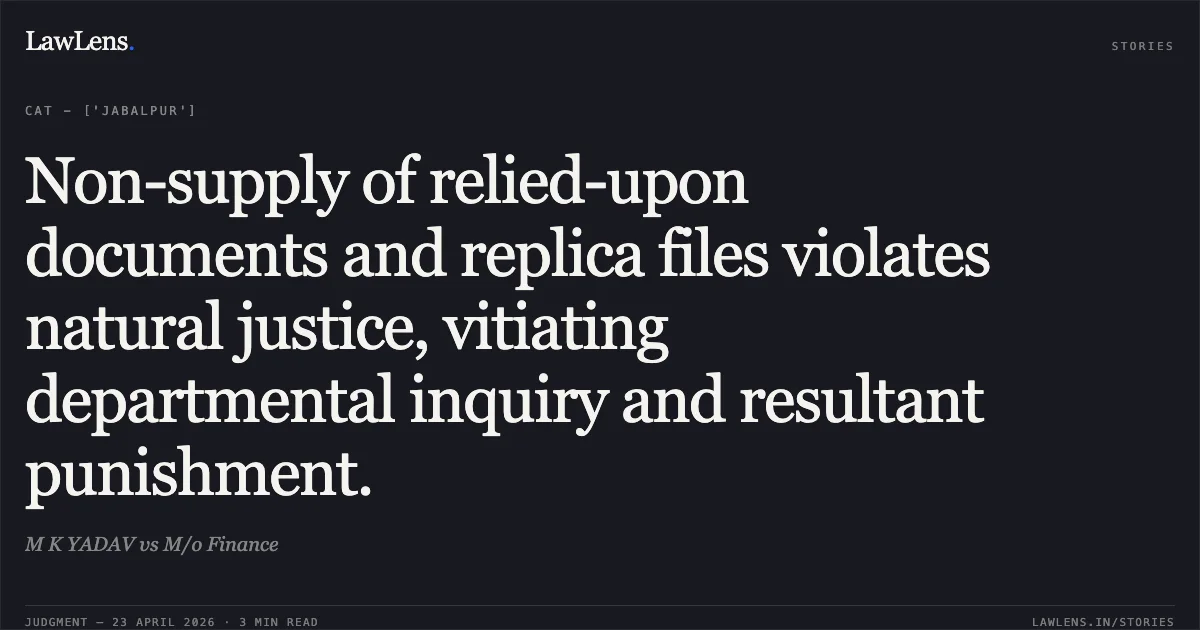
1. Whether the departmental inquiry was vitiated due to the non-supply of essential relied-upon documents (the original case file and Airway Bill), thereby violating principles of natural justice.
Source reference: p. 16, 232. Whether the findings of the Inquiry Officer were based on sufficient evidence or were legally untenable given the absence of the primary record.
Source reference: p. 26, 33Law Applied
The court primarily applied the Principles of Natural Justice, which mandate a fair and reasonable opportunity for a delinquent officer to defend themselves.
Source reference: p. 27, 32It relied on Rule 14 of the CCS (CCA) Rules, 1965, regarding the procedure for imposing major penalties.
Source reference: p. 15The court cited Union of India v. B.V. Gopinath, emphasizing the necessity of formal approval of the charge sheet by the Disciplinary Authority.
Source reference: p. 9It further applied the doctrine from Allahabad Bank v. Krishna Narayan Tewari, holding that a writ court can interfere if the inquiry is vitiated by the non-application of mind or unsupported by evidence.
Source reference: p. 27The court applied M.V. Bijlani v. Union of India, which establishes that an Inquiry Officer must arrive at a conclusion based on a preponderance of probability from the materials on record rather than surmises.
Source reference: p. 31Reasoning
The Tribunal found that the respondents committed a grave procedural error by denying the applicant access to necessary documents.
Source reference: p. 20, 23While the Inquiry Officer claimed the original file was "missing," evidence surfaced (a letter dated 27.09.2013) showing that a "replica file" containing note sheets and correspondence existed and had been forwarded to the Vigilance department.
Source reference: p. 20, 23The Tribunal reasoned that the failure to provide these documents, which formed the "basic foundation" of the investigation, made it impossible for the applicant to mount an effective defense.
Source reference: p. 25, 29Furthermore, the Airway Bill number and dates cited by the department were inconsistent, indicating a casual and unreliable investigation.
Source reference: p. 24The Tribunal determined that the Inquiry Officer’s conclusion—that the applicant was guilty despite the absence of the file—was legally unsustainable and "shocks the judicial conscience".
Source reference: p. 26, 32Holding
The Tribunal held that the charges were not substantiated by evidence on record and the inquiry proceedings were vitiated by the violation of the principles of natural justice.
The court quashed and set aside the charge sheet dated 23.02.2015, the Inquiry Officer's report, and the punishment order dated 13.05.2024. The respondents were directed to grant all consequential benefits to the applicant within three months.
Source reference: p. 33Acts & Sections Cited
2 provisions across 2 statutes referred to in this judgment. Linked provisions open on LawLens.
Customs Act, 19621
Narcotic Drugs And Psychotropic Substances Act, 19851
Original Court PDF
M K YADAVvsM/o Finance
Click to open original judgment
Original judgment, available to read, download and summarize on LawLens.in