Facts
The Appellant (DVC), a statutory body under the DVC Act, 1948, operates as a vertically integrated utility performing generation, transmission, and distribution functions
Source reference: p. 3-4While the Central Electricity Regulatory Commission (CERC) determines tariffs for DVC’s generating stations and unified transmission and distribution (T&D) systems, the State Commissions (JSERC and WBERC) determine retail supply tariffs
Source reference: p. 4DVC appealed the JSERC order dated 27.05.2025, which, during the True-up of FY 2023-24 and ARR for FY 2025-26, treated various items of "Other Income" (e.g., interest on employee loans, sale of scrap, rental income) as Non-Tariff Income (NTI) for DVC's distribution business in Jharkhand
Source reference: p. 4-7DVC contended that since CERC regulates the T&D assets, JSERC lacked jurisdiction to include income from those assets as NTI for distribution
Source reference: p. 6-7Issues
1. Whether JSERC has the jurisdiction to consider income derived from assets whose tariff is regulated by CERC as Non-Tariff Income (NTI) for the purpose of determining distribution tariff.
Source reference: p. 36-37 / para. 87-912. Whether the lack of identified distribution assets justifies the inclusion of all "Other Income" heads from the power business as NTI for the distribution segment.
Source reference: p. 37-41 / para. 91-97Law Applied
Section 62(2) of the Electricity Act, 2003, which empowers Commissions to require licensees to furnish separate details for generation, transmission, and distribution for tariff determination
Source reference: p. 52, para. 112Principle established in prior Tribunal judgments (Appeals 845 of 2023 and 332 of 2024) that the authority regulating the tariff for a particular segment is alone competent to determine associated cost and revenue elements, including NTI
Source reference: p. 33-36, para. 86-87Fourth Proviso to Section 14 of the Electricity Act and Sections 33, 45, and 47 of the DVC Act, holding that the DVC Act does not prohibit the segregation of accounts for "electrical energy" into sub-segments for regulatory transparency
Source reference: p. 53-55, para. 114-117Reasoning
The Tribunal reasoned that a "distribution system" consists of the physical infrastructure, while "distribution business" encompasses the commercial aspects of supply
Source reference: p. 38-39Currently, CERC determines the Annual Fixed Charges (AFC) for DVC’s integrated T&D network, including O&M and human asset costs; therefore, any NTI emanating directly from these physical assets (like sale of scrap or rental of buildings) falls under CERC's regulatory domain
Source reference: p. 40-42The Tribunal found that JSERC’s inclusion of items linked to employees, contractors, and fixed assets (Items j to y in the Impugned Order) resulted in double regulatory oversight, as these are already factored into the CERC-regulated T&D tariff
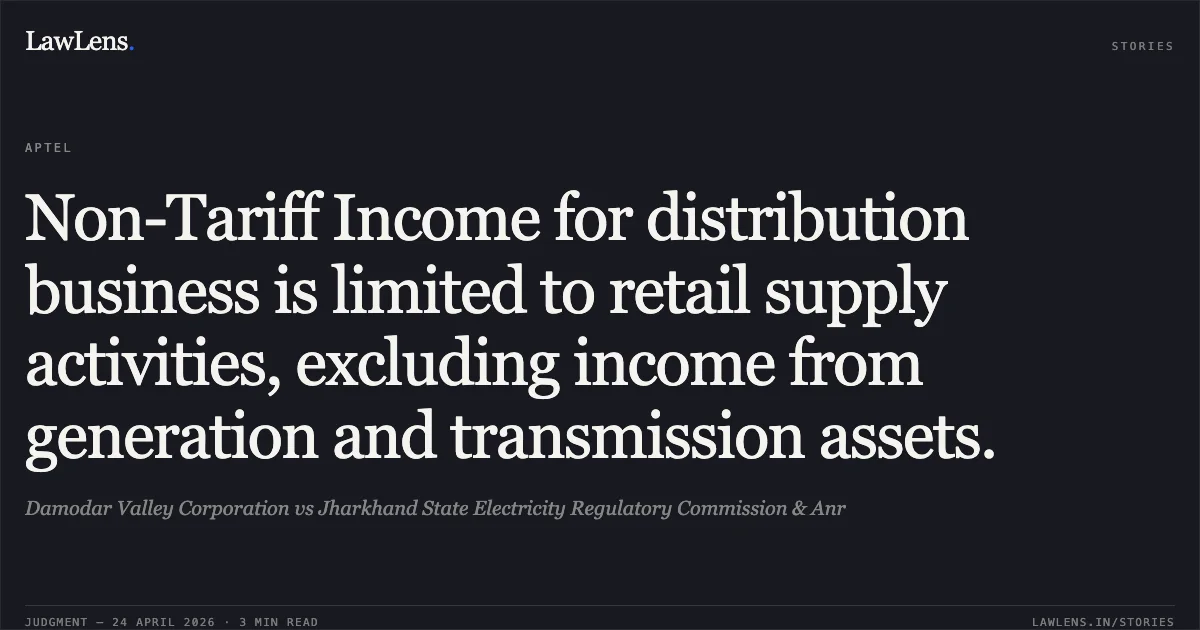
Source reference: p. 42-43Consequently, only the "Delayed Payment Surcharge" (DPS), which arises from the retail supply business regulated by JSERC, qualifies as NTI for the distribution ARR
Source reference: p. 44, para. 102The Tribunal also rejected DVC’s claim that its statutory accounting under the DVC Act prevents segregation, noting that Section 62(2) of the Electricity Act provides an independent mandate for detailed accounting to ensure cost-reflective tariffs
Source reference: p. 52-53Holding
The Tribunal allowed the appeal in part, setting aside JSERC's findings regarding the determination of NTI for items other than Delayed Payment Surcharge
JSERC was directed to re-compute the tariff considering only DPS as NTI; ordered JSERC to identify DVC's distribution assets in Jharkhand within six months and directed DVC to segregate its accounts into distribution, transmission, and generation with effect from 01.04.2027 in consultation with the CAG
Source reference: p. 60, Order (ii), (iii-iv)Acts & Sections Cited
22 provisions across 3 statutes referred to in this judgment. Each provision opens on LawLens.
Damodar Valley Corporation Act, 19485
Electricity Act, 2003
Companies Act, 20131
Original Court PDF
Damodar Valley CorporationvsJharkhand State Electricity Regulatory Commission & Anr
Click to open original judgment
Original judgment, available to read, download and summarize on LawLens.in