Facts
On August 31, 2021, the deceased, Pitchamani, was riding his two-wheeler on the Usilampatti–Patelangur Road when he was struck by a bus belonging to the appellant Transport Corporation, which was being driven in a rash and negligent manner.
Source reference: para. 2.1Pitchamani succumbed to his injuries, prompting his dependents to file a claim petition (M.C.O.P. No. 662 of 2022) seeking compensation.
Source reference: para. 2.2The Motor Accidents Claims Tribunal, Dindigul, held the bus driver primarily responsible but attributed 7% contributory negligence to the deceased for failing to wear a helmet.
Source reference: para. 3.1The Tribunal awarded a total compensation of Rs. 28,85,790/-, calculating the deceased's monthly income at Rs. 18,000/-.
Source reference: para. 3.2The Transport Corporation appealed this award, seeking to increase the percentage of contributory negligence and challenging the income assessment.
Source reference: para. 4Issues
1. Whether the Tribunal was justified in fixing only 7% contributory negligence on the deceased for non-wearing of a helmet, or if it required enhancement.
Source reference: para. 7.12. Whether the fixation of the deceased’s monthly income at Rs. 18,000/- was reasonable and legally sustainable.
Source reference: para. 7.2Law Applied
The Court applied the principles of negligence and quantum assessment under the Motor Vehicles Act, 1988.
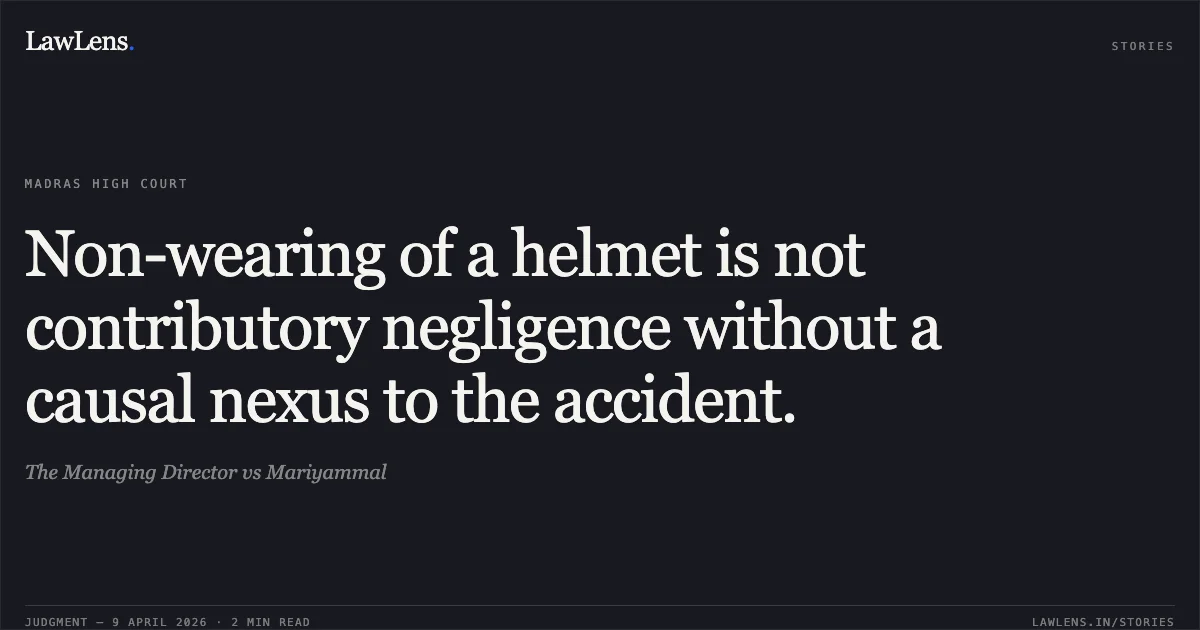
Source reference: para. 9It relied on the settled legal position that a mere statutory violation, such as non-wearing of a helmet, does not automatically constitute contributory negligence unless a causal nexus exists between the violation and the accident's occurrence.
Source reference: para. 9For the assessment of income, the Court followed the precedents set in Syed Sadiq v. Divisional Manager, United India Insurance Co. Ltd. (2014) 2 SCC 735 and Andal v. Avinav Kannan 2019 (1) TNMAC 54 (DB), which advocate for the adoption of a reasonable notional income based on the nature of the avocation and prevailing economic conditions in the absence of strict documentary evidence.
Source reference: para. 10.2Reasoning
The Court first confirmed the bus driver's negligence, noting that the FIR and departmental proceedings supported the testimony of P.W.1 and P.W.2.
Source reference: para. 8.1Addressing contributory negligence, the Court reasoned that the primary purpose of a helmet is to minimize the severity of head injuries (safety measure) rather than to prevent the accident itself (causative factor).
Source reference: para. 9It held that unless it is established that the violation had a direct connection to the impact or the cause of the accident, a heavy deduction for contributory negligence is unwarranted.
Source reference: para. 9Finding no evidence of negligent riding by the deceased, the Court upheld the 7% deduction as a balanced view.
Source reference: para. 9Regarding the quantum, the Court found the fixation of Rs. 18,000/- per month justified by the testimony of P.W.3, which established the deceased’s wood contract business, and by judicial precedents regarding notional income for self-employed individuals.
Source reference: para. 10.2Holding
The Court held that there was no merit in increasing the contributory negligence beyond 7% solely for the non-wearing of a helmet, nor was there any perversity in the income fixation, which was grounded in oral evidence and the rising cost of living.
The High Court dismissed the Civil Miscellaneous Appeal and confirmed the Tribunal’s award of Rs. 28,85,790/-; no costs were ordered.
Source reference: para. 11.2Acts & Sections Cited
1 provisions across 1 statute referred to in this judgment. Each provision opens on LawLens.
Motor Vehicles Act, 19881
Original Court PDF
The Managing DirectorvsMariyammal
Click to open original judgment
Original judgment, available to read, download and summarize on LawLens.in