Facts
On 02 January 2018, the deceased was riding a motorcycle when it collided with a truck bearing registration No. GJ-12-BV-3959. The truck was insured, and the insurer’s liability to satisfy the compensation was undisputed.
Source reference: para. 1The Motor Accident Claims Tribunal held the truck driver 90% negligent and the deceased 10% negligent, assessed the deceased’s monthly income at Rs. 21,354, applied a multiplier of 15, and awarded compensation.
Source reference: para. 2The claimants appealed, challenging the finding of contributory negligence and the assessment of income; the insurer and owner accepted the Tribunal’s award.
Source reference: para. 3The truck driver had fled the accident scene, remained absconding, and was charge-sheeted in the criminal proceedings.
Source reference: paras. 4, 6–7The deceased’s income-tax records disclosed business/professional income and agricultural income.
Source reference: para. 13Issues
Whether the deceased could be held contributorily negligent to the extent of 10% merely because the accident was a head-on collision on a highway and he was allegedly not wearing a helmet.
Source reference: paras. 6–10Whether the deceased’s monthly income was correctly assessed by excluding the agricultural income and whether the compensation required enhancement.
Source reference: paras. 12–17Whether the claimants were entitled to full compensation from the insurer, together with interest and consequential directions.
Source reference: paras. 11, 17–20Law Applied
In proceedings under the Motor Vehicles Act, negligence is determined on the basis of the preponderance of probabilities, and the filing of a charge sheet against the offending vehicle’s driver constitutes prima facie evidence of negligence.
Source reference: para. 8In the absence of evidence establishing negligence by the deceased, contributory negligence cannot be inferred merely from the fact of a head-on collision.
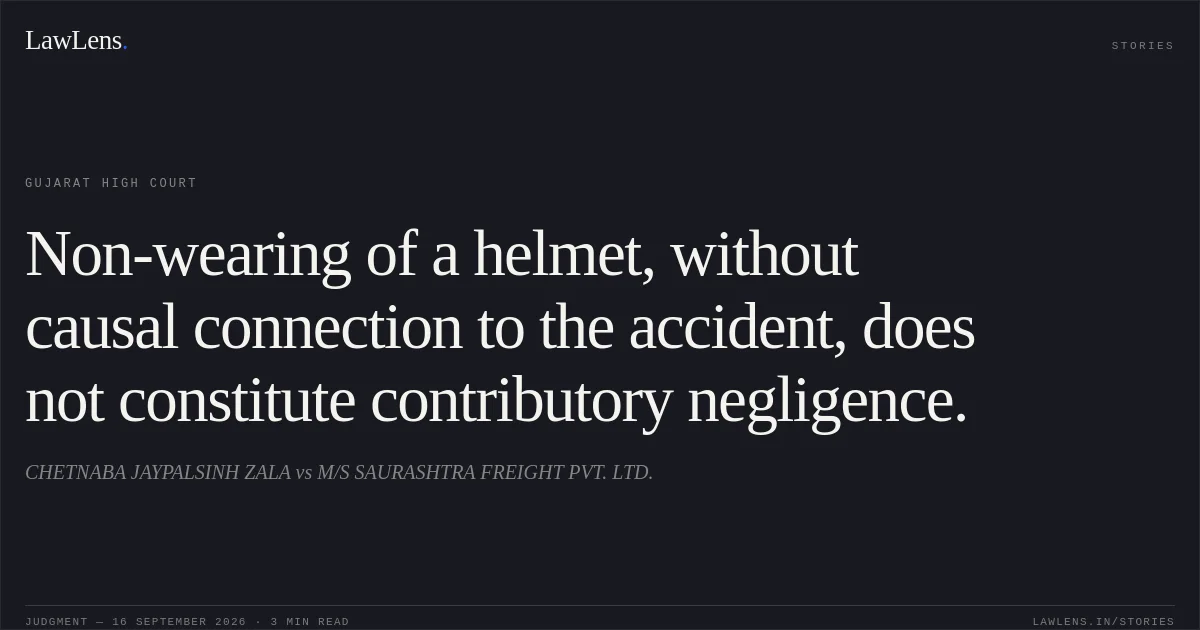
Source reference: para. 9Failure to wear a helmet may constitute a traffic offence but does not, by itself, establish causation or contribution to the occurrence of the accident, applying Anjana Narayan Kamble v. Branch Manager, Reliance General Insurance Co. Ltd., 2022 (0) AIJEL-SC 70720.
Source reference: para. 10Future prospects and the appropriate multiplier were assessed in accordance with National Insurance Co. Ltd. v. Pranay Sethi, while consortium and other conventional heads were determined with reference to Reena v. Managing Director, Karnataka State Road Transport Corporation, 2026 (0) AIJEL-SC 77486.
Source reference: paras. 16–17Reasoning
The Court held that the truck driver’s fleeing from the scene, continued abscondence, and being charge-sheeted supported the finding that he was responsible for the accident.
Source reference: paras. 7–9Since the driver neither appeared to provide evidence nor was there any eyewitness evidence proving negligence by the deceased, the Tribunal had no basis to attribute 10% contributory negligence to the deceased merely because the collision occurred on a highway and was head-on.
Source reference: paras. 7–9The Court further held that non-use of a helmet did not cause the accident and therefore could not justify any deduction from the compensation.
Source reference: para. 10On quantum, the Court assessed business income at Rs. 22,000 per month after considering the income-tax returns and the possibility that part of the declared income represented fixed-deposit interest.
Source reference: paras. 12–14It additionally treated Rs. 10,000 per month as the deceased’s contribution towards supervision of the agricultural activities, notwithstanding that the agricultural income itself continued after his death.
Source reference: para. 15Thus, monthly income was fixed at Rs. 32,000; 40% was added for future prospects, one-fourth was deducted towards personal expenses, and a multiplier of 15 was applied, resulting in a loss of future income of Rs. 60,48,000.
Source reference: para. 16Holding
The appeal was partly allowed. The finding attributing 10% negligence to the deceased was set aside, and the truck driver was held completely responsible for the accident; consequently, the insurer was held liable to satisfy the entire compensation.
The total compensation was enhanced to Rs. 63,47,000, comprising Rs. 60,48,000 for loss of future income, Rs. 2,60,000 for loss of consortium, Rs. 19,500 for loss of estate, and Rs. 19,500 towards funeral expenses.
Source reference: para. 17The enhanced amount was stated to be Rs. 29,15,832, with interest at 9% per annum continuing as awarded by the Tribunal.
Source reference: paras. 17–18The insurer was directed to deposit the additional compensation with interest within eight weeks from receipt of the judgment.
Source reference: paras. 19–20Original Court PDF
CHETNABA JAYPALSINH ZALAvsM/S SAURASHTRA FREIGHT PVT. LTD.
Click to open original judgment
Original judgment, available to read, download and summarize on LawLens.in