Facts
The appellant, Dhiraj Dutta, was the sole executor and beneficiary of a Will dated July 9, 1989, executed by Smt. Gouriprova Sen
Source reference: p. 2Probate of the Will was granted on September 28, 1995
Source reference: p. 2In 2010-11, the appellant initiated mutation proceedings based on this probate; notices for these proceedings were served upon the respondents’ predecessors in 2013
Source reference: p. 2, 5The respondents, who are nephews-in-law of the testatrix, claimed they only discovered the probate in 2019 and subsequently filed a lawsuit for declaration and injunction
Source reference: p. 2On July 5, 2022, the respondents filed an application under Section 263 of the Indian Succession Act (ISA) for revocation of the 1995 probate
Source reference: p. 2The Single Judge dismissed the application as time-barred, but the Division Bench reversed this decision on appeal
Source reference: p. 3Issues
1. Whether the application for revocation of probate filed in 2022 was barred by the law of limitation under Article 137 of the Limitation Act, 1963
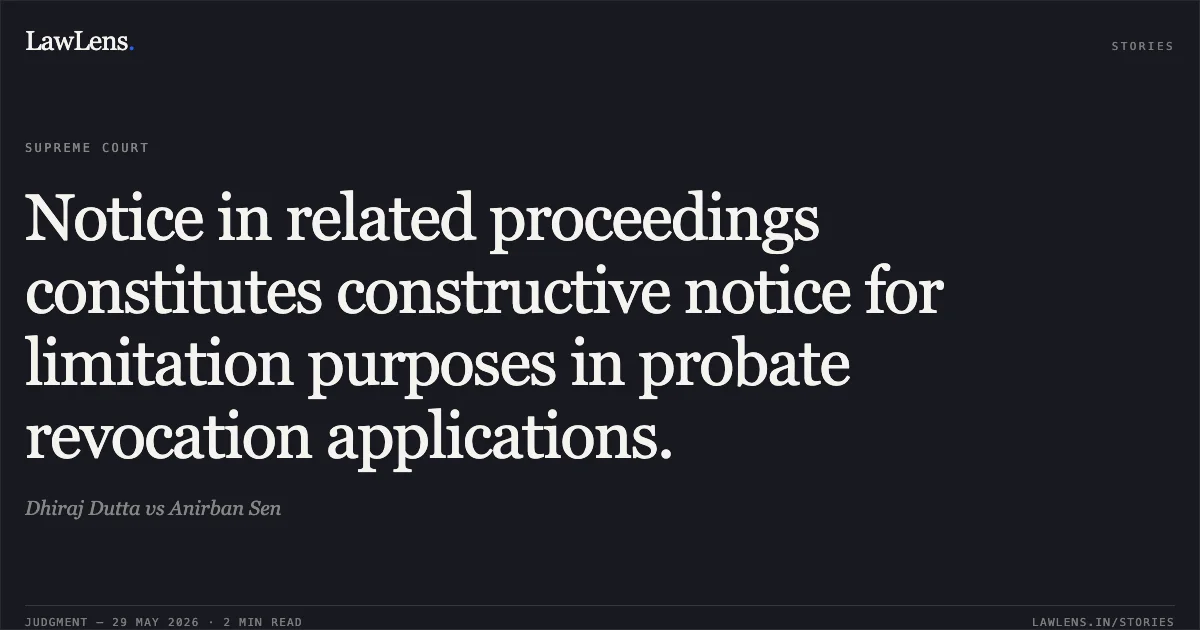
Source reference: p. 32. Whether service of notice in mutation proceedings constitutes constructive notice of the grant of probate to the respondents
Source reference: p. 6Law Applied
Section 263 of the Indian Succession Act, 1925, which provides for the revocation or annulment of a probate grant for "just cause," such as defective proceedings or fraud
Source reference: p. 3Article 137 of the Limitation Act, 1963, which stipulates a three-year limitation period from the date "when the right to apply accrues"
Source reference: p. 4Reliance was placed on Lynette Fernandes v. Gertie Mathias and Ramesh Nivrutti Bhagwat v. Surendra Manohar Parakhe to establish that the right to apply accrues from the date the applicant acquires knowledge
Source reference: p. 5Principles from Rajasthan Housing Board v. New Pink City Nirman Sahkari Samiti Ltd. and Ahmedabad Municipal Corpn. v. Haji Abdulgafur Haji Hussenbhai, establishing that a party is deemed to have notice if they willfully abstain from inquiry or show gross negligence
Source reference: p. 6-7Reasoning
The court analyzed whether the 2013 notice regarding mutation proceedings served as "constructive notice" of the probate grant. It observed that the respondents admitted receiving the 2013 notice but chose to ignore it because they already had mutation entries in their favor
Source reference: p. 6-7The court applied the "reasonably prudent man" standard, determining that a prudent person, upon receiving a court notice regarding property mutation initiated by a third party, is expected to investigate the basis of such a claim
Source reference: p. 7-8The court found that the respondents’ failure to inquire into the appellant’s claim (which was based on the probate) constituted a lack of due diligence. Consequently, the "right to apply" for revocation accrued in 2013, not 2019, when the respondents were first put on notice regarding the appellant's adverse claims over the property
Source reference: p. 8-9Holding
The Court held that the respondents’ application for revocation of probate, filed in 2022, was "hopelessly time-barred" under Article 137 of the Limitation Act
The Supreme Court allowed the appeal, set aside the judgment of the Division Bench, and restored the order of the Single Judge dismissing the revocation application. Costs were made easy
Source reference: p. 9Acts & Sections Cited
2 provisions across 2 statutes referred to in this judgment. Each provision opens on LawLens.
Indian Succession Act, 19251
Limitation Act, 19631
Original Court PDF
Dhiraj DuttavsAnirban Sen
Click to open original judgment
Original judgment, available to read, download and summarize on LawLens.in