Facts
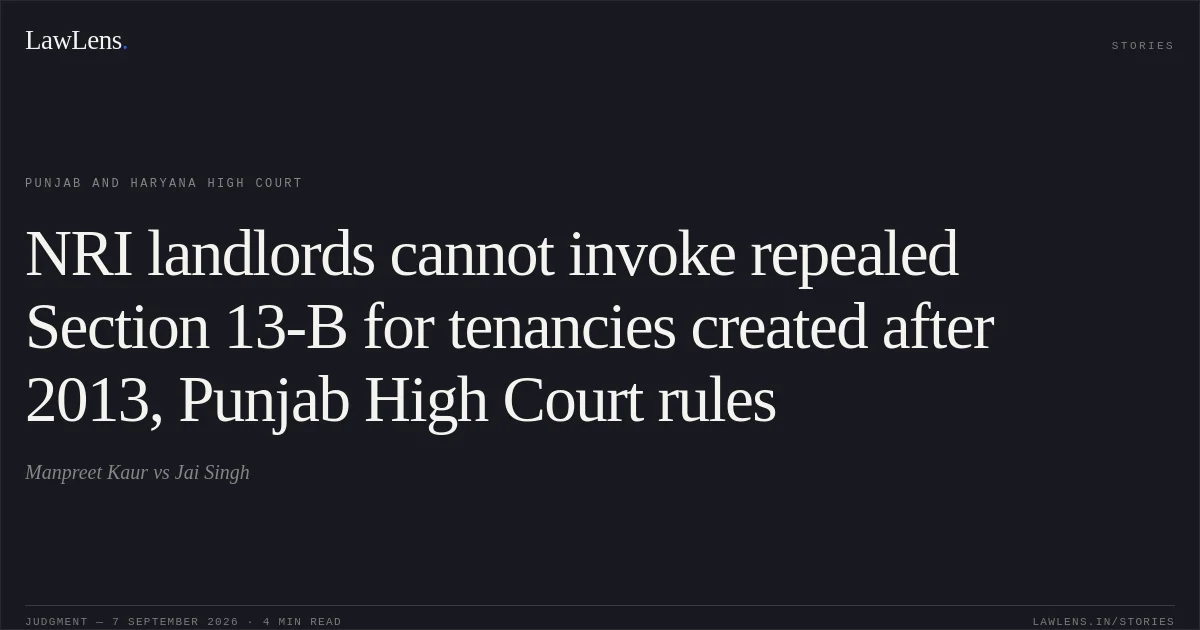
The respondent-landlord, claiming to be a Non-Resident Indian permanently settled in Canada, instituted an ejectment petition on 29 April 2021 under Section 13-B of the East Punjab Urban Rent Restriction Act, 1949 (“1949 Act”), alleging bona fide personal requirement of the residential premises.
Source reference: para. 3He had purchased the plot by registered sale deed dated 24 May 2012, constructed the building thereafter, and let it to the petitioner-tenant on 17 January 2020 at a monthly rent of ₹20,000.
Source reference: para. 3The tenant sought leave to contest. The Rent Controller initially held that, since the Punjab Rent Act, 1995 (“1995 Act”) had come into force on 30 November 2013, the landlord should amend the petition to bring it within Section 24(3) of the 1995 Act.
Source reference: para. 4On the landlord’s application for reconsideration, the Rent Controller held that the premises were exempt under Section 3(1) of the 1995 Act, treated the petition under Section 13-B of the repealed 1949 Act as maintainable, dismissed the tenant’s leave-to-contest application, and ordered ejectment on 12 August 2021.
Source reference: para. 7The tenant challenged that order in revision.
Source reference: no citationIssues
Whether the Rent Controller could review or reconsider its earlier order without an express statutory power of review.
Source reference: paras. 8, 29–30Whether the premises were exempt from the operation of the 1995 Act under Section 3(1)(c) merely because the landlord had purchased the plot in 2012 and constructed the building thereafter, without a finding regarding the date of completion of construction.
Source reference: paras. 9, 14–18Whether an ejectment petition instituted in 2021 under Section 13-B of the 1949 Act was maintainable when that Act had been repealed on 30 November 2013 and the tenancy had commenced only in 2020.
Source reference: paras. 19, 27–28Whether the landlord could invoke the special NRI remedy under Section 24(3) of the 1995 Act when the premises had been let out after commencement of that Act.
Source reference: paras. 23–26Law Applied
Section 75 of the 1995 Act repealed the 1949 Act while saving rights, privileges, obligations, liabilities, and proceedings that had already accrued or existed under the repealed enactment; a savings clause preserves accrued rights but does not create a fresh right after repeal.
Source reference: paras. 13, 27–28Under Section 3(1)(c) of the 1995 Act, premises constructed on or after commencement of the Act are exempt for fifteen years from the date of completion of construction; the statutory Explanation determines that date by reference to intimation to the concerned authority or assessment to property tax, whichever is earlier.
Source reference: para. 14The exemption therefore depends on the date of construction/completion, not the date of acquisition of the land.
Source reference: paras. 15–16Section 24(3) of the 1995 Act permits an NRI owner to seek immediate possession of premises let out on or before commencement of the Act for the owner’s use or that of a dependent family member.
Source reference: para. 23In Krishan Kumar v. Kamla Devi and Sharanjeet Singh v. Harsimran Singh Manchanda, the Court held that NRI eviction proceedings instituted after commencement of the 1995 Act must satisfy the statutory scheme of that Act.
Source reference: paras. 20–21Under Patel Narshi Thakershi v. Pradyumansinghji Arjunsinghji, an authority cannot exercise substantive review jurisdiction unless conferred by statute.
Source reference: para. 29Reasoning
The Rent Controller’s reconsideration of its order dated 19 July 2021 was impermissible because no statutory power of substantive review was shown, and the landlord had sought reconsideration instead of pursuing an appropriate remedy against that order.
Source reference: para. 29In any event, the subsequent order could not be sustained on merits.
Source reference: no citationThe landlord’s purchase of the plot in 2012 did not establish that the building was constructed or completed before or after commencement of the 1995 Act; the date of completion had to be determined in accordance with the statutory Explanation to Section 3(1)(c).
Source reference: paras. 15–18, 31More fundamentally, the tenancy was created on 17 January 2020, long after the 1949 Act had been repealed. Consequently, no right under Section 13-B had accrued before repeal and could be preserved by Section 75.
Source reference: paras. 19, 27–28The landlord also could not shift to Section 24(3) of the 1995 Act, because that provision applies only to premises let out on or before 30 November 2013, whereas the present tenancy commenced in 2020.
Source reference: paras. 23–26Thus, regardless of whether the premises were exempt under Section 3(1)(c), the special eviction remedy under Section 13-B was unavailable: exemption from the 1995 Act could not revive the repealed 1949 Act, while application of the 1995 Act did not assist the landlord because Section 24(3) was temporally inapplicable.
Source reference: paras. 31–33Holding
The revision petition was allowed.
The order dated 12 August 2021 dismissing the tenant’s leave-to-contest application and directing ejectment was set aside.
Source reference: para. 36The ejectment petition under Section 13-B of the repealed 1949 Act was held not maintainable because the tenancy was created after repeal and no accrued right had been saved under Section 75 of the 1995 Act.
Source reference: para. 37The landlord was left at liberty to pursue any other remedy available in law, without any determination on the merits of his alleged bona fide requirement or on the parties’ rights under another applicable statutory or general law.
Source reference: paras. 37–38Acts & Sections Cited
4 provisions across 2 statutes referred to in this judgment. Linked provisions open on LawLens.
East Punjab Urban Rent Restriction Act, 19491
Punjab Rent Act, 19953
Original Court PDF
Manpreet KaurvsJai Singh
Click to open original judgment
Original judgment, available to read, download and summarize on LawLens.in