Facts
The dispute concerned a passage measuring approximately nine feet, described as a “14 Kari Rasta,” situated between the parties’ properties.
Source reference: paras. 3–4; pp. 2–3The petitioner claimed that the passage had been left by his father for use by both branches of the family and the general public and had been used for several decades.
Source reference: paras. 3–4; pp. 2–3He alleged that the opposite parties obstructed the passage by installing a “Jafari”.
Source reference: paras. 3–4; pp. 2–3An agreement dated 16 November 2011 acknowledged the arrangement concerning use of the passage.
Source reference: paras. 5–7; pp. 2–3A Karamchari’s report dated 30 June 2017 recorded the existence of a passage, while the Anchal-Amin’s measurement report dated 16 August 2017 stated that only approximately seven Kari remained available and that the rest had been covered by the obstruction.
Source reference: paras. 5–7; pp. 2–3The Sub-Divisional Magistrate, Madhepura initiated proceedings under Section 147 Cr.P.C. and, by order dated 4 October 2017, directed removal of the obstruction.
Source reference: para. 8; p. 4In revision, the Additional Sessions Judge-III, Madhepura set aside the S.D.M.’s order on the ground that the dispute was civil in nature and ought to be decided by a Civil Court.
Source reference: paras. 9–10; p. 4Issues
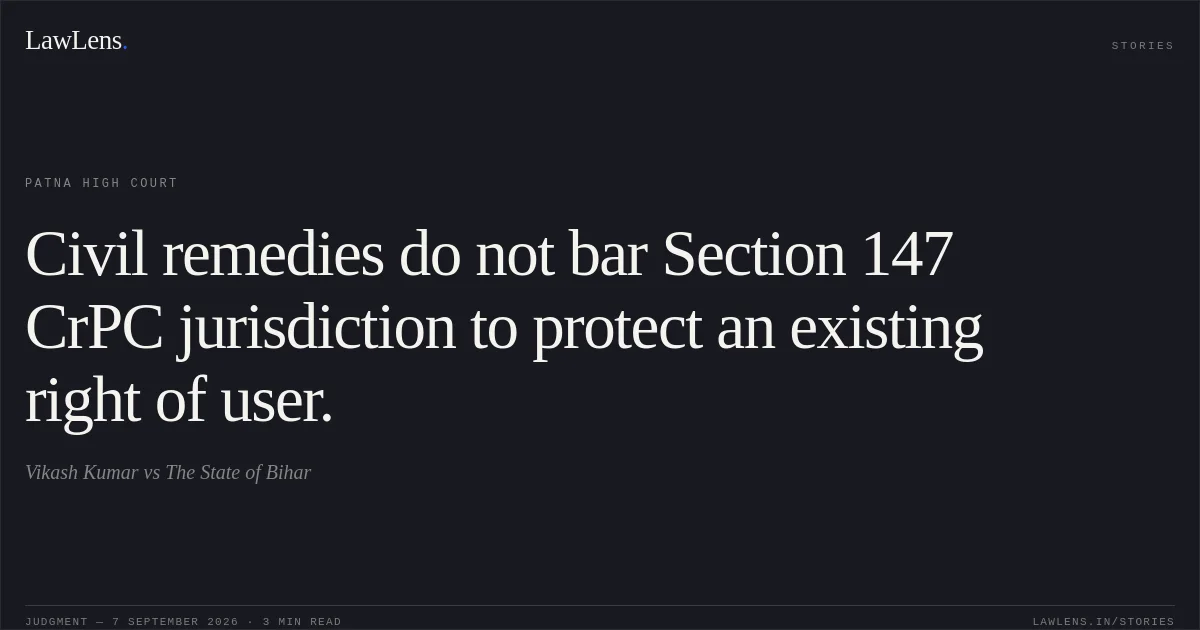
Whether the existence of a possible civil dispute concerning title or easementary rights barred the Executive Magistrate from exercising jurisdiction under Section 147 Cr.P.C. to protect an existing right of user of the passage?
Source reference: paras. 12–18; pp. 4–7Whether the revisional court erred in setting aside the S.D.M.’s order without properly examining the scope of Section 147 Cr.P.C., the material on record, and the likelihood of breach of peace?
Source reference: paras. 15–22; pp. 5–9Whether the S.D.M.’s order directing removal of the obstruction was supported by sufficient material and jurisdictionally valid?
Source reference: paras. 13–19; pp. 5–7Law Applied
Section 147 Cr.P.C. empowers an Executive Magistrate to address disputes concerning the right of user of land or water where such dispute is likely to cause a breach of peace; the jurisdiction is preventive and is intended to preserve an existing right of user until the parties obtain a final declaration from a competent Civil Court.
Source reference: para. 12; p. 4The existence of a civil remedy or an incidental dispute concerning title does not, by itself, oust jurisdiction under Section 147 Cr.P.C., provided that the statutory ingredients are otherwise satisfied.
Source reference: paras. 16–18; pp. 6–7The Court also relied on Syed Shahnawaz Ali v. State of Madhya Pradesh & Ors., 2025 INSC 1484, which explains that criminal revisional jurisdiction is a statutory supervisory jurisdiction requiring examination of the correctness, legality, and propriety of the subordinate court’s order.
Source reference: paras. 20–21; pp. 7–9Reasoning
The High Court held that the immediate dispute was not limited to title or ownership but concerned the obstruction of a passage allegedly used by the petitioner, his family, and members of the public for a considerable period.
Source reference: paras. 12–14; pp. 4–5The Karamchari’s report, the Anchal-Amin’s measurement report, and the accompanying map prima facie established the existence of the passage and subsequent obstruction.
Source reference: para. 14; p. 5The parties had also been heard by the S.D.M., and the dispute had resulted in an altercation and registration of a criminal case, providing a factual basis for apprehension of breach of peace.
Source reference: paras. 15, 19; pp. 5–7Consequently, the S.D.M. acted within the preventive jurisdiction conferred by Section 147 Cr.P.C.
Source reference: no citationThe revisional court erred by treating the availability of a civil remedy as sufficient reason to invalidate the proceedings, instead of examining whether the statutory requirements of Section 147 Cr.P.C. were met.
Source reference: paras. 16–18, 22; pp. 6–9The High Court clarified that it was not finally adjudicating title, ownership, or easementary rights.
Source reference: paras. 23–24; p. 9Holding
The High Court held that the pendency or availability of a civil remedy did not bar proceedings under Section 147 Cr.P.C. where there was prima facie material showing an existing right of user, obstruction, and likelihood of breach of peace.
It found the S.D.M.’s order legally sustainable and held that the revisional court had committed an error of law by setting it aside primarily on the ground that the dispute was civil in nature.
Source reference: paras. 22–24; pp. 9–10Accordingly, the order dated 12 July 2019 passed by the Additional Sessions Judge-III, Madhepura in Criminal Revision No. 43 of 2018 was quashed and set aside qua the petitioner, with consequential relief; the parties remained at liberty to pursue their civil remedies independently.
Source reference: paras. 24–26; p. 10Acts & Sections Cited
3 provisions across 1 statute referred to in this judgment. Each provision opens on LawLens.
Code of Criminal Procedure, 19733
Original Court PDF
Vikash KumarvsThe State of Bihar
Click to open original judgment
Original judgment, available to read, download and summarize on LawLens.in