Facts
On 26 June 2015, Dwarik Sahani was allegedly sleeping outside his house after dinner when his son, Gandhi Sahani, attacked him with a knife.
Source reference: paras. 3–4Madhu Devi, the deceased’s daughter-in-law, claimed to have witnessed the appellant stabbing the deceased repeatedly, including on his chest, back, and other vital parts, resulting in his death.
Source reference: paras. 3–4The appellant was allegedly apprehended at the place of occurrence with the blood-stained knife, which was seized in the presence of witnesses.
Source reference: paras. 3–4, 18The post-mortem examination recorded five incised injuries and attributed death to haemorrhage and shock caused by sharp-cut weapon injuries.
Source reference: paras. 19–20The appellant was charged under Section 302 of the Indian Penal Code, 1860, and was convicted by the Sessions Judge, Muzaffarpur, on 10 July 2017.
Source reference: paras. 2, 7He was sentenced to imprisonment for life and a fine of ₹10,000, with two months’ rigorous imprisonment in default.
Source reference: paras. 2, 7He challenged the conviction and sentence before the Patna High Court, alleging false implication arising from a family dispute and failure of the prosecution to establish motive.
Source reference: paras. 13–14Issues
Whether the prosecution proved beyond reasonable doubt that the appellant intentionally caused the death of Dwarik Sahani and was therefore guilty under Section 302 IPC?
Source reference: paras. 17–24Whether the absence of an established motive and the appellant’s plea of false implication created reasonable doubt warranting interference with the conviction?
Source reference: paras. 13–18, 23–24Whether the life sentence and fine imposed by the trial court required appellate interference?
Source reference: paras. 2, 24–25Law Applied
The Court applied Section 302 of the Indian Penal Code, 1860, which prescribes punishment for murder.
Source reference: no citationThe prosecution was required to establish the appellant’s guilt beyond reasonable doubt through reliable and legally admissible evidence.
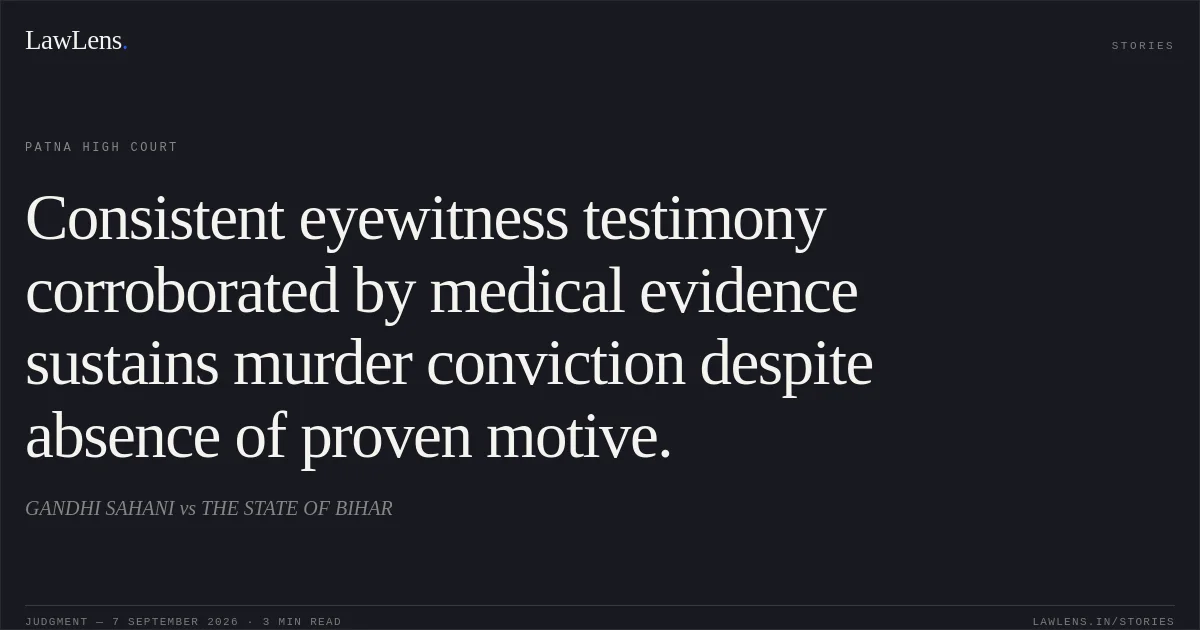
Source reference: no citationThe Court relied on the settled principle that credible ocular testimony, when corroborated by medical evidence and surrounding circumstances, can sustain a conviction; motive is not indispensable where direct evidence satisfactorily proves the occurrence.
Source reference: paras. 18–22The Court also considered the evidentiary value of the recovery of the weapon from the accused and the medical opinion connecting the sharp-cut injuries with the cause of death.
Source reference: paras. 18–22Reasoning
The Court found the testimony of PW-1 to PW-5 consistent with the prosecution case and treated them as eyewitnesses to the occurrence.
Source reference: para. 18The evidence of PW-3 specifically identified the appellant as the assailant and described the repeated knife attacks.
Source reference: para. 18This ocular account was corroborated by the post-mortem evidence, which established multiple incised wounds and death from haemorrhage and shock caused by a sharp weapon.
Source reference: paras. 17, 19–20The appellant’s apprehension at the scene with the knife and the seizure of that weapon further supported the prosecution version.
Source reference: para. 18The Court held that the defence had failed to elicit any material contradiction or circumstance sufficient to discredit the prosecution witnesses.
Source reference: paras. 10–12, 23The alleged absence of motive did not undermine the prosecution case because the direct eyewitness evidence, medical evidence, and recovery evidence proved the appellant’s involvement beyond reasonable doubt.
Source reference: paras. 13–18, 23–24Holding
The Patna High Court answered the issues against the appellant and held that the prosecution had proved his guilt under Section 302 IPC beyond reasonable doubt.
It found no error in the trial court’s appreciation of the evidence or in the sentence of imprisonment for life with a fine of ₹10,000, subject to two months’ rigorous imprisonment in default.
Source reference: paras. 24–26The appeal was accordingly dismissed, and the conviction and sentence were affirmed.
Source reference: paras. 24–26Acts & Sections Cited
2 provisions across 2 statutes referred to in this judgment. Each provision opens on LawLens.
Indian Penal Code, 18601
Code of Criminal Procedure, 19731
Original Court PDF
GANDHI SAHANIvsTHE STATE OF BIHAR
Click to open original judgment
Original judgment, available to read, download and summarize on LawLens.in