01Facts
The petitioner challenged an order dated 27 March 2026 passed under Section 74 of the Central Goods and Services Tax Act, 2017 and the West Bengal Goods and Services Tax Act, 2017, concerning the tax period from January 2020 to November 2023.
¶ 2 · ¶ 6The challenge concerned, inter alia, the alleged invalid signature on the Form DRC-1A pre-show-cause notice, non-consideration of the petitioner’s response, vagueness of the Form DRC-01 show-cause notice, alleged impermissible clubbing of different tax periods, and the alleged participation of different authorities in receiving the response, conducting the hearing, and passing the order.
¶ 3The petitioner had earlier challenged the same show-cause notices in WPA 11 of 2026 but withdrew that petition and was granted liberty by order dated 17 March 2026 to submit its response and face adjudication; no liberty was reserved to invoke writ jurisdiction thereafter.
¶ 6The petitioner nevertheless approached the High Court instead of availing the statutory appellate remedy and stated that it was unwilling to make the prescribed pre-deposit.
¶ 10–1102Issues
i.Whether the writ petition challenging the Section 74 adjudication order should be entertained despite the availability of a multi-tier statutory appellate remedy under the GST legislation.
¶ 6, 9–11ii.Whether the alleged defects in the Form DRC-1A and Form DRC-01 notices, including invalid signatures, vagueness, non-consideration of the response, and alleged clubbing of tax periods, established a jurisdictional or procedural defect warranting interference under Article 226.
¶ 3, 7–8iii.Whether the adjudication was vitiated because the authority receiving the petitioner’s response was allegedly different from the authority who conducted the hearing and passed the order.
¶ 3(e), 9iv.Whether the impugned order was non-speaking or demonstrated a predetermined consideration because it allegedly failed to deal with the petitioner’s objections.
¶ 903Law Applied
The Court applied Sections 73 and 74 of the CGST/WBGST Act, 2017, observing that Section 74 governs determinations involving fraud, wilful misrepresentation, or suppression of facts.
¶ 6The statutory scheme provides a multi-tiered adjudicatory and appellate process, including appeals against determinations under Sections 73 and 74 and a further remedy before the appellate tribunal; access to the appellate remedy is conditioned upon the prescribed mandatory pre-deposit, which protects both the taxpayer and the revenue.
¶ 10The Court further applied the established principle that writ jurisdiction ordinarily should not be exercised where an efficacious alternative statutory remedy exists, particularly when the dispute involves disputed questions of fact.
¶ 8–11It also noted that there cannot be a piecemeal hearing of disputed factual matters.
¶ 9Provisions in the judgment · 4 · Linked ones open on LawLens
Central Goods and Services Tax Act, 2017 Section 73Section 74
West Bengal Goods And Services Tax Act, 2017 Section 73Section 74
04Reasoning
The Court held that the petitioner’s objections largely raised factual matters unsuitable for determination in writ proceedings.
The record showed that the detailed show-cause notice was available, while the petitioner’s challenge primarily concerned the signature on the Form DRC-01 summary; whether the notices were properly signed required examination of the original records.
¶ 7–8The Form DRC-01 summaries identified the demand and the relevant taxable periods, and therefore did not themselves impermissibly club different periods, although the detailed reasons were presented in a composite format.
¶ 8Given the allegations concerning smuggling of cement from Bhutan and concealment of GST liability, the consolidated presentation of the detailed show-cause reasons was not, at that stage, found legally unsustainable.
¶ 8The Court also found that the authority who conducted the hearing was a “proper officer” and was the same officer who passed the impugned order; the petitioner had filed its response, was heard, and was represented by counsel.
¶ 9Any dispute regarding the adequacy of consideration of the objections was therefore a matter for the statutory appellate forum.
In light of the earlier withdrawal of the writ petition, the absence of liberty to re-approach the High Court, the availability of an appellate remedy, and the petitioner’s refusal to make the required pre-deposit, the Court declined to exercise extraordinary jurisdiction.
¶ 6, 9–1105Holding
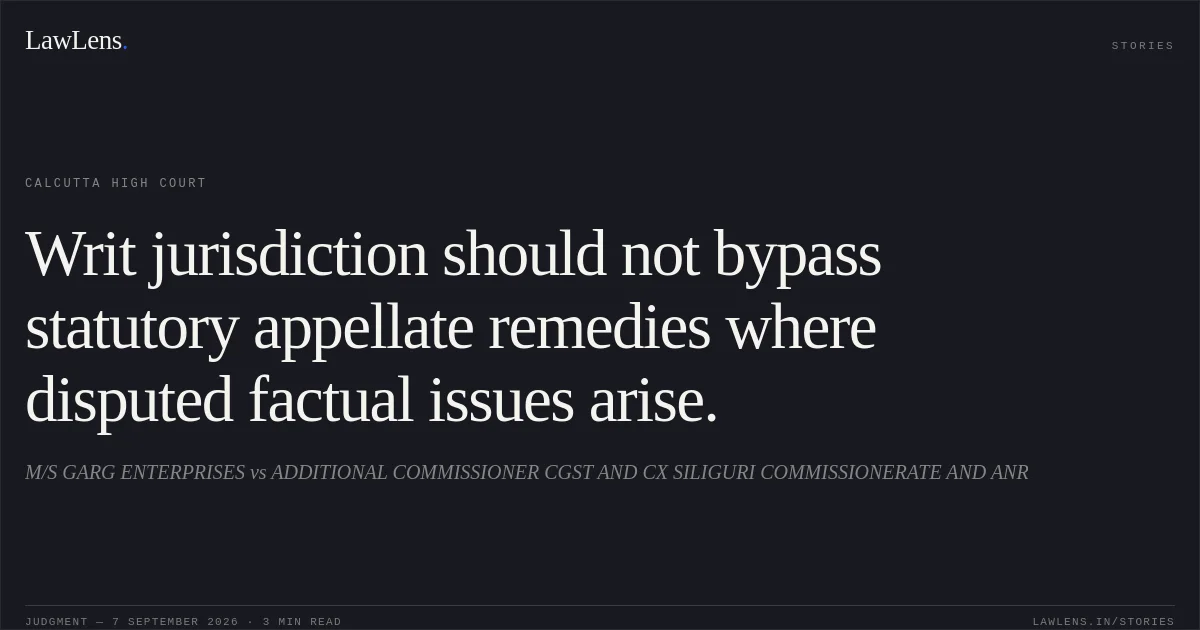
The Court dismissed WPA 991 of 2026, holding that the petitioner should pursue the statutory appellate remedy rather than bypass the GST adjudicatory process through a writ petition, particularly where disputed factual issues were involved.
¶ 12The dismissal was without prejudice to the petitioner’s right to challenge the Section 74 order before the appropriate forum in accordance with law.
¶ 13Original Court PDF
M/S GARG ENTERPRISESvsADDITIONAL COMMISSIONER CGST AND CX SILIGURI COMMISSIONERATE AND ANR
Click to open original judgment
Original judgment, available to read, download and summarize on LawLens.in