Facts
The appellant filed a civil suit for the recovery of Rs. 10 lakhs, alleging he provided a friendly loan to the respondent via a bank transfer from his account in Delhi
Source reference: p. 1-2The respondent issued a repayment cheque which was presented and dishonored in Delhi
Source reference: p. 2The respondent filed a written statement on 02.05.2019 without objecting to the territorial jurisdiction of the Delhi courts; in fact, the respondent stated the jurisdiction paragraph was a "matter of record"
Source reference: p. 3Issues were subsequently settled on 18.02.2021
Source reference: p. 3Thereafter, the respondent filed an application under Order VII Rule 10 of the CPC for return of the plaint, arguing that because the respondent resided in Karnataka and documents were executed there, Delhi lacked jurisdiction
Source reference: p. 2The Trial Court allowed the application via the impugned order dated 23.07.2022
Source reference: p. 1Issues
Whether a defendant is precluded from raising an objection to territorial jurisdiction via an application under Order VII Rule 10 CPC if such an objection was not raised in the written statement or before the settlement of issues
Source reference: p. 3-4Law Applied
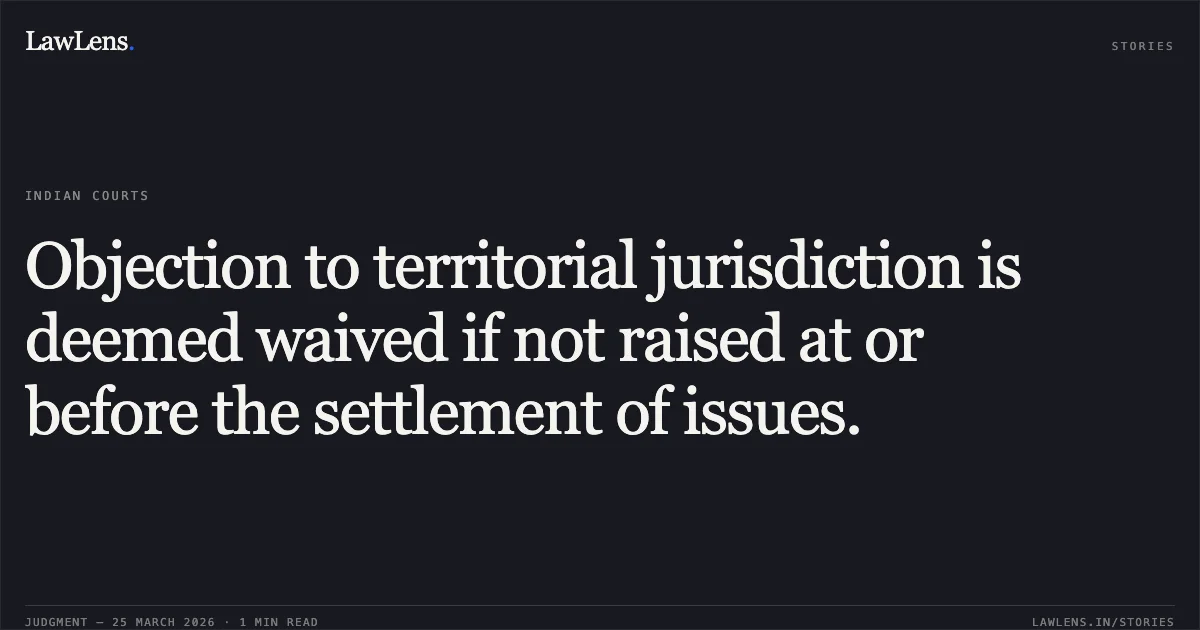
Section 21 of the Code of Civil Procedure (CPC), which mandates that objections to territorial jurisdiction must be taken at the earliest possible opportunity, specifically at or before the settlement of issues
Source reference: p. 4-5Harshad Chiman Lal Modi v. DLF Universal Ltd., which distinguishes between subject matter jurisdiction (which cannot be waived) and territorial or pecuniary jurisdiction (which is waived if not timely challenged)
Source reference: p. 4principle from Bahrein Petroleum Company Ltd. v. Pappu, establishing that territorial jurisdiction is a statutory defect that can be waived by the parties, unlike inherent lack of jurisdiction
Source reference: p. 5Reasoning
the Court observed that for the purposes of Order VII Rule 10 CPC, while a court can return a plaint at "any stage," this power is subject to the principles of waiver and acquiescence
Source reference: p. 4The Court noted that the respondent failed to raise any jurisdictional objection in his written statement and conceded that the appellant's jurisdictional claims were a "matter of record"
Source reference: p. 3Under Section 21 CPC, territorial jurisdiction does not go to the root of the court's inherent power; therefore, if a party fails to object before the settlement of issues, they are deemed to have waived such an objection
Source reference: p. 4-5The Court highlighted that since the issues had already been framed on 18.02.2021 without any issue being struck regarding jurisdiction, the respondent was precluded from subsequently challenging it
Source reference: p. 5-6Holding
The High Court allowed the appeal and set aside the impugned order dated 23.07.2022
The Court held that the respondent’s failure to object to territorial jurisdiction at the first instance or at the stage of framing issues constituted a waiver of that objection
Source reference: p. 6The suit was restored to its original number, and the parties were directed to appear before the Trial Court on 30.03.2026
Source reference: p. 6Acts & Sections Cited
1 provisions across 1 statute referred to in this judgment. Each provision opens on LawLens.
Code of Civil Procedure, 19081
Original Court PDF
Hanuman Prasad Sharma @ H.P. SharmavsJ. Mithyleshwar
Click to open original judgment
Original judgment, available to read, download and summarize on LawLens.in