Facts
The respondents circulated a tentative seniority list of Agriculture Extension Officers as on 1 March 2026 on 10 March 2026 and invited objections from affected employees.
Source reference: p.2The petitioners submitted objections challenging their placement in the tentative list. By office letter dated 21 July 2026, respondent No. 2 rejected all objections collectively, stating that the seniority had been prepared in accordance with directions of the Personnel Department and referring, inter alia, to pending litigation concerning the seniority list and the decision in Devinder Kumar v. State of H.P. The petitioners approached the High Court, contending that their objections had not been individually or substantively considered. It was also informed that the final seniority list had not yet been issued.
Source reference: p.2Issues
1. Whether the respondents’ summary rejection of the petitioners’ objections to the tentative seniority list, without addressing the grounds raised, was legally sustainable.
Source reference: pp.2–32. Whether the competent authority was required to pass a reasoned and speaking order before finalizing the seniority list.
Source reference: pp.3–53. Whether the respondents could take action on the basis of the tentative seniority list pending fresh consideration of the objections.
Source reference: p.5Law Applied
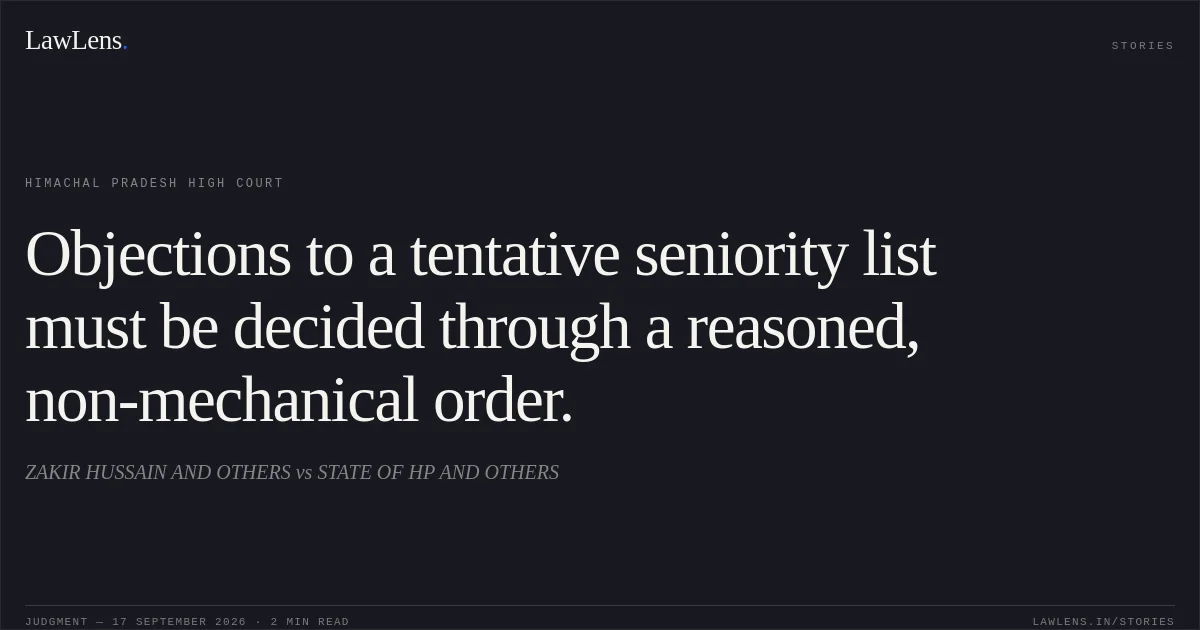
The Court applied the principle that administrative and quasi-judicial decisions having prejudicial consequences must disclose reasons. Relying on Kranti Associates (P) Ltd. v. Masood Ahmed Khan, (2010) 9 SCC 496, it held that recording reasons is an essential component of fair decision-making, restrains arbitrary exercise of power, demonstrates consideration of relevant factors, facilitates judicial review, and requires reasons to be cogent, clear and not merely “rubber-stamp” or pretended reasons.
Source reference: pp.3–5The Court further applied the principle that objections invited against a tentative seniority list must be considered in accordance with law before the list is finalized, since final seniority may affect an employee’s entitlement to promotion and other service benefits.
Source reference: p.3Reasoning
The Court found that the petitioners had raised several grounds against the tentative seniority list, but respondent No. 2 had rejected them through a generalized order that merely referred to departmental directions and pending litigation.
Source reference: pp.2–3The order did not examine or answer the specific objections and therefore amounted to a mechanical and summary disposal. Such an approach defeated the purpose of inviting objections and failed to satisfy the requirement of a reasoned decision, particularly because finalization of seniority could affect promotional and other service rights. Since the final seniority list had not yet been issued, the appropriate course was to set aside the rejection and remit the objections to the competent authority for fresh consideration.
Source reference: p.3Holding
The High Court quashed and set aside the respondents’ office letter dated 21 July 2026 rejecting the petitioners’ representations.
Respondent No. 2 was directed to reconsider and decide the petitioners’ objections to the tentative seniority list as circulated on 10 March 2026, in accordance with law and the Court’s observations, within four weeks, and to communicate the fresh decision to the petitioners. Until such decision was taken, the respondents were restrained from taking any action on the basis of the tentative seniority list. The writ petition and pending miscellaneous applications were disposed of accordingly.
Source reference: pp.5–6Original Court PDF
ZAKIR HUSSAIN AND OTHERSvsSTATE OF HP AND OTHERS
Click to open original judgment
Original judgment, available to read, download and summarize on LawLens.in