Facts
The Petitioner (Plaintiff) filed O.S. No. 59 of 2016 for partition and 1/3rd share of a specific property
Source reference: p. 5After the commencement of trial and completion of Plaintiff’s evidence, the Respondents (Defendants) filed I.A. No. 274/2023 under Order VI Rule 17 CPC to amend the Plaintiff’s plaint to include more properties and modify the prayer, and I.A. No. 275/2023 under Order I Rule 10 CPC to implead the mother as Defendant No. 3
Source reference: p. 7The Trial Court allowed both applications on 10.07.2023 and directed the Plaintiff to carry out the amendments
Source reference: p. 7When the Plaintiff failed to amend the plaint (arguing that a plaintiff cannot be forced to amend his own pleading at a defendant's instance), the Trial Court dismissed the entire suit for default via a docket order dated 06.11.2023
Source reference: p. 8-9Issues
1. Whether a suit can be dismissed for default under Order VI Rule 18 CPC for failure to carry out amendments sought by the opposing party?
Source reference: p. 17 / para. 112. Whether the orders permitting amendment and impleadment after the commencement of trial were legally sustainable without a finding of due diligence?
Source reference: p. 17 / para. 113. Whether a Plaintiff can be compelled to amend their own plaint at the instance of a Defendant?
Source reference: p. 10 / para. 9(A)(d)Law Applied
Order VI Rule 18 of the CPC, which stipulates that if a party who obtained leave to amend fails to do so within the specified time, they shall not be permitted to amend thereafter unless time is extended
Source reference: p. 18Union of India v. Pramod Gupta (2005) 12 SCC 1, establishing that the obligation to amend lies solely on the party who sought the leave and the only consequence of failure is forfeiture of the right to amend, not dismissal of the suit
Source reference: p. 19Proviso to Order VI Rule 17 CPC, which bars amendments after trial commencement unless "due diligence" is proven
Source reference: p. 24Principle of dominus litis regarding impleadment under Order I Rule 10 CPC, as discussed in Sudhamayee Pattnaik v. Bibhu Prasad Sahoo (2022) SCC Online SC 1234
Source reference: p. 25-26Reasoning
The High Court observed that the Trial Court committed a fundamental jurisdictional error by misinterpreting Order VI Rule 18. The statutory obligation to amend is cast only upon the "party who has obtained an order for leave to amend"—in this case, the Defendants—not the Plaintiff
Source reference: p. 18-19The law only prescribes the loss of the right to amend as a penalty for delay; it does not authorize the dismissal of a suit
Source reference: p. 20-21The High Court found the Trial Court's direction to the Plaintiff to amend his own plaint at the Defendants' behest to be legally alien
Source reference: p. 20Regarding the Interlocutory Applications, the Court noted the Trial Court failed to record any finding on "due diligence" required for post-trial amendments under the Rule 17 proviso and failed to provide reasoned findings on why the mother was a "necessary party" versus a "proper party" under Rule 10
Source reference: p. 25, 27The Court noted that passing a dismissal order while the underlying orders were sub-judice in revision was a breach of judicial propriety
Source reference: p. 29-30Holding
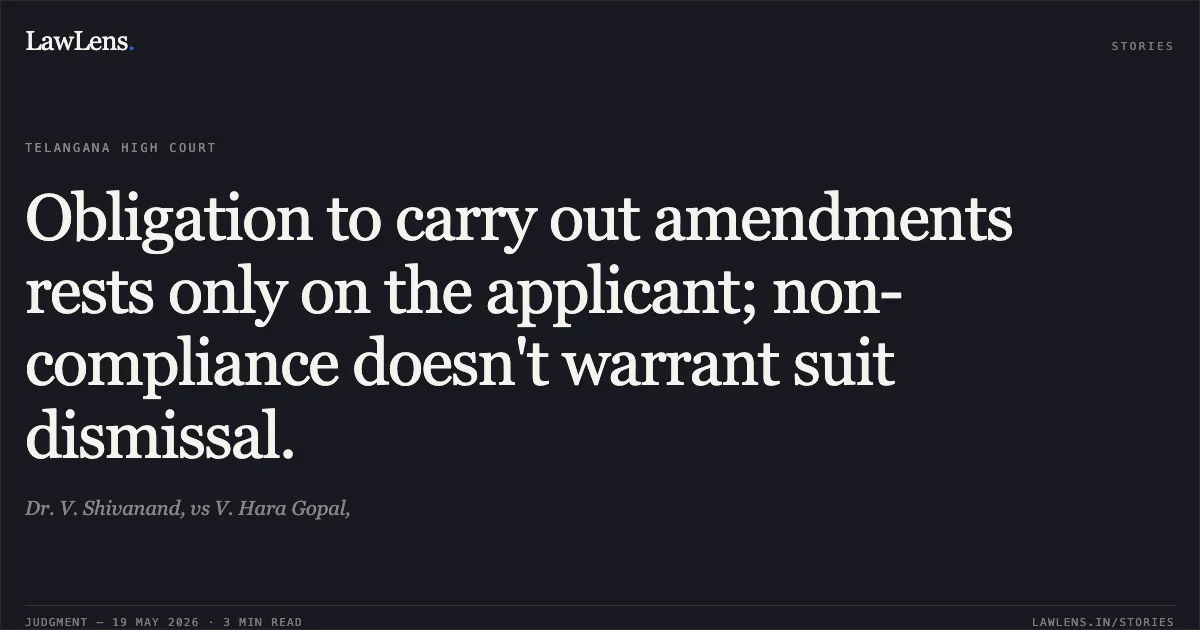
A suit cannot be dismissed for a procedural default that is not contemplated by the CPC, especially when the burden of amendment was wrongly shifted to the non-moving party
The High Court allowed all three Civil Revision Petitions, set aside the docket order dated 06.11.2023, restored O.S. No. 59 of 2016 to the file, and set aside the orders in I.A. Nos. 274 and 275 of 2023, remitting them back to the Trial Court for fresh consideration
Source reference: p. 30, 31Acts & Sections Cited
1 provisions across 1 statute referred to in this judgment. Each provision opens on LawLens.
Code of Civil Procedure, 19081
Original Court PDF
Dr. V. Shivanand,vsV. Hara Gopal,
Click to open original judgment
Original judgment, available to read, download and summarize on LawLens.in