Facts
The respondent was married to the deceased, Alpaben, for approximately 20 years, and they had two children. The prosecution alleged that, during the last five years of the marriage, the respondent occasionally quarrelled with and harassed the deceased over household matters, including preparation of food, and sometimes assaulted her.
Source reference: paras. 2–2.1, pp. 2, 4On 5 March 2011, the deceased sustained fatal burn injuries while preparing food. Although the prosecution alleged that she had committed suicide by pouring kerosene and setting herself on fire, the case narrative also recorded that she accidentally caught fire from the stove. She died at Godhra Civil Hospital, and the post-mortem examination confirmed death due to burns.
Source reference: paras. 2–2.1, pp. 2, 4The deceased’s brother lodged the FIR. Following investigation, the respondent was charged under Sections 498-A and 306 of the Indian Penal Code, 1860. The Sessions Court, Godhra, acquitted him in Sessions Case No. 76 of 2011 by judgment dated 6 March 2012.
Source reference: paras. 2.2–2.5, pp. 1–3The State preferred the present appeal against acquittal under Section 378(1) and (3) of the Code of Criminal Procedure, 1973.
Source reference: paras. 1, 2.2–2.5, pp. 1–3Issues
1. Whether the Trial Court committed an error in acquitting the respondent of the offences under Sections 498-A and 306 of the IPC.
Source reference: para. 5, p. 52. Whether the Trial Court improperly appreciated the oral and documentary evidence led by the prosecution.
Source reference: para. 5, p. 53. Whether the acquittal was affected by illegality, perversity, or a manifest error warranting appellate interference.
Source reference: paras. 5, 11, pp. 5, 7Law Applied
Section 498-A IPC, under which “cruelty” requires either wilful conduct likely to drive a woman to suicide or cause grave injury, or harassment connected with an unlawful demand for property or valuable security.
Source reference: para. 12, p. 8Section 306 IPC requires proof that the accused abetted the commission of suicide, read with Section 107 IPC, which defines abetment through instigation, conspiracy, or intentional aid.
Source reference: para. 12, pp. 8–9The Court relied on Ramesh Kumar v. State of Chhattisgarh, (2001) 9 SCC 618, and Ram Pyarey v. State of Uttar Pradesh, (2025) 6 SCC 820, concerning abetment of suicide.
Source reference: para. 13, p. 9The Court referred to the principles governing appeals against acquittal in Chandrappa v. State of Karnataka, (2007) 4 SCC 415; Rajesh Prasad v. State of Bihar, (2022) 3 SCC 471; Babu Sahebagouda Rudragoudar v. State of Karnataka, (2024) 8 SCC 149; and Ramesh v. State of Karnataka, (2024) 9 SCC 169.
Source reference: paras. 17–20, pp. 10–13These authorities establish that an appellate court may reappreciate evidence in an acquittal appeal, but must account for the strengthened or “double” presumption of innocence and should not interfere where two reasonable views are possible unless the Trial Court’s conclusion is perverse or manifestly erroneous.
Source reference: paras. 17–20, pp. 10–13Reasoning
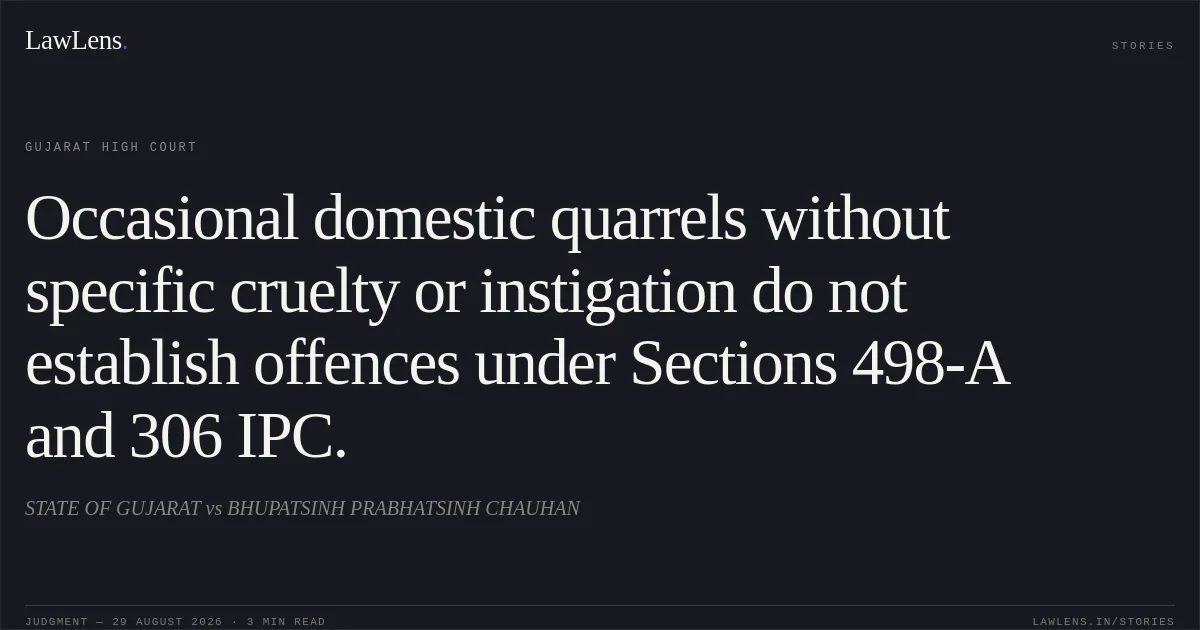
The Court held that the prosecution evidence established, at most, occasional quarrels between the spouses concerning food and household work, with some allegations of assault, but did not establish specific, cogent, or reliable conduct amounting to statutory cruelty under Section 498-A IPC.
Source reference: paras. 7–10, pp. 6–7The absence of any allegation of cruelty or harassment during the first 15 years of the 20-year marriage further weakened the prosecution case.
Source reference: paras. 7, 9, p. 6The evidence also failed to identify any proximate act of instigation, intentional aid, or conduct so compelling that it drove the deceased to commit suicide, as required under Sections 107 and 306 IPC.
Source reference: paras. 10, 14, pp. 7, 10The medical evidence proved the cause of death as burn injuries but did not establish that the respondent had abetted suicide.
Source reference: para. 4.2, p. 4Applying the restrictive standard for interference with an acquittal, the Court found that the Trial Court’s view was reasonably possible and neither illegal nor perverse.
Source reference: paras. 18–22, pp. 11–14Holding
The High Court answered the issues against the State and held that the prosecution had failed to prove the charges under Sections 498-A and 306 IPC beyond reasonable doubt.
The Trial Court’s acquittal was found to be lawful, reasonable, and supported by the evidence; no appellate interference was warranted.
Source reference: paras. 14–16, 21–22, pp. 10–14The appeal was dismissed, the judgment and order of acquittal dated 6 March 2012 were confirmed, the respondent’s bail bond was cancelled, and the record and proceedings were directed to be returned to the Trial Court.
Source reference: para. 23, p. 14Acts & Sections Cited
5 provisions across 2 statutes referred to in this judgment. Each provision opens on LawLens.
Code of Criminal Procedure, 19732
Indian Penal Code, 18603
Original Court PDF
STATE OF GUJARATvsBHUPATSINH PRABHATSINH CHAUHAN
Click to open original judgment
Original judgment, available to read, download and summarize on LawLens.in
![Courts will not interfere with transfers absent mala fides or violation of statutory rules.. M Ramya vs EMPLOYEES STATE INSURANCE CORPORATION (ESIC). CAT - ['Chennai']. LawLens](/stories/thumbnails/courts-will-not-interfere-with-transfers-absent-mala-fides-or-violation-of-statutory-rules-a6845e9ca6f548fca284c51c8351957f.webp)
![Courts cannot direct one-time recruitment age relaxation absent authority in the governing rules or advertisement.. UT OF PUDUCHERRY vs M ANDAL. CAT - ['Chennai']. LawLens](/stories/thumbnails/courts-cannot-direct-one-time-recruitment-age-relaxation-absent-authority-in-the-governing-895d78fde47143e2a8ed0207c4b6a44f.webp)
![A review cannot correct an allegedly erroneous decision absent an error apparent on the record.. Ajit Kumar Jha vs RAILWAY BOARD. CAT - ['Delhi']. LawLens](/stories/thumbnails/a-review-cannot-correct-an-allegedly-erroneous-decision-absent-an-error-apparent-on-the-re-8ac952fd4eba470c92f7da20af72a220.webp)