01Facts
The original propositus, Kenchappa Badiger, owned Sy. No. 105 (4 acres 3 guntas) at Devara Hubballi, which is reportedly attached to a Durga Devi temple.
¶ 1 · ¶ 9After his death in 1939, Neelakantappa Badiger claimed the land as an adopted son and had his name entered in revenue records.
¶ 1Parwatewwa, claiming as sole legal heir, filed O.S. No. 377/1959, which was decreed on 19.06.1974.
¶ 1In R.A. No. 65/1974, the appeal was dismissed and her cross-objection allowed on 04.10.1977, declaring her owner of the entire land; she obtained possession on 12.12.1984 and her name was entered in revenue records in 1997.
¶ 2Neelakantappa and his sons (Respondents 1 and 2) filed a series of unsuccessful suits and appeals, the last dismissed on 06.02.2025.
¶ 3On 26.06.1981, Respondents 1 and 2 applied for occupancy rights under the Karnataka Certain Inam Abolition Act, 1977, without impleading Parwatewwa, and obtained an order on 11.01.1982.
¶ 4A writ petition (W.P. No. 28274/1997) set that order aside and remanded the matter.
¶ 4On remand, the Land Tribunal, Dharwad, by order dated 29.08.2025 (Annexure-P), conferred occupancy rights on Respondents 1 and 2 without addressing the basis of the revenue entries or the civil court decrees.
¶ 1 · ¶ 10 · ¶ 1102Issues
i.1. Whether the Land Tribunal's order conferring occupancy rights was sustainable when it failed to consider the revenue entries' basis, the civil court decrees in favour of Parwatewwa, and the maintainability of the application in light of those decrees.
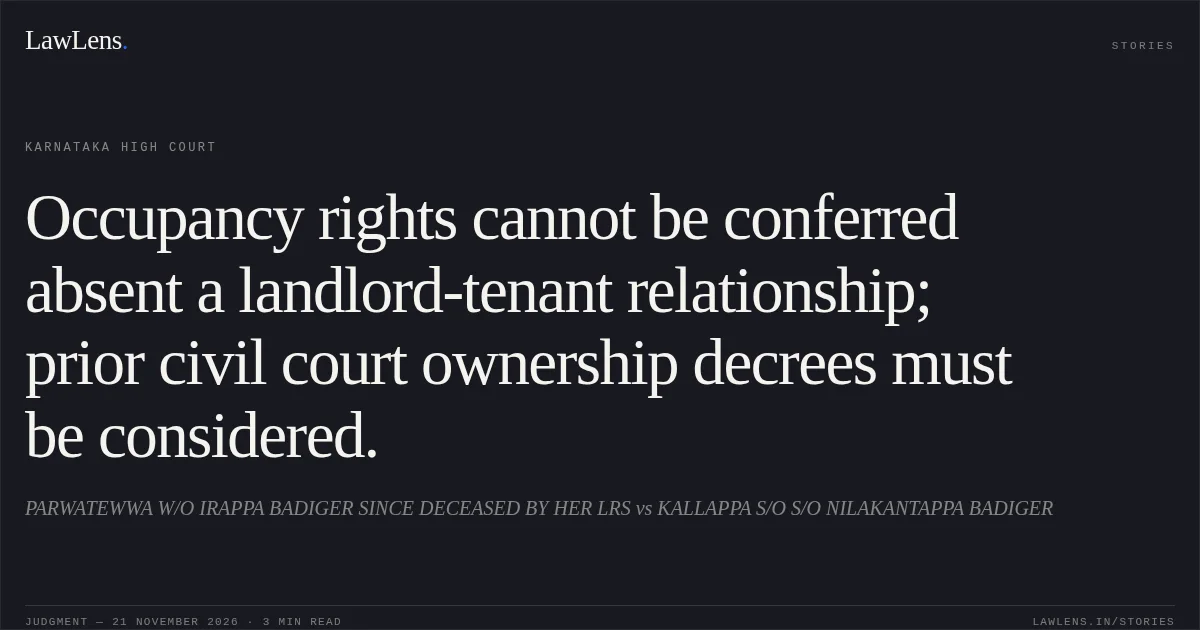
¶ 5 · ¶ 6 · ¶ 7 · ¶ 11ii.2. Whether a landlord-tenant relationship existed between the parties, a precondition for the Land Tribunal to determine the application.
¶ 12iii.3. Whether the subject property fell within the Karnataka Certain Inam Abolition Act, 1977, or was amenable to determination under the Karnataka Land Reforms Act, 1961.
¶ 1303Law Applied
The Karnataka Certain Inam Abolition Act, 1977, under which Respondents 1 and 2 sought occupancy rights, and the Karnataka Land Reforms Act, whose applicability the Tribunal was required to examine.
¶ 4 · ¶ 13The civil court decrees (O.S. No. 377/1959, decreed 19.06.1974, and the subsequent R.A. and execution proceedings) are binding determinations of ownership that operated prior to the Tribunal proceedings and that the Tribunal must consider.
¶ 2 · ¶ 12 · ¶ 15A landlord-tenant relationship is an elementary requirement for tenancy-based relief before a Land Tribunal, and the absence of such relationship precludes the Tribunal from determining the application.
¶ 12Revenue entries are required to have a legal basis, and the Tribunal must assign reasons referencing the civil court orders.
¶ 5 · ¶ 1104Reasoning
The impugned order recorded the pendency of the suits but did not examine the basis of the revenue entries in favour of Respondents 1 and 2, nor did it give reasons tied to the civil court decrees.
¶ 10 · ¶ 11Since the decree of 19.06.1974 declaring Parwatewwa the absolute owner predated the Tribunal proceedings, the Tribunal was obliged to examine whether Respondents 1 and 2 had any maintainable claim in light of it.
¶ 11 · ¶ 12The absence of any landlord-tenant relationship between the parties went to the Tribunal's jurisdiction to decide the application on merits.
¶ 12The Tribunal failed to determine whether the land fell within the 1977 Inam Abolition Act or the Land Reforms Act.
¶ 13Because these were foundational omissions, the Court did not adjudicate the merits and instead quashed the order for fresh consideration.
¶ 1405Holding
The order dated 29.08.2025 was unsustainable for want of consideration of the civil court decrees, the revenue basis, the landlord-tenant requirement, and statutory applicability.
¶ 11–13The writ petition was allowed, the impugned order quashed, and the matter remitted to the Land Tribunal, Dharwad, to re-examine the application afresh. The Tribunal must take into account the decrees declaring Parwatewwa the absolute owner as of 19.06.1974 and the subsequent suits that rejected Respondents' claims, and must pass a fresh order within three months from receipt of a certified copy of the judgment.
¶ 14 · ¶ 15 · ¶ 16Original Court PDF
PARWATEWWA W/O IRAPPA BADIGER SINCE DECEASED BY HER LRSvsKALLAPPA S/O S/O NILAKANTAPPA BADIGER
Click to open original judgment
Original judgment, available to read, download and summarize on LawLens.in