Facts
The plaintiffs, representing the branch of Durganaika, sued for partition of land in Survey No. 198, claiming that three brothers had cultivated separate portions under a family arrangement and that occupancy rights obtained by Kallanaika included land originally cultivated by Jattanaika.
Source reference: para. 5–11The defendants disputed the plaintiffs’ entitlement and also alleged that other family properties had been omitted from the suit. The Trial Court dismissed the suit; the First Appellate Court reversed that decision and decreed partition. The defendants appealed, challenging the decree in the second appeal.
Source reference: para. 5–11Issues
1. Whether the First Appellate Court was right to decline to consider whether properties other than those in the suit schedule belonged to the joint family.
Source reference: para. 132. Whether the First Appellate Court erred in disregarding the Trial Court’s failure to frame an issue concerning other alleged joint-family properties.
Source reference: para. 133. Whether the First Appellate Court was right to decree partition of the suit-schedule property, including Item No. 2.
Source reference: para. 13; paras. 17–19, 25–28Law Applied
The Court considered the Karnataka Land Reforms Act, under which occupancy rights were sought through Form No. 7, and applied the principle that a claim to partition occupancy rights must be supported by pleadings and evidence establishing the nature of the original tenancy and the capacity in which the occupancy rights were obtained.
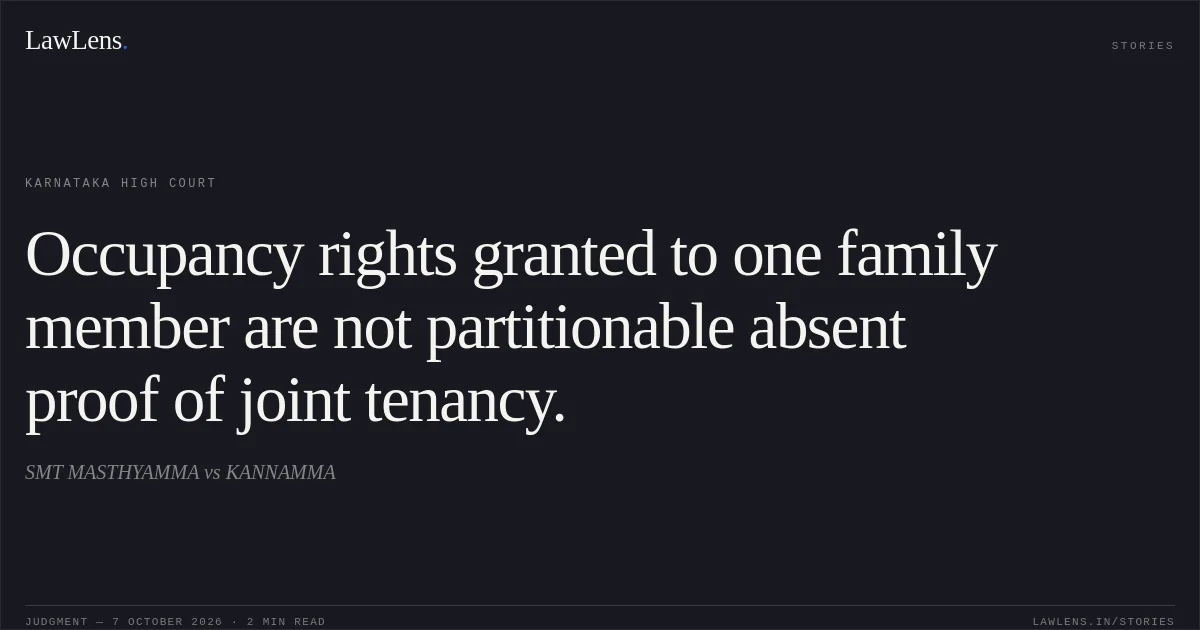
Source reference: para. 17–19, 25–28The fact that one family member prosecuted a Form No. 7 application or received occupancy rights does not, by itself, establish a joint tenancy or make those rights joint-family property.
Source reference: para. 17–19, 25–28A claim that other joint-family properties were omitted must also identify the properties and provide a basis for their alleged joint-family character.
Source reference: para. 20–24Reasoning
The Court found no particulars or evidence identifying other ancestral or joint-family properties allegedly omitted from the suit, and no counterclaim seeking their partition; that objection therefore failed.
Source reference: para. 20–24For Item No. 1, the pleadings and material supported the First Appellate Court’s conclusion concerning the tenancy and Kallanaika’s prosecution of the Form No. 7 application relating to the portion originally cultivated by Jattanaika; the decree was therefore not disturbed.
Source reference: para. 26For Item No. 2, the plaintiffs had not pleaded or proved that the original tenancy was joint or that Kallanaika obtained occupancy rights on behalf of the other branches. His participation in the Tribunal proceedings alone could not establish a partitionable joint-family interest.
Source reference: para. 17–19, 25–27Holding
The appeal was allowed in part. The High Court set aside the partition decree concerning Item No. 2 and dismissed the suit to that extent, while affirming the preliminary decree for partition of Item No. 1.
The First Appellate Court’s judgment and decree were modified accordingly, with no order as to costs.
Source reference: para. 28–30Acts & Sections Cited
1 provisions across 1 statute referred to in this judgment. Each provision opens on LawLens.
Code of Civil Procedure, 19081
Original Court PDF
SMT MASTHYAMMAvsKANNAMMA
Click to open original judgment
Original judgment, available to read, download and summarize on LawLens.in