Facts
Two second appeals were filed against concurrent judgments of the lower courts granting decrees of eviction against the appellants
Source reference: para. 1The appellants’ predecessor-in-interest was originally a tenant, and a previous eviction suit against him had abated
Source reference: para. 3, 5However, the current suits were filed against the appellants on the ground that they had become trespassers by operation of Section 2(g) of the West Bengal Premises Tenancy Act, 1997
Source reference: para. 1One of the defendants named in the current suit had died prior to its institution
Source reference: para. 4The appellants challenged the jurisdiction of the civil court, arguing the matter fell under the Thika Controller
Source reference: para. 3Issues
1. Whether the civil court lacked jurisdiction to entertain the suit under Section 8(1) of the West Bengal Thika Tenancy (Acquisition and Regulation) Act, 2001
Source reference: para. 32. Whether the abatement of a previous suit against the appellants' predecessor-in-interest rendered the present suit non-maintainable
Source reference: para. 3, 63. Whether the decree was a nullity because it was passed against a person who died before the institution of the suit
Source reference: para. 4Law Applied
The court applied Section 2(g) of the West Bengal Premises Tenancy Act, 1997, which defines the limited circumstances under which a tenant’s heirs retain tenancy rights, failing which they are categorized as trespassers
Source reference: para. 1, 8It further interpreted Section 8(1) of the West Bengal Thika Tenancy (Acquisition and Regulation) Act, 2001, which mandates that eviction of 'bharatias' (tenants under thika tenants) be governed by the 1997 Act and typically handled by specific authorities
Source reference: para. 3, 7Finally, the court applied the principle that a right to sue for trespass does not survive upon the heirs of a deceased trespasser and that a decree against a dead person is a nullity only to the extent of that individual
Source reference: para. 9, 10Reasoning
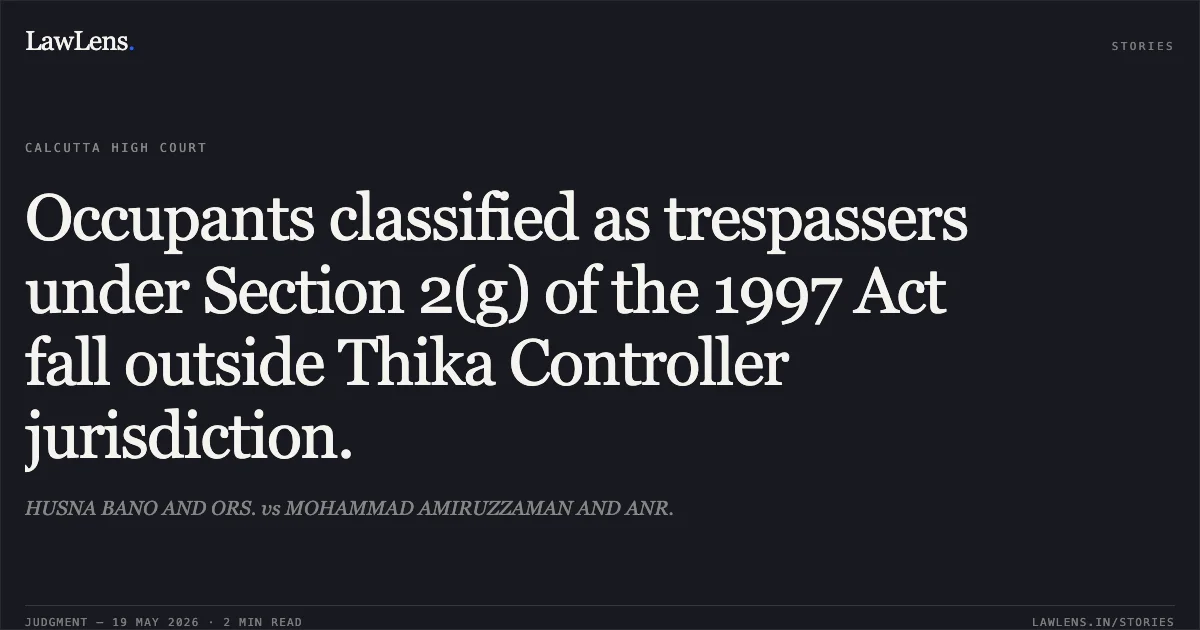
The court reasoned that because the appellants were deemed trespassers under Section 2(g) of the 1997 Act, they ceased to be "tenants" or "bharatias"
Source reference: para. 8Consequently, the protections and jurisdictional shifts under Section 8(1) of the Act of 2001 did not apply, as that provision requires an existing landlord-tenant/bharatia relationship
Source reference: para. 8Regarding the second issue, the court found the previous suit irrelevant because it was filed against the predecessor as a "tenant," whereas the present suit was filed against the appellants in a different capacity as "trespassers"
Source reference: para. 5, 6the court determined that the death of one defendant prior to the suit did not vitiate the entire decree; since a trespasser's right to occupy does not survive to heirs, the inclusion of the deceased was a mere superfluity that did not affect the validity of the judgment against the living occupants
Source reference: para. 9, 10Holding
The court answered all issues in the negative and held that no substantial question of law was made out
The court dismissed the appeals and the connected applications under Order XLI Rule 11 of the Code of Civil Procedure
Source reference: para. 12, 13The decrees of eviction were upheld, clarifying that the impleadment of a deceased defendant was irrelevant to the substance of the decree against the remaining trespassers
Source reference: para. 10No order as to costs was made
Source reference: para. 14Acts & Sections Cited
2 provisions across 2 statutes referred to in this judgment. Each provision opens on LawLens.
West Bengal Premises Tenancy Act, 19971
West Bengal Thika Tenancy ( Acquisition And Regulation ) Act, 20011
Original Court PDF
HUSNA BANO AND ORS.vsMOHAMMAD AMIRUZZAMAN AND ANR.
Click to open original judgment
Original judgment, available to read, download and summarize on LawLens.in


