Facts
The prosecution alleged that on July 12, 1996, the appellants, Naresh Paswan (armed with a saif) and Sanjay Paswan (armed with a lathi), assaulted Sitaram Paswan after Naresh prohibited the deceased from using a government hand pump.
Source reference: p.2-3The deceased succumbed to head injuries the following day at PMCH, Patna.
Source reference: p.3The trial court (Additional Sessions Judge-V, Nalanda) convicted the appellants under Sections 302/34 and 323 of the IPC on March 26, 1998.
Source reference: p.2During the High Court appeal, it was noted that while P.W. 1 initially supported the case, he turned hostile upon recall, and all other material witnesses, including the informant (P.W. 6), were declared hostile.
Source reference: p.4-5, 7-8Issues
1. Whether the conviction can be sustained when all material prosecution witnesses turned hostile and failed to support the factum of assault during trial?
Source reference: p.7-82. Whether a fundamental defect exists in the prosecution case due to a direct contradiction between the ocular testimony and medical evidence regarding the weapon used?
Source reference: p.8-10Law Applied
The court primarily applied Sections 302 and 34 of the Indian Penal Code regarding murder and common intention.
Source reference: p.2If a witness specifies a sharp weapon was used but injuries are caused by a blunt object, the prosecution must clarify the discrepancy; otherwise, the account is falsified.
Source reference: p.8-9Where medical evidence completely rules out the possibility of the ocular version being true, the oral testimony must be disbelieved.
Source reference: p.9-14Reasoning
While the I.O. (P.W. 7) claimed witnesses supported the case during investigation, such statements are not substantive evidence.
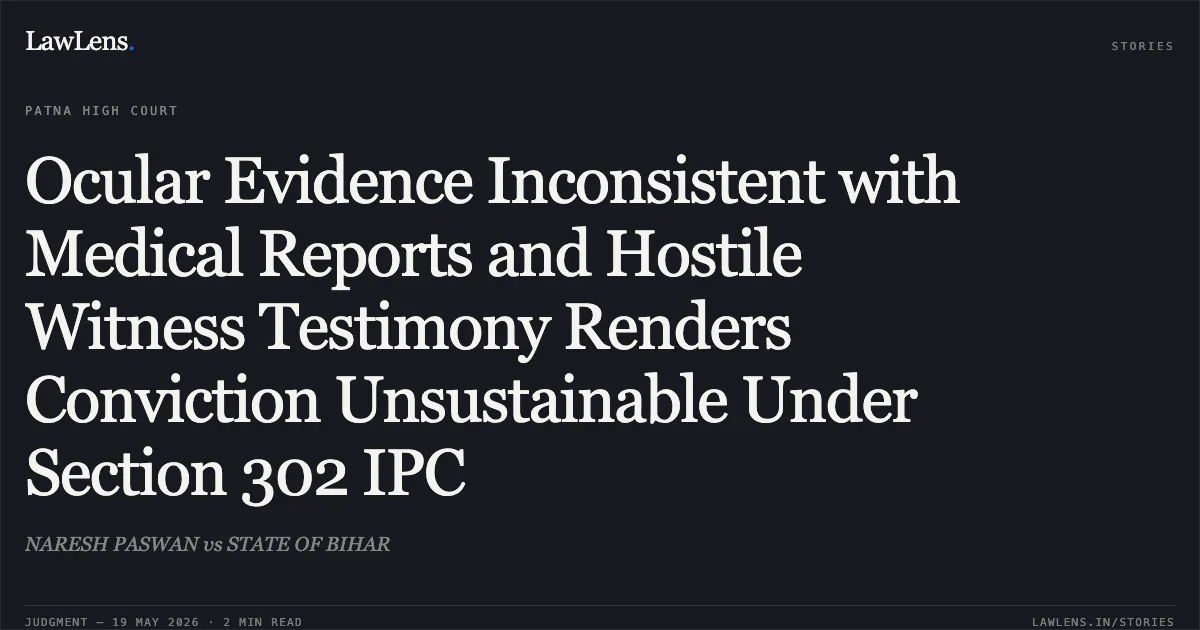
Source reference: p.7-8The court identified a "fundamental defect" in the contradiction between the FIR/oral testimony—which alleged the use of a saif (a sharp-cutting weapon)—and the post-mortem report, which stated the head injury was caused by a "hard blunt substance".
Source reference: p.5, 8-9Since the prosecution failed to explain why a sharp weapon resulted in blunt-force injuries, the evidence was deemed "totally irreconcilable".
Source reference: p.13Applying the principle of harmonious construction, the court held that the medical evidence improbableized the ocular testimony to such an extent that the conviction could not stand.
Source reference: p.10, 13-14Holding
The court held that the foundational facts were not proven beyond reasonable doubt because the material witnesses were hostile and the medical evidence contradicted the weapon of offense.
The High Court allowed the appeals and set aside the judgment of conviction and order of sentence dated March 26/30, 1998. The appellants were acquitted of all charges and ordered to be released or discharged from their bail bonds.
Source reference: p.14-15Acts & Sections Cited
4 provisions across 2 statutes referred to in this judgment. Each provision opens on LawLens.
Indian Penal Code, 18603
Code of Criminal Procedure, 19731
Original Court PDF
NARESH PASWANvsSTATE OF BIHAR
Click to open original judgment
Original judgment, available to read, download and summarize on LawLens.in