Facts
The appellants were convicted by the Trial Court on December 16, 2006, under Sections 324/323/34 of the IPC
Source reference: p.1The prosecution alleged that on September 9, 2002, the appellants assaulted Ashok Kundu with sharp weapons ("dao" and "hesua") and a "lathi" over a land dispute regarding a boundary wall
Source reference: p.2Ashok and his mother, Shanti Kundu, were injured. The injured were treated at Bethuadari Hospital
Source reference: p.2The defense argued that there was an inordinate delay of 6 days in dispatching the FIR to the Magistrate, and that the medical evidence (P.W. 7) contradicted the ocular testimony regarding the use of sharp weapons
Source reference: p.3-4Issues
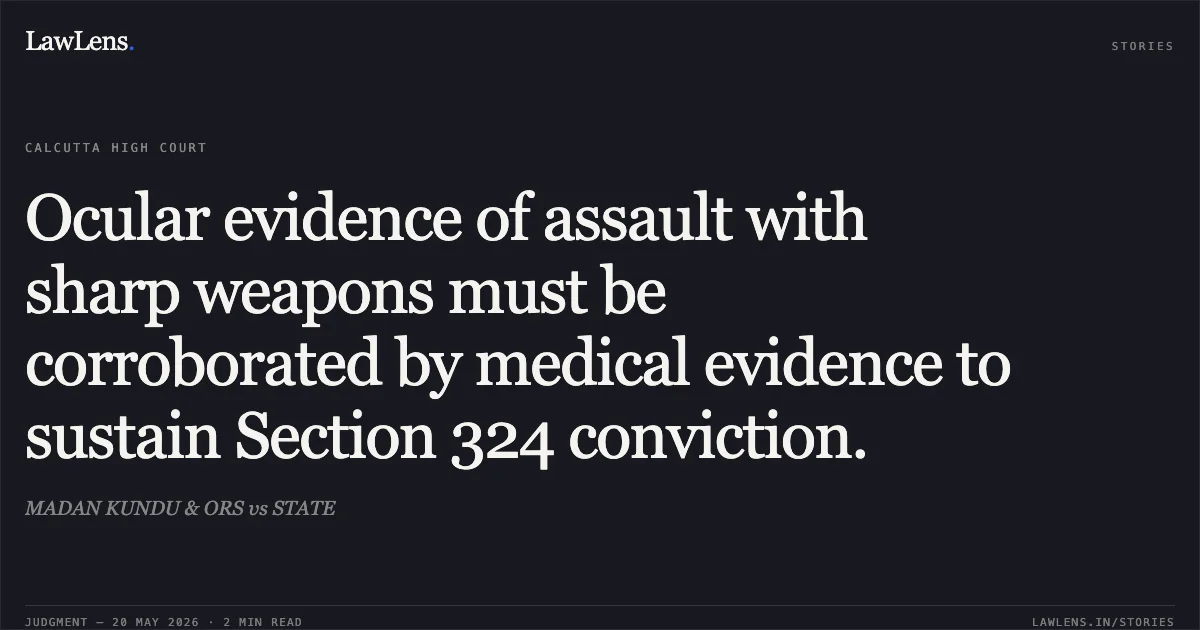
1. Whether the conviction under Section 324/34 IPC can be sustained when ocular testimony alleging assault by sharp-cutting weapons is contradicted by medical evidence showing only blunt injuries
Source reference: p.19, 212. Whether the appellants are liable for voluntarily causing simple hurt under Section 323/34 IPC despite investigative deficiencies
Source reference: p.20, 22Law Applied
The Court applied Section 319 of the IPC defining "hurt" as bodily pain, disease, or infirmity
Source reference: p.20Section 323 for voluntarily causing simple hurt.
Source reference: no citationThe Court further applied Section 324 of the IPC, which requires the voluntary causing of hurt by means of shooting, stabbing, or cutting instruments likely to cause death
Source reference: p.21The principle of "common intention" under Section 34 IPC was applied to establish collective participation in the assault
Source reference: p.20The Court also relied on the evidentiary principle that while an injured witness's testimony is significant, it must be consistent with medical evidence to prove the specific nature of the weapon used
Source reference: p.19Reasoning
The Court observed a clear "incongruity" between the statements of P.W. 1, 2, and 3 (who alleged assault by sharp weapons like dao and hesua) and the medical testimony of P.W. 7
Source reference: p.19The Medical Officer found only "lacerated blunt" injuries and abrasions, categorically stating that no sharp-cutting injuries were present and the weapons used were blunt
Source reference: p.14, 19The Court noted significant investigative lapses, including the failure to seize the alleged weapons, blood-stained clothes, or examine independent witnesses despite the incident occurring in a densely populated area
Source reference: p.20The Court held that the substratum of the case—that an altercation occurred due to a land dispute resulting in some injury—was established by the consistent ocular accounts and the fact of the victim’s hospitalization
Source reference: p.20-21Since the injuries were simple and the use of dangerous/sharp weapons was not medically proven, the ingredients of Section 324 were not met, but those of Section 323 were satisfied
Source reference: p.22Holding
The Court set aside the conviction and sentence under Section 324/34 IPC due to the lack of evidence of sharp-cutting injuries
The conviction under Section 323/34 IPC was affirmed, as simple hurt was proven
Source reference: p.25The Court modified the sentence from imprisonment to a fine of Rs. 20,000 each. All sentences of imprisonment were vacated upon payment of the fine
Source reference: p.22, 27-28Acts & Sections Cited
15 provisions across 2 statutes referred to in this judgment. Each provision opens on LawLens.
Indian Penal Code, 1860
Code of Criminal Procedure, 19731
Original Court PDF
MADAN KUNDU & ORSvsSTATE
Click to open original judgment
Original judgment, available to read, download and summarize on LawLens.in