Facts
On September 7, 2011, during a community dinner in village Badagaon, an altercation occurred between the deceased, Pappu, and one Badu. Badu summoned Rakesh and Kailash.
Source reference: para 6Rakesh allegedly assaulted Pappu on the head with a luhangi (iron-bound stick), while Kailash assaulted him with a lathi (wooden staff).
Source reference: para 6, 23Pappu succumbed to head injuries the following day.
Source reference: para 6, 20The Trial Court convicted Rakesh and Kailash under Section 302/34 IPC.
Source reference: para 1During the pendency of the appeal, Rakesh expired, leading to the abatement of his appeal; the proceedings continued solely against Appellant No. 2, Kailash.
Source reference: para 4, 5Issues
1. Whether the ocular testimony of the eyewitnesses can be discarded if it appears inconsistent with medical evidence regarding the specific site of injury.
Source reference: para 322. Whether an accused can be held vicariously liable for murder under Section 34 of the IPC when the fatal injury was attributed to a co-accused.
Source reference: para 38, 413. Whether the non-recovery or absence of a forensic report for the weapon of offence is fatal to the prosecution’s case.
Source reference: para 46, 47Law Applied
The court applied Section 302 (Murder) and Section 34 (Common Intention) of the IPC, establishing that act done by several persons in furtherance of common intention makes each person liable as if it were done by him alone.
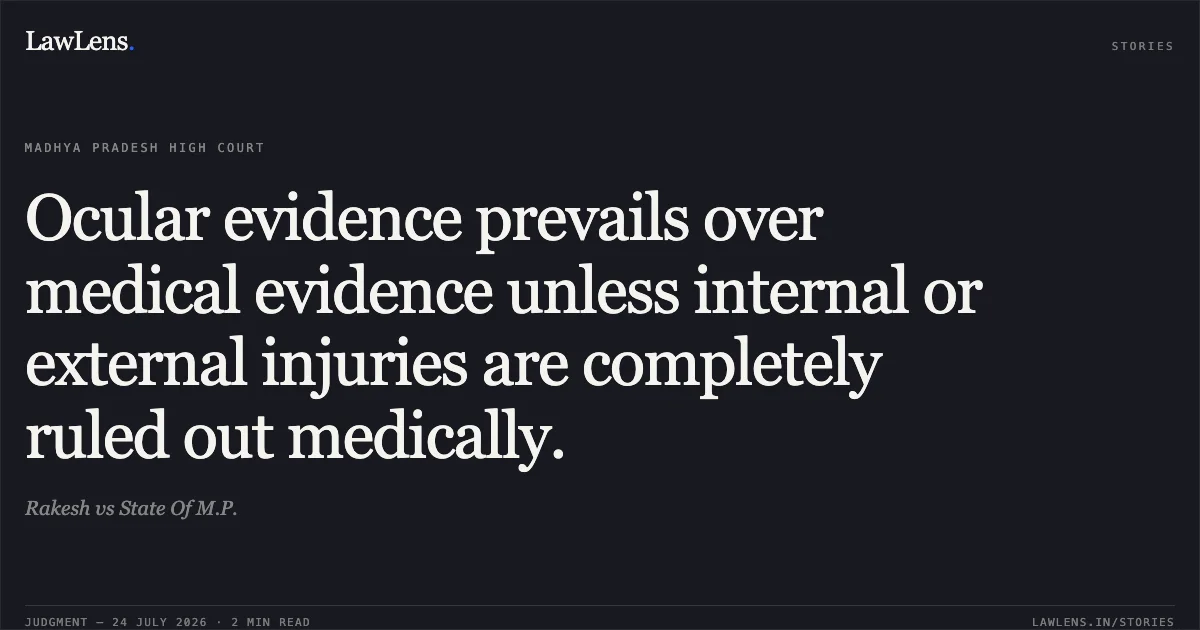
Source reference: para 39-40It relied on Bhajan Singh v. State of Haryana and CBI v. Mohd. Parvez Abdul Kayuum, holding that ocular evidence prevails over medical evidence unless the latter completely rules out the former.
Source reference: para 33Relying on Rakesh v. State of U.P. and Goverdhan v. State of Chhattisgarh, the court affirmed that the recovery of the weapon of crime is not a sine qua non for conviction if trustworthy eyewitness accounts exist.
Source reference: para 46Reasoning
The Court observed that while medical reports lacked a specific external injury on the deceased's back (where Kailash allegedly struck), such a discrepancy does not negate the overall credibility of the consistent eyewitness accounts of PW-2, PW-3, and PW-4.
Source reference: para 34-36The Court reasoned that in a multi-person assault, witnesses cannot be expected to provide minute-by-minute anatomical details.
Source reference: para 35Regarding Section 34 IPC, the Court found that Kailash’s presence, use of a weapon, and participation alongside Rakesh clearly demonstrated a shared common intention to cause death; thus, whether Kailash caused the specific fatal head injury was legally immaterial.
Source reference: para 41The Court dismissed the defense's theory that injuries resulted from an accidental fall while intoxicated, as the medical examiner (PW-12) specifically ruled out such a possibility.
Source reference: para 43Holding
The Court held that the prosecution successfully proved the homicide beyond reasonable doubt through reliable eyewitnesses and the application of Section 34 IPC.
The High Court dismissed the appeal and affirmed the conviction and life imprisonment sentence of Appellant No. 2, Kailash.
Source reference: para 50, 53The appeal filed by Rakesh was dismissed as abated due to his death.
Source reference: para 4The Court ordered Kailash to surrender within one month to undergo his remaining sentence.
Source reference: para 51, 52Acts & Sections Cited
8 provisions across 2 statutes referred to in this judgment. Each provision opens on LawLens.
Code of Criminal Procedure, 19731
Indian Penal Code, 18607
Original Court PDF
RakeshvsState Of M.P.
Click to open original judgment
Original judgment, available to read, download and summarize on LawLens.in