Facts
The informant, Mahipal Singh, alleged that on April 10, 1998, his son Jagpal was murdered near a canal culvert by four accused (Mukesh, Bablu, Pravesh, and Leela) due to a long-standing land dispute.
Source reference: para. 4The prosecution claimed the accused intercepted Jagpal, who was on a bicycle, and assaulted him with sticks and knives.
Source reference: para. 4An FIR was lodged at 10:30 am.
Source reference: para. 5Following investigation and recovery of weapons, the Trial Court convicted the appellants under Sections 302/34 IPC and the Arms Act.
Source reference: para. 2During the pendency of the appeal, appellants Lila, Mukesh, and Bablu died, leaving the appeal to survive only for appellant Pravesh.
Source reference: para. 3Issues
1. Whether the appellant-convict Pravesh had any motive to commit the murder.
Source reference: para. 21(i)2. Whether there was an unexplained delay in lodging the FIR.
Source reference: para. 21(ii)3. Whether the non-examination of eye-witness Rohtash was fatal to the prosecution.
Source reference: para. 21(iii)4. Whether the use of knives could cause the multiple fractures found on the deceased's head.
Source reference: para. 21(v)5. Whether the prosecution proved its case against Pravesh beyond reasonable doubt.
Source reference: para. 21(iv)Law Applied
The Court applied Section 302 read with Section 34 of the IPC regarding common intention to murder, and Section 4/25 of the Arms Act.
Source reference: para. 2, 7It relied on Section 134 of the Evidence Act, which stipulates that the quality, not quantity, of witnesses matters.
Source reference: para. 49The Court followed the principle that in cases of direct ocular evidence, proof of motive is not indispensable (Chandan v. State).
Source reference: para. 44Regarding inquest reports, it applied the rule that Section 174 Cr.P.C. is limited to ascertaining the apparent cause of death and need not contain names of witnesses (Radha Mohan Singh v. State of U.P.).
Source reference: para. 69-70The principle of "falsus in uno, falsus in omnibus" was rejected as having no general acceptability in India.
Source reference: para. 57Reasoning
The Court found the motive established through documented land litigation involving Pravesh’s father.
Source reference: para. 41-42The FIR was deemed prompt as it was lodged within two hours of the incident occurring 12km away.
Source reference: para. 46Although the appellant challenged his presence, the Court held that the eye-witnesses (PW-1 and PW-2) were trustworthy despite being relatives, as they provided consistent accounts of the assault.
Source reference: para. 65-67The Court clarified that the witnesses' failure to sign the inquest report did not discredit them, as an inquest is not substantive evidence of the killers' identities.
Source reference: para. 69Medical evidence from PW-4 confirmed that the incised wounds were caused by sharp weapons (knives) with sufficient force to fracture underlying bone, corroborating the ocular testimony.
Source reference: para. 24, 98The recovery of a blood-stained knife on Pravesh's pointing out, which remained uncontroverted in cross-examination, further linked him to the crime.
Source reference: para. 27Holding
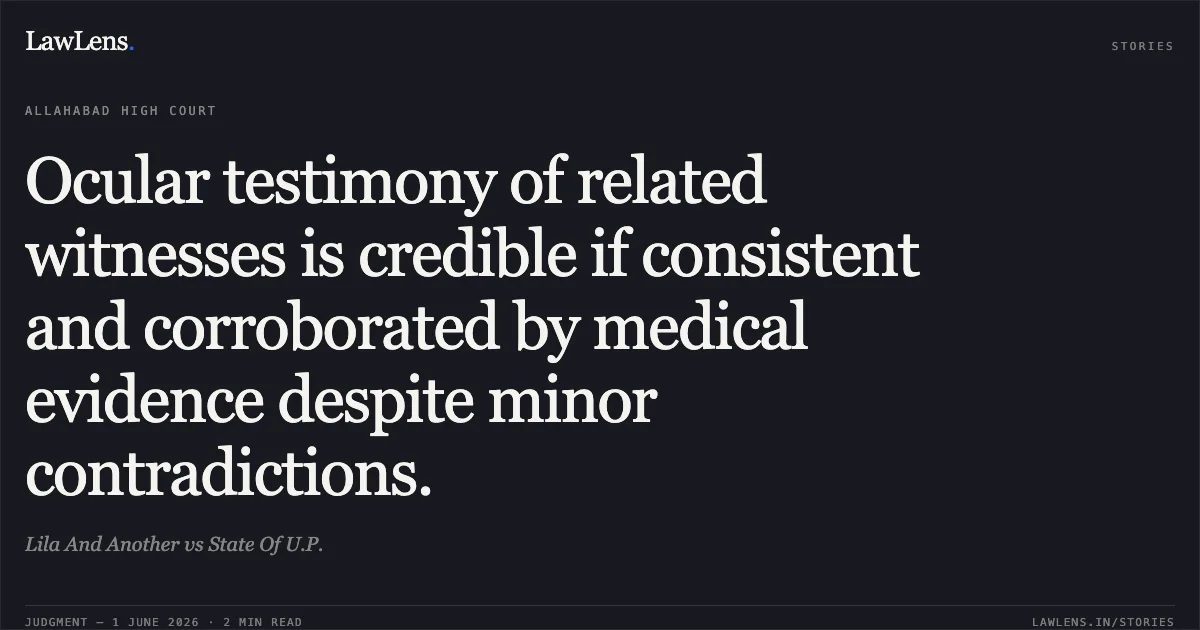
The Court answered all issues in favor of the prosecution, holding that the testimony of the related witnesses was reliable and corroborated by medical evidence and weapon recovery.
The Court affirmed the conviction and life imprisonment of appellant Pravesh under Section 302/34 IPC and his sentence under the Arms Act. The appeal was dismissed, and the appellant was ordered to serve the remainder of his sentence.
Source reference: para. 100-104Acts & Sections Cited
7 provisions across 3 statutes referred to in this judgment. Each provision opens on LawLens.
Code of Criminal Procedure, 19733
Indian Penal Code, 18602
Arms Act, 19592
Original Court PDF
Lila And AnothervsState Of U.P.
Click to open original judgment
Original judgment, available to read, download and summarize on LawLens.in