Facts
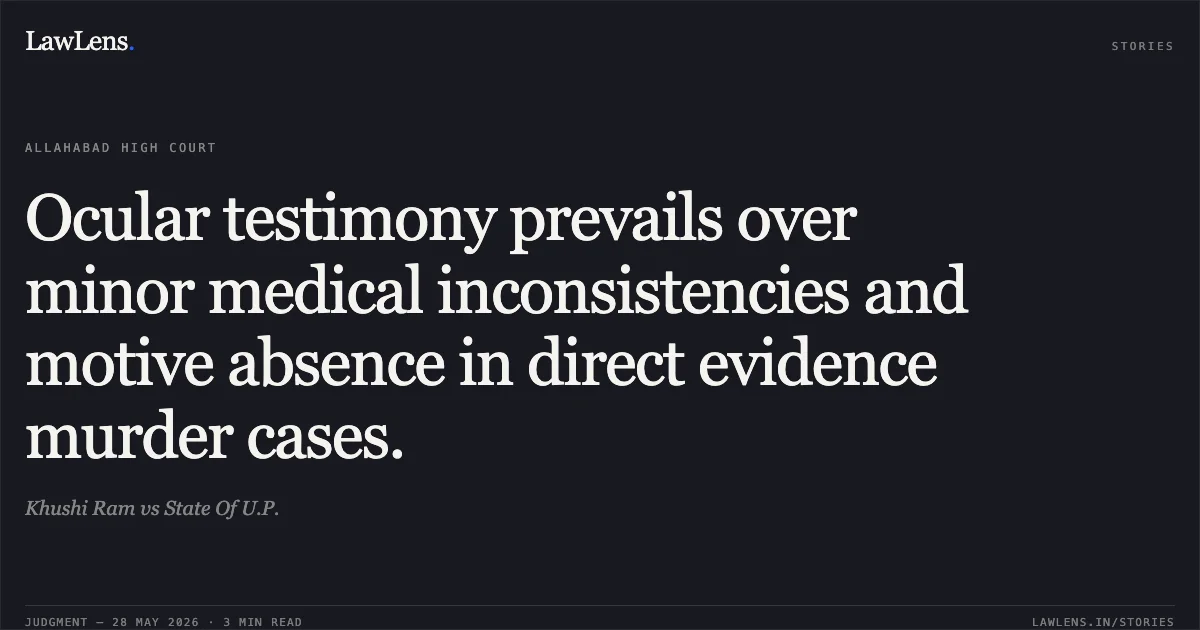
The appellant, Khushi Ram, was accused of murdering Mohd. Umar @ Munna on 28.02.2002.
Source reference: para. 4The prosecution alleged that while the deceased was sleeping in a mango orchard, the appellant slit his throat with a spade (kudal).
Source reference: para. 4Eyewitnesses (PW-1 and PW-2) claimed to have chased the appellant, who fled after discarding the weapon.
Source reference: para. 4The Trial Court (Fast Track Court No. 3, Sitapur) convicted the appellant under Section 302 IPC on 30.10.2003, sentencing him to life imprisonment.
Source reference: para. 2Despite the appellant's release on remission on 26.01.2019, the High Court proceeded to adjudicate the appeal on merits regarding the legality of the conviction.
Source reference: para. 3Issues
1. Whether the FIR was ante-timed and if the delay in forwarding it to the Magistrate vitiated the trial
Source reference: para. 282. Whether the ocular testimony was contradicted by medical evidence and the absence of a serological report on the origin of blood
Source reference: para. 383. Whether minor discrepancies in the witnesses' testimonies regarding the recovery of the weapon and the place of occurrence rendered the prosecution story unreliable
Source reference: para. 534. Whether the non-examination of the scribe of the FIR was fatal to the prosecution's case
Source reference: para. 70Law Applied
The court applied Section 302 of the IPC for murder
Source reference: para. 2It relied on Section 157 Cr.P.C. regarding the dispatch of FIRs to Magistrates, noting that delay is not fatal unless prejudice is shown
Source reference: para. 32Precedents including Brahm Swaroop v. State of U.P. established that inquest reports are not substantive evidence
Source reference: para. 35Principles from Punjab Singh v. State of Haryana and Sudha Renukaiah v. State of A.P. were applied to hold that ocular evidence prevails over hypothetical medical opinions
Source reference: para. 42The court also applied the doctrine from State of Rajasthan v. Teja Ram that the disintegration of blood on weapon exhibits does not invalidate a recovery
Source reference: para. 45Himanshu Mohan Rai v. State of U.P. regarding the non-necessity of examining a scribe
Source reference: para. 74Reasoning
The Court found the one-hour delay in lodging the FIR reasonably explained by the informant’s need to travel by bicycle and draft the report
Source reference: para. 30It rejected the challenge to the inquest report, holding its purpose is limited to identifying the apparent cause of death, not detailing witnesses
Source reference: para. 35-36Regarding medical evidence, the Court noted that PW-6 (the doctor) confirmed the injuries were possible with a kudal, and that medical alternatives do not constitute contradictions to direct ocular evidence
Source reference: para. 42-44The Court dismissed the forensic concerns, citing that climatic factors often cause blood disintegration
Source reference: para. 46The "minor discrepancies" in the testimonies of PW-1 and PW-2 were viewed as natural variations for rustic witnesses deposing years after a traumatic event
Source reference: para. 57-60Finally, the Court held that since the informant (PW-1) proved the contents of the FIR, the testimony of the scribe was unnecessary
Source reference: para. 73-75Holding
The Court answered all issues in the negative, holding that the prosecution successfully proved the guilt of the appellant beyond a reasonable doubt
The High Court dismissed the appeal and affirmed the judgment and order of conviction under Section 302 IPC. Since the appellant had already been released on remission, no order for surrender was made unless required for other cases. The Court quantified the Amicus Curiae fee at Rs. 25,000.
Source reference: para. 90-94Acts & Sections Cited
3 provisions across 2 statutes referred to in this judgment. Each provision opens on LawLens.
Indian Penal Code, 18601
Code of Criminal Procedure, 19732
Original Court PDF
Khushi RamvsState Of U.P.
Click to open original judgment
Original judgment, available to read, download and summarize on LawLens.in