Facts
The respondents had contributed 1.837 acres of land from Plot Nos. 344, 352 and 353 at Nayapalli, now Jayadev Vihar, Bhubaneswar, for implementation of the Bhubaneswar Development Authority’s Town Planning Scheme-II.
Source reference: p.4–8The Scheme was subsequently abandoned, and the respondents sought restoration of the land or allotment of equivalent land having similar potential value.
Source reference: p.4–8By judgment dated 21 May 2009, the High Court directed the State to allot equivalent land measuring 1.837 acres with similar potential value.
Source reference: p.8–9The Supreme Court dismissed the State’s challenge on 9 January 2013, while permitting payment of the prevailing market value if suitable land could not be found.
Source reference: p.8–9Upon the State’s non-compliance, the Supreme Court appointed Justice R.K. Patra, former Chief Justice of the Sikkim High Court, to determine the prevailing market value.
Source reference: p.9–16After considering documentary and oral evidence and conducting a spot inspection, the Arbitrator valued Plot No.353 at Rs.14 crore per acre as on 9 January 2013.
Source reference: p.9–16In Execution Petition No.2 of 2015, the learned Single Judge accepted the State’s submission that the land was valued at Rs.7 crore per acre and directed deposit of the balance amount on that basis.
Source reference: p.16–19The State filed the present execution appeal, contending, inter alia, that it had offered equivalent land at Sampur and that the Arbitrator’s valuation was excessive and failed to account for the land’s alleged Sarad-II classification, road and drainage features, and the State’s earlier written submissions.
Source reference: p.23–29Issues
1. Whether the State could challenge, in execution proceedings, the valuation of the subject land determined by the Arbitrator appointed pursuant to the Supreme Court’s order, and whether the executing court was justified in substituting the rate of Rs.7 crore per acre for Rs.14 crore per acre?
Source reference: p.30–34, 44–492. Whether the State had established that the subject land was covered by a road or drain, or was otherwise incapable of being valued as Sarad-II/residential land, so as to justify reduction of the Arbitrator’s valuation?
Source reference: p.36–463. Whether the State was bound by its statement before the learned Single Judge that it was ready and willing to deposit the value of the land at Rs.7 crore per acre?
Source reference: p.32–33Law Applied
The Court applied the settled principle that an executing court cannot go behind the decree, must execute it according to its tenor, and cannot reopen its correctness unless it has been set aside in appropriate proceedings, relying on Vasudev Dhanjibhai Modi v. Rajabhai Abdul Rehman, Topanmal Chhotamal v. Kundomal Gangaram and Satyawati v. Rajinder Singh.
Source reference: p.30It further applied the doctrine that a party cannot approbate and reprobate, relying on State of Punjab v. Dhanjit Singh Sandhu, particularly where the State had made a clear submission before the executing court regarding the applicable valuation.
Source reference: p.32–33The Court also relied on the Supreme Court’s orders dated 11 March 2014 and 28 January 2015, which authorised determination of the prevailing market value and permitted the respondents to execute the order in accordance with law.
Source reference: p.31–32, 35–36The valuation principles under Rule 41 and Appendix-II of the Odisha Stamp Rules, 1952, including consideration of the value of adjacent or nearby land, were also relevant.
Source reference: p.24, 27Finally, factual findings reached by the Court-appointed Arbitrator after considering evidence, cross-examination, official records and spot inspection were not to be disturbed in the absence of persuasive material demonstrating legal or factual infirmity.
Source reference: p.38–46Reasoning
The Court held that the State had participated in the valuation proceedings before the Court-appointed Arbitrator, produced evidence, cross-examined witnesses and filed objections to the report.
Source reference: p.38–41The Arbitrator had specifically found from the 1992 Record-of-Rights and survey materials that no road or drain existed over the relevant portion of Plot No.353 at the material time; the State failed to dislodge that finding with credible contemporaneous evidence.
Source reference: p.38–41The State’s argument that the land was low-lying Sarad-II land covered by a drain was also inconsistent with its own earlier position and with the evidence showing that part of the plot had subsequently been converted for homestead use.
Source reference: p.43–46Although the learned Single Judge had accepted Rs.7 crore per acre on the basis of the State’s submission, the record did not establish that Rs.7 crore was the applicable benchmark valuation as on 9 January 2013.
Source reference: p.47–48Conversely, official material placed before the Court indicated a benchmark valuation of Rs.14.40 crore per acre for Plot No.353, Sarad-II, Jayadev Vihar, in 2016, broadly corroborating the Arbitrator’s determination of Rs.14 crore per acre as on 9 January 2013.
Source reference: p.47–48The State therefore could not both rely upon the Rs.7 crore figure to obtain disposal of the execution petition and subsequently challenge the valuation basis in appeal.
Source reference: p.44–49More importantly, the Arbitrator’s determination, made pursuant to the Supreme Court’s directions and after a full evidentiary process, had not been shown to suffer from any legal flaw.
Source reference: p.44–49Holding
The appeal was found devoid of merit.
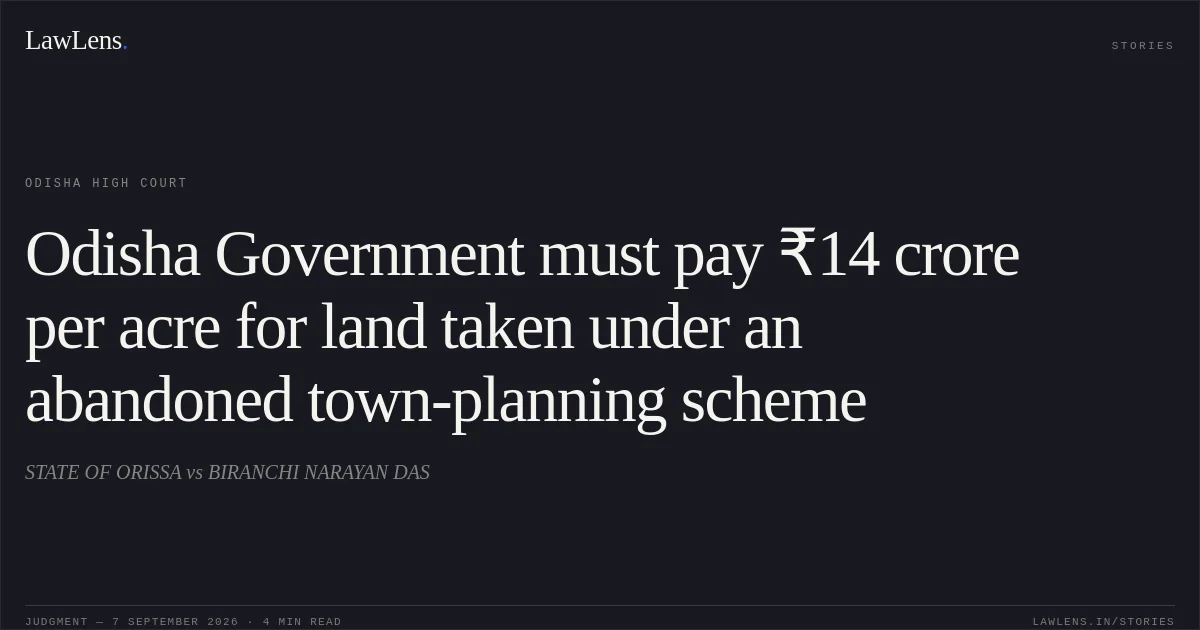
The Division Bench modified the learned Single Judge’s order dated 11 August 2017 and directed the State to pay the respondents the value of 1.837 acres at the rate of Rs.14 crore per acre, as determined by the Court-appointed Arbitrator.
Source reference: p.48–49The State was directed to deposit the balance amount with the High Court Registry within four weeks, if not already deposited.
Source reference: p.49The respondents were entitled to disbursement of the balance amount, together with any interest accrued on deposits made pursuant to earlier court orders.
Source reference: p.49The parties were directed to bear their own costs.
Source reference: p.49Acts & Sections Cited
1 provisions across 1 statute referred to in this judgment. Linked provisions open on LawLens.
Orissa Development Authorities Act, 19821
Original Court PDF
STATE OF ORISSAvsBIRANCHI NARAYAN DAS
Click to open original judgment
Original judgment, available to read, download and summarize on LawLens.in