01Facts
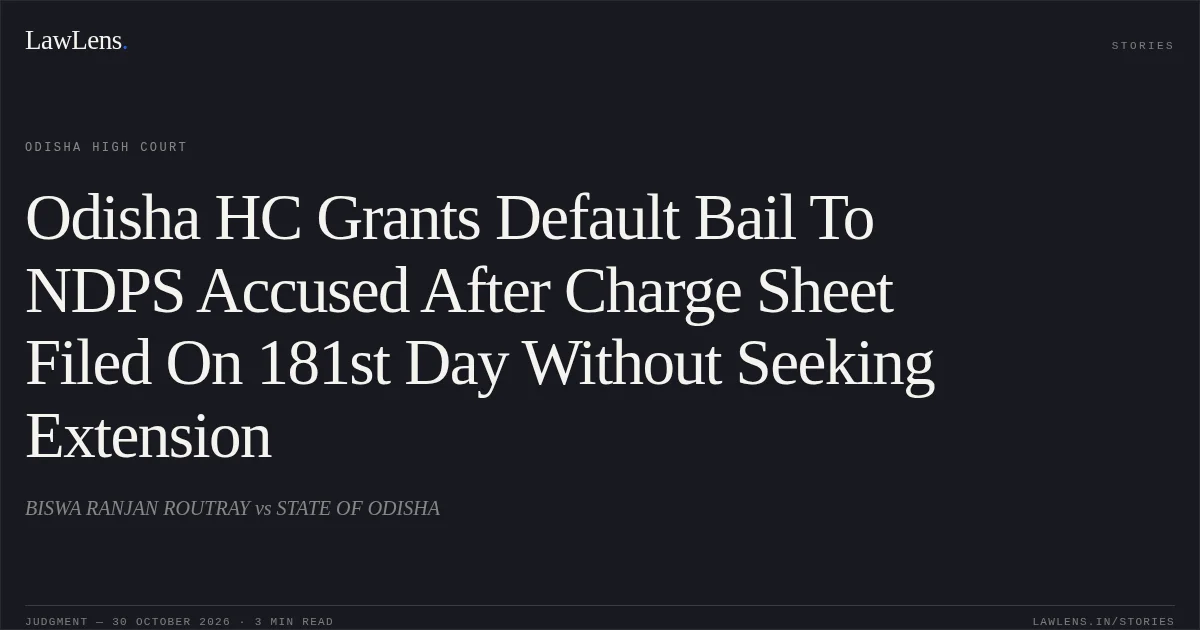
The petitioner was in custody from 28 July 2025 in an NDPS case alleging possession of 320 grams of brown sugar
p. 3The 180th day of his remand was 23 January 2026.
p. 4Although the charge sheet was dated 22 January, the State acknowledged that it was filed in court only on 24 January, the 181st day; no application to extend the investigation period had been made under Section 36-A(4) of the NDPS Act.
pp. 4, 8–9The Special Judge rejected the petitioner’s bail application on 10 February 2026.
p. 3The petitioner then sought bail before the High Court, relying on his right to default bail.
pp. 5–602Issues
i.Whether the petitioner was entitled to default bail where the charge sheet was filed after expiry of the 180-day period under Section 36-A(4) of the NDPS Act and no extension had been obtained.
pp. 5–6, 8–10ii.Whether the petitioner’s application could be considered despite the earlier order of 27 January 2026 not having been challenged.
p. 703Law Applied
Section 36-A(4) of the NDPS Act allows 180 days to complete the investigation in cases involving commercial quantity, extendable up to one year on a Public Prosecutor’s report stating the investigation’s progress and specific reasons for further detention.
pp. 3–4Where the charge sheet is not filed within the prescribed period and no valid extension is obtained, the accused’s statutory right to default bail arises, subject to the accused invoking that right in accordance with law.
pp. 8–10Section 37(1)(b)(ii) imposes stringent conditions on bail in specified NDPS cases, but the Court held that those restrictions did not displace the petitioner’s right arising from non-compliance with the statutory investigation timeline.
pp. 8–10Article 21 of the Constitution protects personal liberty in accordance with procedure established by law.
p. 3, 9The judgment refers to M. Ravindran v. Intelligence Officer, Directorate of Revenue Intelligence as relied on by the State and the Special Judge, and to Suresh Chandra Sahoo v. State of Odisha and Gopal Pal v. State of Odisha as authorities relied on by the petitioner.
pp. 5–7Provisions in the judgment · 12 · Linked ones open on LawLens
Bharatiya Nagarik Suraksha Sanhita, 2023 Section 483Section 480Section 187
Narcotic Drugs and Psychotropic Substances Act, 1985 Section 21Section 29Section 37Section 19Section 24
Indian Penal Code, 1860 Section 116
Bharatiya Nyaya Sanhita, 2023 Section 65Section 70
Code of Criminal Procedure, 1973 Section 167
04Reasoning
The State’s affidavit admitted that the charge sheet was not filed until the 181st day, and the record disclosed no application for extension under Section 36-A(4).
pp. 8–9The Court rejected the explanation that a law-and-order situation prevented timely filing, holding that it could not excuse breach of the statutory timeline.
p. 9It also noted that the matter had not been placed before the Special Judge on the 180th day.
p. 9The Court considered that rejecting the application solely because the earlier order of 27 January had not been challenged would sacrifice the accused’s right on a technicality, particularly as the later impugned order had considered and rejected the claim for default bail.
pp. 7–8The NDPS Act’s stringent bail provisions and the alleged quantity of contraband did not override the statutory right arising from the prosecution’s failure to comply with Section 36-A(4).
p. 905Holding
The High Court held that the petitioner was entitled to default bail because the charge sheet was filed after the 180-day period and no extension had been sought or granted.
pp. 9–10It directed that he be released on bail on terms fixed by the court seized of the case and disposed of the BLAPL.
p. 10Original Court PDF
BISWA RANJAN ROUTRAYvsSTATE OF ODISHA
Click to open original judgment
Original judgment, available to read, download and summarize on LawLens.in