01Facts
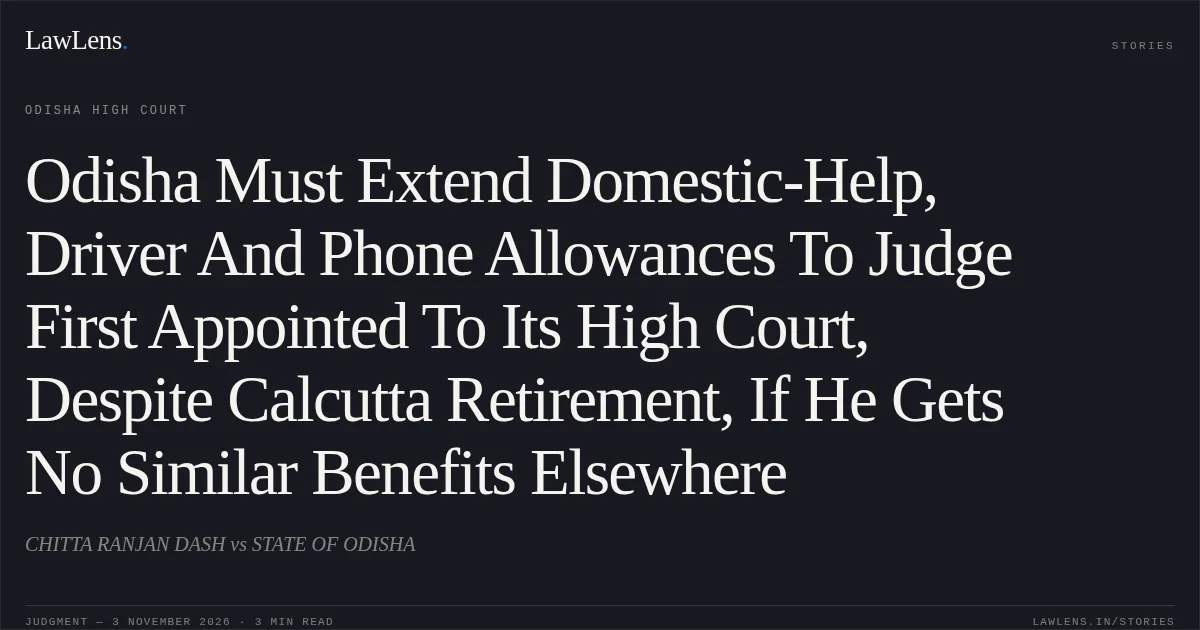
The petitioner was appointed as a Judge of the Orissa High Court on 7 October 2009, transferred to the Calcutta High Court in June 2022, and retired there on 20 May 2024.
p. 2 · ¶ 2By order dated 31 July 2025, Odisha permitted him to avail medical facilities but did not sanction allowances for domestic help, driver, secretarial assistance, security and telephone facilities.
p. 2 · ¶ 3–4He challenged that limitation, relying on the State’s notification of 24 April 2025 and Supreme Court directions concerning post-retirement benefits for retired High Court Judges.
pp. 3–4 · ¶ 5–1002Issues
i.Whether a Judge initially appointed to the Orissa High Court, but transferred and retired from the Calcutta High Court, may claim domestic-help, driver, secretarial, security and telephone allowances from Odisha after electing to receive post-retirement benefits there.
p. 5 · ¶ 1103Law Applied
Articles 226 and 227 of the Constitution confer the High Court’s writ and supervisory jurisdiction.
p. 1In P. Ramakrishnam Raju v. Union of India, the Supreme Court encouraged States to formulate post-retirement benefit schemes for retired High Court Judges.
pp. 8–9 · ¶ 14–15Subsequent orders in Justice V.S. Dave, President, Association of Retired Judges of Supreme Court and High Courts v. Kusumjit Sidhu directed States to extend benefits under the Andhra Pradesh model, including domestic-help and telephone allowances, and clarified that, for a transferred Judge, the concerned State may be the State where the Judge was first appointed or the State from which the Judge retired.
pp. 9–13 · ¶ 16–26Odisha’s notification dated 24 April 2025 provides the relevant allowances, subject to the condition that the retired Judge is not availing the same or similar facilities from another High Court.
p. 13 · ¶ 27The Court also relied on Orissa High Court Retired Judges’ Association v. Union of India, which recognised the importance of medical, domestic-help and telephone facilities to retired Judges’ dignity and well-being.
pp. 5–8 · ¶ 1304Reasoning
The Court read the Supreme Court’s directions on domestic help and telephone benefits alongside the 15 April 2025 clarification on which State may be responsible for a transferred Judge’s benefits.
pp. 11–13 · ¶ 22–26Although that clarification arose in the context of medical reimbursement, it recognised the State of first appointment as a possible concerned State; the other directions separately addressed domestic help and related benefits.
pp. 11–13 · ¶ 22–26Odisha’s notification did not expressly exclude a Judge who retired from another High Court; its condition instead prevents duplicate benefits.
pp. 13–14 · ¶ 27–30Since the petitioner had elected to receive benefits from Odisha, and Odisha had accepted that election for medical facilities, the Court held that retirement from Calcutta alone was insufficient to deny the other allowances, provided he received no same or similar benefits from another High Court.
pp. 14–17 · ¶ 29–3705Holding
The petition was allowed.
p. 17 · ¶ 38The order dated 31 July 2025 was set aside insofar as it failed to consider and sanction the claimed allowances.
p. 17 · ¶ 38Odisha was directed to extend the benefits admissible under the applicable orders and the notification dated 24 April 2025, subject to verification that the petitioner was not receiving the same or similar facilities from the Calcutta High Court or another High Court.
p. 18 · ¶ 39Any arrears were to be determined under the applicable orders and paid within eight weeks of receipt of the judgment.
p. 18 · ¶ 39No order as to costs.
p. 20 · ¶ 45Original Court PDF
CHITTA RANJAN DASHvsSTATE OF ODISHA
Click to open original judgment
Original judgment, available to read, download and summarize on LawLens.in