01Facts
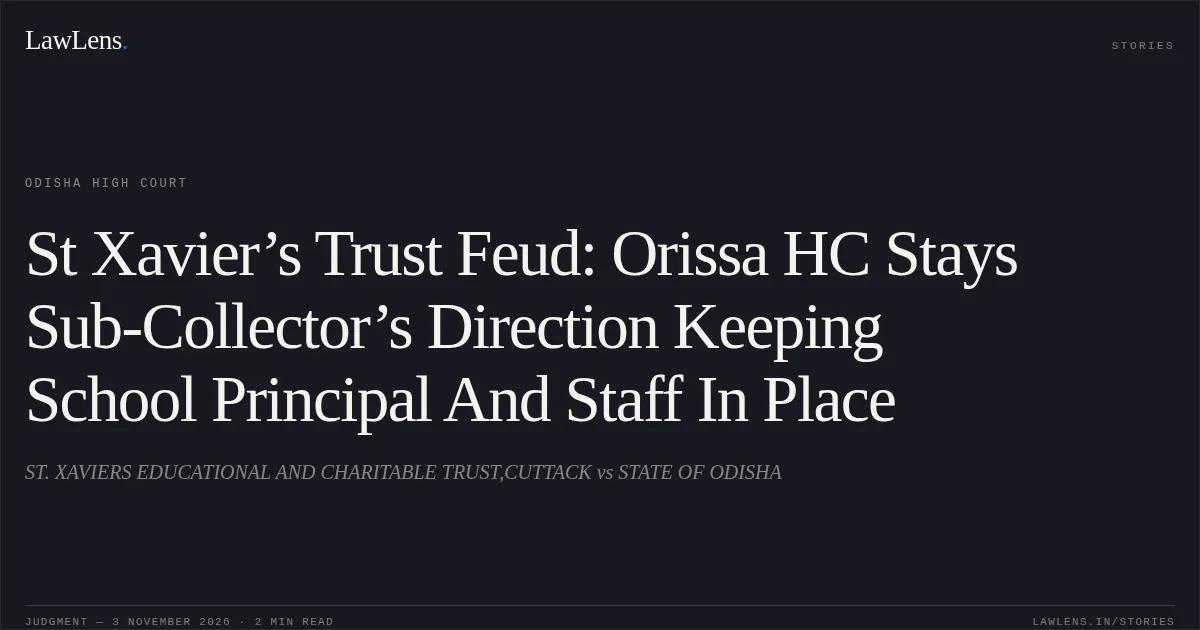
The appellant Trust and a separate Society operated several schools. Disputes arose over amendments to the Trust deed, the trustees, and management of a school, including the removal of the Principal and staff. A related application under Section 9 of the Arbitration and Conciliation Act, 1996, was pending before the District Judge; proceedings in that matter had been stayed by the High Court in a separate writ petition.
pp. 3–5Following disturbances and police complaints, the Sub-Collector, Athagarh, directed rival groups to refrain from disrupting the school and directed the existing Principal, staff, and office bearers to continue in their roles.
pp. 2–6The appellant challenged that direction in a writ petition. The Single Bench directed the Collector and Superintendent of Police to maintain law and order but did not stay the Sub-Collector’s directions. The Trust appealed, seeking a stay insofar as those directions affected the school’s management and administration.
pp. 2–602Issues
i.1. Whether the State administration could, under the guise of maintaining law and order, issue directions governing the management and administration of a private educational institution.
pp. 5–6, 13–15ii.2. Whether the direction to maintain law and order could be sustained separately from the directions concerning the school’s management and administration.
pp. 14–1603Law Applied
Article 226 is not ordinarily a remedy for enforcing private-law rights; the challenged action must involve a public-law element (Sushmita Basu v. Ballygunge Siksha Samity, (2006) 7 SCC 680; K.K. Saxena v. International Commission on Irrigation and Drainage, (2015) 4 SCC 670).
p. 8A private educational institution’s performance of the public function of imparting education does not, by itself, make an internal management dispute one involving the State under Article 12; Trigun Chand Thakur v. State of Bihar, (2019) 7 SCC 513, was cited in support.
pp. 8–9T.M.A. Pai Foundation v. State of Karnataka, (2002) 8 SCC 481, recognises institutional autonomy, subject to appropriate State regulation to maintain academic standards, atmosphere, and infrastructure.
p. 6The State has a constitutional responsibility to maintain law and order under Entry 1 of the State List, but that responsibility does not authorise it to intrude into a private institution’s management or administration.
pp. 9–10Provisions in the judgment · 1 · Linked ones open on LawLens
Arbitration and Conciliation Act, 1996 Section 9
04Reasoning
The dispute concerned internal control of the Trust and the school, including the continuation or replacement of the Principal and staff. Those matters were private management disputes, with related proceedings already pending before the competent court; they did not become matters for State determination merely because the institution imparted education.
pp. 5, 9–10The Sub-Collector’s directions protecting the existing school functionaries therefore exceeded the State’s law-and-order role.
pp. 9–10However, the State remained obliged to prevent disruption and preserve public peace. The Court accordingly treated the law-and-order direction as severable from the directions affecting management and administration.
pp. 9–1005Holding
The appeal was disposed of by staying the Sub-Collector’s direction insofar as it concerned the management, administration, or affairs of the educational institution.
p. 10The Court declined to interfere with the direction to maintain law and order and requested the Single Bench to give priority to the pending writ petition and dispose of it at the earliest.
p. 10Original Court PDF
ST. XAVIERS EDUCATIONAL AND CHARITABLE TRUST,CUTTACKvsSTATE OF ODISHA
Click to open original judgment
Original judgment, available to read, download and summarize on LawLens.in