Facts
The applicant was proposed for engagement as a "fresh face substitute" Telephone Attendant cum Dak Khallasi (TADK) in the Railways on June 5, 2020, with approval granted on July 23, 2020
Source reference: p. 2, para. 1An offer of appointment was issued on July 30, 2020; the applicant accepted the offer and submitted the required documents and medical fees on July 31, 2020
Source reference: p. 2, para. 2Before the medical examination and formal joining could be completed, the Railway Board issued instructions on August 6, 2020 (reiterated via RBE No. 102/2020 on December 1, 2020) discontinuing the engagement of fresh face substitute TADKs to eliminate perceived "backdoor entries"
Source reference: p. 6, para. 8Consequently, the respondents issued a letter on May 7, 2021, cancelling the applicant's appointment process
Source reference: p. 3, para. 3The applicant challenged this cancellation, seeking a direction to allow him to join the post
Source reference: p. 4, para. 4Issues
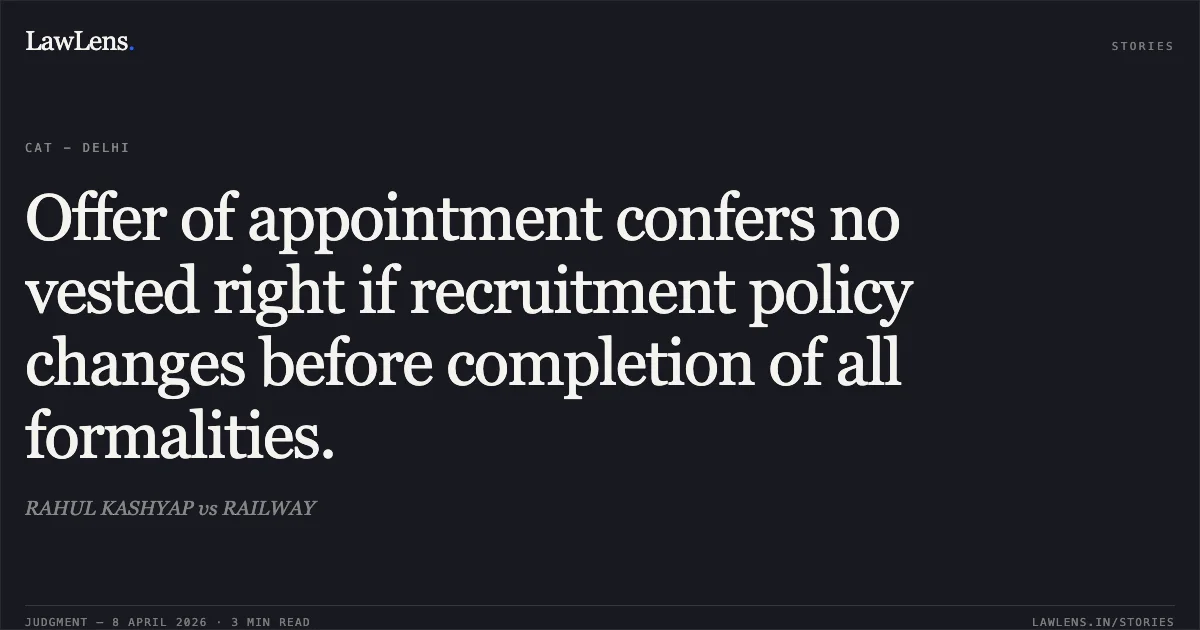
1. Whether the issuance and acceptance of an offer of appointment confers an indefeasible or vested right to employment upon the candidate
Source reference: p. 8, para. 122. Whether a change in executive policy discontinuing a recruitment scheme applies to candidates whose appointment process was initiated but not finalized prior to the policy change
Source reference: p. 9-10, para. 14-153. Whether administrative delay in completing joining formalities creates a legal right to appointment in contravention of a subsequent valid policy decision
Source reference: p. 10, para. 16Law Applied
The Tribunal applied the fundamental principle of service jurisprudence that the mere issuance of an offer letter or inclusion in a select list does not confer an indefeasible right to appointment; such rights only crystallize upon the issuance of a formal appointment order after fulfilling all conditions precedent
Source reference: p. 9, para. 13It relied on the doctrine of executive discretion in policy-making, noting that the government has the authority to discontinue recruitment schemes to ensure transparency and prevent irregular appointments under Articles 14 and 16 of the Constitution
Source reference: p. 9-10, para. 14; p. 12, para. 18Further, the court held that administrative delay cannot override a valid policy change or create a right where none exists in law
Source reference: p. 10-11, para. 16Reasoning
The Tribunal reasoned that the applicant’s appointment process was at an "inchoate stage" because essential requirements, such as the medical examination and document verification, were never completed
Source reference: p. 8, para. 12Since a formal appointment order had not been issued, no concluded contract of employment existed, and thus no vested right was violated by the policy change
Source reference: p. 8, para. 12; p. 10, para. 15The court rejected the applicant's plea regarding retrospective application, clarifying that because no right had crystallized by August 6, 2020, the new policy was validly applied to the pending process
Source reference: p. 10, para. 15Additionally, the Tribunal found that administrative delays do not entitle a candidate to a post if the underlying policy has changed in the interim
Source reference: p. 10-11, para. 16Finally, the plea of discrimination failed as the applicant could not prove that any other "fresh face" TADK was appointed after the cutoff date
Source reference: p. 11, para. 17Holding
The Tribunal dismissed the Original Application, holding that the applicant had no enforceable right to the appointment
The court concluded that the respondents' decision to cancel the offer based on the Railway Board's revised policy was legally sustainable, bona fide, and neither arbitrary nor discriminatory
Source reference: p. 12-13, para. 19No relief was granted regarding the prayer to quash the cancellation order or to direct the respondents to allow the applicant to join
Source reference: p. 13, para. 20Acts & Sections Cited
1 provisions across 1 statute referred to in this judgment. Each provision opens on LawLens.
Administrative Tribunals Act, 19851
Original Court PDF
RAHUL KASHYAPvsRAILWAY
Click to open original judgment
Original judgment, available to read, download and summarize on LawLens.in