Facts
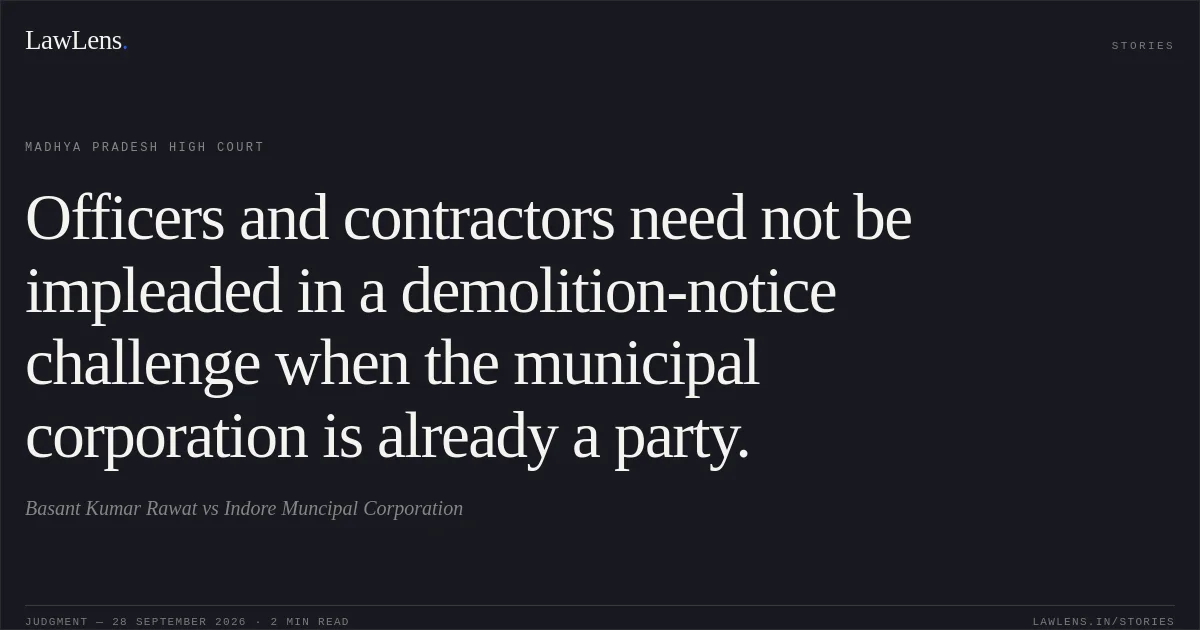
The appellant challenged a Municipal Corporation notice dated 7 April 2026 directing removal of construction from part of his shop.
Source reference: para. 1–3During the writ petition, he sought to implead the Corporation’s Superintending Engineer and the private contractor executing a road project, amend the relief clause, and place additional documents on record.
Source reference: para. 1–3The writ court rejected the application, finding the proposed parties unnecessary, the amendment would change the petition’s nature, and the appellant had not explained why the documents could not earlier have been produced despite due diligence.
Source reference: para. 1–3The appellant appealed that rejection, arguing that the documents came into his possession after filing and that the proposed parties were connected with the work order and its execution.
Source reference: para. 4–5Issues
1. Whether the Superintending Engineer and the contractor were necessary parties to the writ petition challenging the demolition notice.
Source reference: para. 4, 102. Whether the appellant should have been permitted to amend the relief clause and bring additional documents on record through the application.
Source reference: para. 3, 5, 10Law Applied
The Court applied the procedural principle that a party need be impleaded only where its presence is necessary for the effective adjudication of the dispute; an officer of a public authority already represented in the proceeding, or a contractor whose role is confined to carrying out the project, need not be added where neither is necessary to decide the challenge.
Source reference: para. 10It also treated an amendment that changes the nature of the petition or enlarges its relief as unsuitable for inclusion in the proceeding, and considered the applicant’s explanation for producing documents belatedly.
Source reference: para. 10The judgment cites no specific statutory provision or precedent as the basis for these procedural principles.
Source reference: para. 10Although the notice referred to sections 305, 307, 322 and 325 of the Madhya Pradesh Municipal Corporation Act, 1956, and the Rules of 2012, those provisions were not the basis of the appellate decision.
Source reference: para. 2, 10Reasoning
The appellant’s principal challenge was to the demolition notice issued by the Corporation, which was already a party and represented.
Source reference: para. 10The Court therefore found no need to add another Corporation officer merely because he had issued the underlying work order; it viewed the proposed demolition as consequential to that work order.
Source reference: para. 10The contractor’s role was confined to road construction, making it an outsider to the dispute over the notice.
Source reference: para. 10The Court also considered that the proposed documents and amended relief would enlarge or change the nature of the petition, rather than assist in deciding the existing challenge.
Source reference: para. 10Holding
The Court found no error or illegality in the writ court’s rejection of the application.
The Court dismissed the appeal as misconceived.
Source reference: para. 11–12Acts & Sections Cited
4 provisions across 1 statute referred to in this judgment. Linked provisions open on LawLens.
the Act of 1956 (alias, unresolved)4
Original Court PDF
Basant Kumar RawatvsIndore Muncipal Corporation
Click to open original judgment
Original judgment, available to read, download and summarize on LawLens.in