01Facts
The plaintiff, Bhanu Datta Pathak, grandson of late Shankar Dutt Pathak, instituted a suit seeking cancellation of a registered Will dated 6 December 1971 executed by Shankar Dutt in favour of his surviving son, Hari Dutt Pathak, and sought partition of his alleged half share in the disputed property.
¶ 11–12The plaintiff alleged that the property was ancestral, that the testator was approximately 81 years old and mentally and physically feeble, and that the Will had been procured through undue influence, coercion, fraud and collusion.
¶ 13–19The trial court found that the Will was surrounded by suspicious circumstances, that the testator was not in a sound disposing state of mind, and that the defendants had failed to establish its genuine and voluntary execution; it consequently cancelled the Will and partly decreed the plaintiff’s claim for partition.
¶ 32–41The first appellate court reversed that decision, holding that the Will had been duly proved through the testimony of an attesting witness, that the testator was mentally competent, and that the circumstances relied upon by the plaintiff did not establish undue influence or suspicious circumstances.
¶ 44–56During the appeal, the plaintiff’s heirs and most respondents entered into a verified compromise; respondent no. 2/2 alone continued to contest the appeal on merits.
¶ 5–1002Issues
i.Whether the first appellate court’s failure to separately frame points of determination caused prejudice to the plaintiff and vitiated its judgment?
¶ 43, 57–83ii.Whether the Will was duly attested in compliance with Section 63(c) of the Indian Succession Act, 1925, despite only one attesting witness being examined?
¶ 84–93, 117iii.Whether the Will represented the conscious and voluntary act of the testator when the plaintiff alleged that there was no sufficient evidence of his physical and mental fitness?
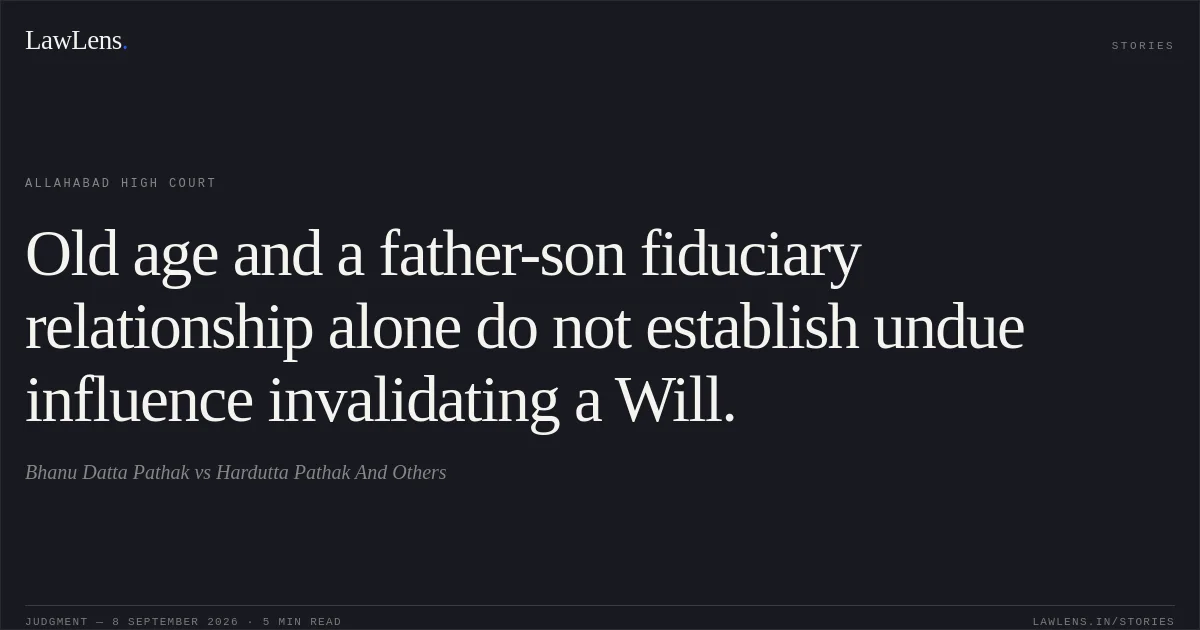
¶ 118–124iv.Whether the testator’s advanced age and the beneficiary’s alleged fiduciary or dominant position, by themselves, constituted suspicious circumstances or established undue influence sufficient to invalidate the Will?
¶ 125–14003Law Applied
The Court applied Order XIV Rule 1 and Order XX Rule 5 CPC, holding that non-framing of a specific issue or point of determination is not fatal where the parties knew the controversy, had an opportunity to lead evidence, and suffered no prejudice.
¶ 62–75Under Sections 61 and 63 of the Indian Succession Act, 1925, a Will must be the product of the testator’s free agency and must be signed and attested by at least two witnesses in the prescribed manner; under Section 68 of the Evidence Act, examination of at least one available and competent attesting witness is ordinarily sufficient to prove execution.
¶ 84–86, 104–106The Court relied on H. Venkatachala Iyengar v. B.N. Thimmajamma and Rani Purnima Debi v. Kumar Khagendra Narayan Deb for the rule that the propounder must prove due execution, testamentary capacity and removal of legitimate suspicious circumstances.
¶ 94–106However, exclusion of a natural heir or an unequal disposition, without more, is not itself suspicious, particularly where the bequest is made in favour of a child who cared for the testator, as recognised in Savithri v. Karthyayani Amma, Mahesh Kumar v. Vinod Kumar, and Swarnalatha v. Kalavathy.
¶ 94–106Undue influence must be proved as actual improper influence; a familial or fiduciary relationship and advanced age do not automatically establish it.
¶ 90–91, 125–140Provisions in the judgment · 8 · Linked ones open on LawLens
Indian Succession Act, 1925 Section 59Section 61Section 63
Code of Civil Procedure, 1908 Section 2Section 96Section 115Section 41
Indian Contract Act, 1872 Section 16
04Reasoning
The Court held that the omission by the first appellate court to separately frame points of determination was only a procedural irregularity. The parties had fully understood that the validity, execution, testamentary capacity and alleged undue influence relating to the Will were in issue, had led evidence on those matters, and had made submissions; therefore, no prejudice was established.
¶ 71–83On execution, the Court accepted the testimony of DW-2, who was an attesting witness and also the scribe. He stated that the testator read the Will, signed it in his presence, and thereafter directed him to sign as an attesting witness; he also stated that the other witness signed in the testator’s presence.
¶ 87–89Since the scribe had signed in the capacity of an attesting witness and gave evidence satisfying the statutory requirements, Section 63 was held to have been complied with.
¶ 112–117The allegation that the testator lacked testamentary capacity was not supported by medical evidence or reliable testimony. Conversely, DW-2 gave specific evidence that the testator understood and read the Will, acted voluntarily, and personally attended the registration proceedings.
¶ 121–124The testator also continued to write letters to the plaintiff for approximately six months after execution, which supported the inference that he remained mentally alert.
¶ 121–124Finally, the Court found that the beneficiary’s status as the testator’s son, his residence with and care of the testator, and the testator’s age did not by themselves establish domination or undue influence.
¶ 126–138The Will gave a rational explanation for excluding the plaintiff: the plaintiff lived away due to government service, whereas Hari Dutt resided with the testator and looked after him and the family property.
¶ 126–138The plaintiff failed to prove that the beneficiary had exercised improper influence or that the testator’s free will had been overborne.
¶ 126–13805Holding
The Court answered all issues against the plaintiff. It held that the first appellate court’s failure to separately frame points of determination caused no prejudice; the Will was duly attested under Section 63 of the Indian Succession Act; the testator possessed sufficient mental capacity and executed the Will consciously and voluntarily; and neither his advanced age nor the son’s fiduciary or familial relationship established suspicious circumstances or undue influence.
¶ 83, 117, 123–124, 133, 140The second appeal was dismissed on merits insofar as respondent no. 2/2 was concerned, and the judgment and decree of the first appellate court dated 28 August 1980 were upheld.
¶ 140In respect of the remaining respondents, the appeal had already been disposed of in accordance with the verified compromise dated 19 July 2022, which was directed to form part of the decree.
¶ 140Original Court PDF
Bhanu Datta PathakvsHardutta Pathak And Others
Click to open original judgment
Original judgment, available to read, download and summarize on LawLens.in